Behavioral DLP vs Static Rule DLP for Large Enterprises
Behavioral detection outperforms static rules at enterprise scale.

Enterprise data protection has a scale problem dressed up as a data protection problem. Static-rule DLP, the pattern-matching systems built on predetermined policy, was built to handle known, structured formats in narrower environments — not the volume and variety of data movement inside a company running thousands of users across dozens of SaaS apps at once. Behavioral DLP shifts the unit of detection from the single event to the person, and that shift is structural. Most enterprises buying more static DLP right now are solving the wrong problem, and the vendors selling it to them know it.
Most large enterprises evaluating this question have already deployed some form of DLP. Forrester's July 2024 "State of Data Security" report found 83% of enterprises run endpoint DLP, yet only 13% have fully deployed data security in the cloud. That gap didn't happen by accident. It's what happens when tools built for a static, on-premise world get pointed at an environment that no longer looks anything like that world.
The pressure to fix this is no longer just operational. European regulators handed out EUR 1.2 billion in GDPR fines in 2025, a 22% jump from the year before, and mounting regulatory pressure means boards now attach a real cost to every exposed record. Spending reflects the anxiety: the global DLP market, worth around USD 3.40 billion in 2025, is on track to hit USD 23.76 billion by 2034, a 24.10% compound annual growth rate. A bigger budget doesn't necessarily buy better detection, though. Most of that money is going toward more static architecture, deployed at greater scale and greater cost, which is the same model that created the gap in the first place. Buying more of the same tool and calling it a strategy is the mistake worth naming outright.
What static-rule DLP actually does — and where it was designed to work
Static DLP checks data in motion, at rest, or in use against a fixed set of patterns: regular expressions tuned for credit card numbers and Social Security numbers, keyword dictionaries, file-type rules. Something matches, a policy fires: block, quarantine, alert, log. That's the whole chain. Nothing in it asks who moved the data, why, or whether the action fits how that person actually works day to day.
That's a design choice suited to a narrower job. Static DLP earns its keep with known, structured sensitive-data formats where a regex match is genuinely enough signal on its own: PAN data, SSNs, regulated templates that don't change shape. It also holds up in simple, well-scoped environments, a single-tenant network with a small user base and clear data boundaries. And for compliance checkbox purposes, where the mere presence of a pattern satisfies an auditor regardless of intent, static rules do the job cleanly with low setup cost.
Buried in all of this is an assumption: that matching a data pattern is the same as identifying risk. At small scale, that assumption mostly holds up. At enterprise scale, it falls apart. The mistake most security teams make isn't picking the wrong vendor. It's renewing the same tool year after year instead of asking whether it was ever built for a job this size.
How the static-rule assumption breaks at enterprise scale
The false positive problem here isn't something you tune away. It's structural, built into the math of matching patterns at volume. Finance teams email spreadsheets full of account numbers. HR sends compensation data. Legal shares contracts loaded with SSNs. Every one of these fires an alert under a static rule, and every one looks, at the rule level, identical to actual exfiltration.
Analysts drown in that noise, and once detection accuracy drops far enough, they stop trusting the system entirely. Research from Safetica found that only 35% of organizations consider their DLP program mature, while 88% of all data loss events in 2024 came from just 1% of users. Risk sits packed into a tiny sliver of the workforce; static rules spread alert volume evenly across everyone, so the system ends up loudest exactly where the actual danger is smallest.
Unstructured and novel data types make the gap worse. Source code, CAD files, proprietary models, internal strategy decks, the material that actually makes a company competitive, carries no regex fingerprint at all. Research has noted that conventional DLP struggles with GenAI-related data loss risk, pointing to exposure through encrypted traffic, blindness to user intent, and shadow AI use as direct failure points. That's not a minor gap. It's an admission that pattern matching can't keep pace with how data actually moves now.
Rules also need constant upkeep. Every new SaaS integration, new file format, new collaboration pattern demands a manual rule update, and that eats security team hours that don't come back. In practice, rules go stale, and the protection surface develops gaps that widen as the company's data ecosystem keeps shifting underneath it. Security teams end up running the tools they have and staying exposed anyway, not because anything got misconfigured, but because pattern matching alone can't resolve context.
Why data movement stripped of behavioral context cannot distinguish threat from routine work
The same action carries wildly different risk depending on who's doing it, when, and in what order. A sales engineer downloading a customer list two days before their last day is not the same signal as that engineer pulling the same list the week they close a major deal. A finance analyst emailing a spreadsheet full of account numbers to an outside address during audit season reads nothing like the identical action six weeks after the audit closes. Static rules see one event both times. They fire, or don't fire, the same way regardless.
The Ponemon Institute's 2025 Cost of Insider Risks report puts a number on the stakes: insider-related incidents cost organizations an average of $17.4 million a year, with containment stretching to 81 days on average. Fifty-five percent of those incidents trace back to negligence, not malice, a distinction static rules cannot make but one that decides the entire response.
Three distinct insider types feed into one undifferentiated alert queue, and treating them the same is where most DLP programs waste their investigative hours. The malicious insider exfiltrates on purpose, for money, revenge, or an outside handler, and needs investigation and legal follow-through. The negligent insider mishandles data carelessly, misconfigures a sharing setting, falls for phishing, and needs training and process fixes rather than punishment. The compromised insider isn't really an insider at all; someone outside has taken over their credentials or device, and the response belongs with incident response, not HR. Static DLP treats all three identically, and that failure to sort them is what burns analyst time on the wrong cases.
The real question is whether this person's pattern of activity, over time, adds up to risk.
How behavioral DLP builds the detection layer static rules cannot
Behavioral DLP starts by building a baseline. It works out a normal activity profile per user: what data they usually touch, at what volume, through which channels, at what hours, to which destinations. Detection then means deviation from that individual's own baseline, measured against that person's history rather than a policy written for the whole population. That's exactly why behavioral systems catch what static rules miss entirely: an employee quietly staging intellectual property over three weeks, where every single action stays inside policy, but the cumulative pattern sits well outside that person's own norm.
Timeline stitching does the heavy lifting here. One event, on its own, carries almost no signal. The pattern across a timeline does. Behavioral DLP links access to a sensitive repository, then file staging in a personal folder, then a USB connection, then a resignation letter, where each step alone is unremarkable but the sequence isn't. Building that picture means pulling signals from endpoint, identity, cloud, and HR systems together, rather than enforcing at one choke point.
Machine learning adds two specific things worth naming. First, contextual classification of unstructured content: a model can recognize a document as a strategic plan or competitive analysis without any regex match on the text. Second, dynamic risk scoring: a user's risk level updates continuously as new signals arrive, instead of staying fixed at whatever the policy said the day it was written, which is the kind of continuous behavioral context that platforms like Candor Security, an AI-native insider threat and DLP platform, are built around. Research into AI-powered behavioral DLP versus rule-based systems consistently points to dramatically lower false-positive rates, and that is the number that actually explains what "fewer false positives" means to an analyst staring down a queue at 4pm.
None of this replaces content inspection for structured, regulated data. Regex matches on SSNs and PAN data still do real work. Behavioral context sits on top of that layer as an additional detection dimension, not a substitute for it.
Explainability isn't optional, either. An alert nobody can explain to an analyst, a legal team, or an auditor doesn't help anyone, no matter how accurate the model behind it claims to be. A behavioral DLP system worth deploying surfaces the assembled timeline, the actual sequence of events behind the risk score, rather than a bare number with no story attached. That's the difference between a system analysts trust and one they quietly route around within a month.
What the departure and IP-theft archetypes reveal about detection timing
Departures create a predictable window of risk, and it opens earlier than most security teams assume. Exfiltration risk around departures tends to open earlier than most security teams assume, with data movement often accelerating before a resignation is formally submitted or an offboarding process begins. A significant share of corporate data breaches involve access that remains active beyond an employee's departure, meaning the exposure often happens right around offboarding, not sometime after access should have been cut. Static DLP only catches this if the specific data matches a rule. Behavioral DLP catches the shift itself: a jump in download volume, new compression activity, transfers routed to personal accounts, often before a resignation letter even gets submitted.
Real-world breaches involving retained post-departure access illustrate the cost of late detection. When a former employee's credentials remain active and no system recognizes the resulting access pattern as abnormal over time, the exposure compounds well beyond what any single missing policy rule would explain. Legal and regulatory consequences follow, and the downstream liability is the direct bill for a detection gap that behavioral baselines exist specifically to close.
IP theft and corporate espionage present the hardest version of this problem: the insider who joins a company specifically to exfiltrate trade secrets, moving slowly inside access patterns that look normal on the surface. Static rules stay silent here, because the data being taken often doesn't match any regulated-data pattern at all. The real signal is the trajectory: access to competitive roadmaps, a rising frequency of exports, destinations that fall outside the person's normal peer group. Only a system tracking behavior over time, against that person's own baseline, can surface this class of threat before the damage is done.
Both archetypes point to the same requirement: detection needs time-series behavioral context, not a single point-in-time match against a pattern.
How behavioral DLP fits into the enterprise security stack — and what integration actually requires
Signal exists everywhere across the enterprise stack; context lives nowhere. SIEM holds logs. EDR holds endpoint telemetry. The identity provider holds authentication events. HR systems hold employment status and role changes. None of these alone has the cross-source behavioral picture that actually matters. Behavioral DLP's real job is pulling these signals together, so a role change logged in the HR system, a spike in file access on a cloud drive, and a new external email destination in the mail system get read as one correlated event instead of three unrelated log lines.
Integration depth is what separates real behavioral detection from a sales pitch, and it's the part most buyers skip past. Piping syslog data into a SIEM just produces more logs to sift through by hand, not genuine behavioral context. Real behavioral DLP needs API-level integration with identity providers, endpoint agents, cloud application connectors, and HR systems, so user identity stays the one consistent thread running through every event source.
The broader market is converging on unified data protection platforms that tie enforcement to identity context and data posture together, rather than treating them as separate tools bolted side by side. Integration between DLP, cloud access security brokers, and zero-trust network architecture is the procurement trend actually reshaping how enterprises buy in this category right now.
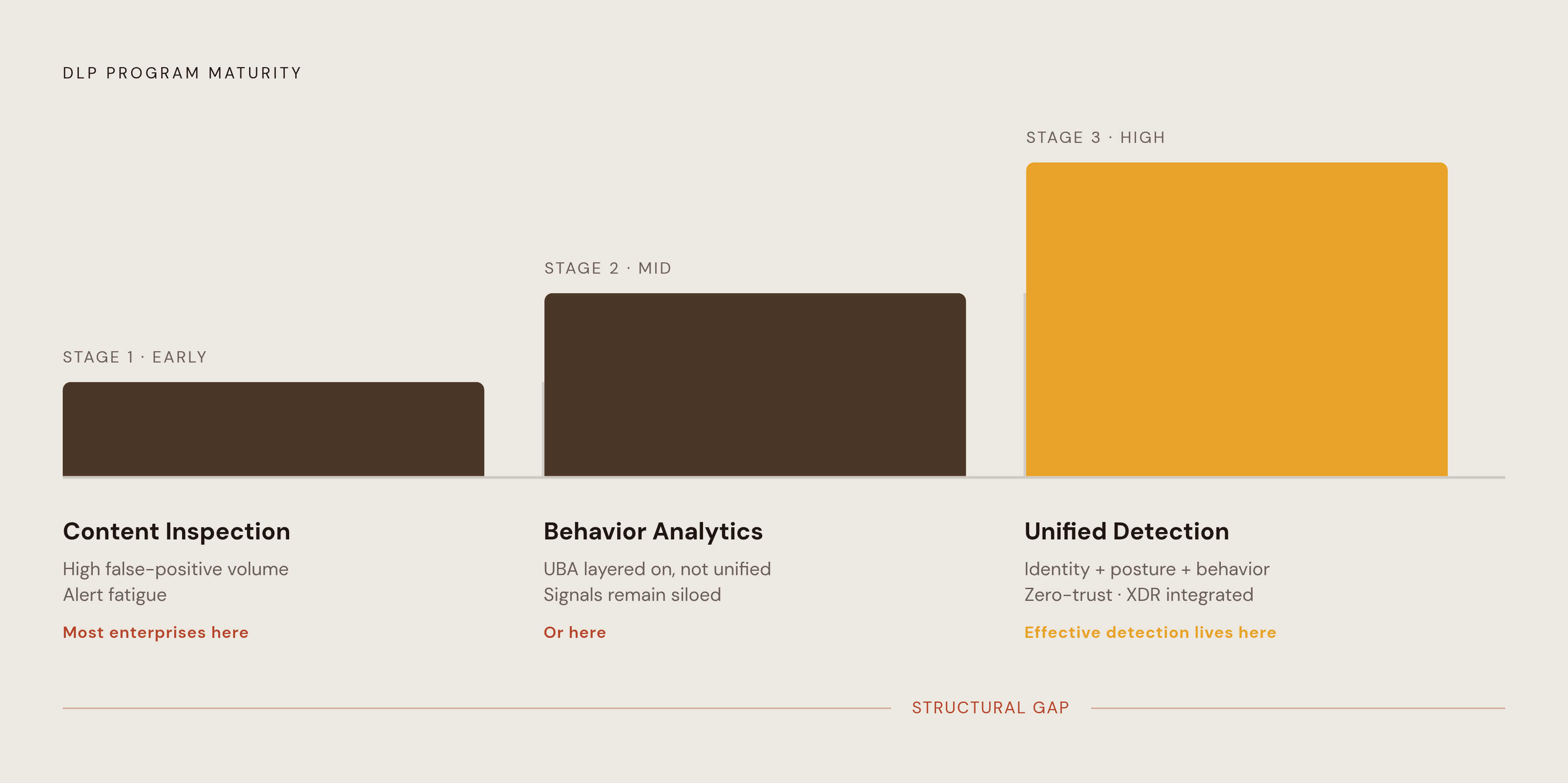
Maturity is a useful way to figure out where a given enterprise actually stands, and most overrate their own position on it. Early-maturity programs run on basic content inspection, generate heavy false-positive volume, and are already fighting alert fatigue. Mid-maturity programs have layered some user-behavior analytics on top but haven't unified it with content-level signals. High-maturity programs run behavioral context, identity integration, and data posture management as one detection surface, tied into zero-trust and XDR frameworks. Research into DLP maturity consistently finds that risk-driven programs lean on behavioral context to catch insider threats rather than leaning solely on static policy, and that the highest-maturity organizations pair data visibility with identity and device context for a fuller risk picture.
Deployment speed belongs in this evaluation too, and it's the criterion most often left out of the RFP. A behavioral DLP platform that needs six months of professional-services work before it produces usable signal isn't viable for a lean security team trying to close a gap now. Time-to-value is as legitimate a measure here as detection accuracy itself, and a program that ignores it usually ends up back where it started: buying more static rules and calling it progress.