Generative AI Data Exposure and the DLP Coverage Gap
Most employees leak data to GenAI through personal accounts beyond traditional DLP reach.
Palo Alto Networks tracked GenAI traffic climbing more than 890% in 2024 across its customer base, with the average enterprise now running something like 66 GenAI applications side by side. Security teams saw this coming; what they failed to build in time was the architecture to actually watch it, and that failure, more than the growth curve itself, is the real story.
Endpoint activity is the sharper edge of the problem. Endpoint-based AI agent adoption grew sharply in a single year, and adoption of endpoint coding assistants climbed substantially in 2025 alone. An agent on the endpoint doesn't wait for anyone to open a tab. It sits there around the clock, acting on data whether or not a human is watching the session, which makes it a different animal entirely from the browser-based tools most DLP conversations still center on. Treating the two as one problem is the first mistake most programs make, and it's the mistake worth naming first.
Most enterprises already had DLP tools running and acceptable-use policies written before any of this happened, and exposure kept happening anyway. That's the tell. The tools were built for a world before this channel existed, and policy language, however carefully worded, cannot patch an architecture that was never designed to see the thing it's now being asked to police.
What employees are actually sharing, and why most of it goes undetected
A 2024 Kaspersky study found that 67% of employees share internal company data with GenAI tools without authorization. A separate 2024 study from CybSafe and the National Cybersecurity Alliance put the number who openly admit to it at 38%. Different methodologies, close enough in outcome to stop reading as coincidence.
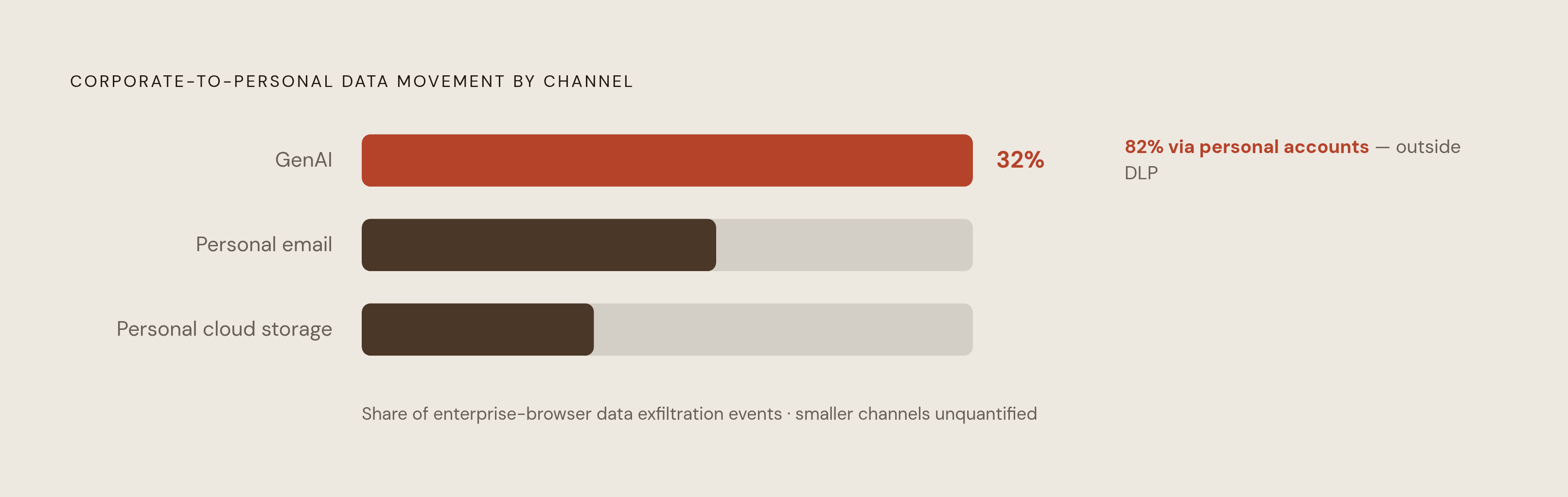
The real failure point is the personal account, and it deserves to be named plainly rather than folded into a general warning about "shadow AI." LayerX's 2025 report found that 77% of employees paste data into GenAI tools, and 82% of that activity runs through personal accounts rather than corporate ones. Enterprise DLP is scoped to enterprise accounts and company-managed devices by design, so a personal Gmail-linked ChatGPT session on a personal laptop sits outside its jurisdiction from the start. The tool never had a door to watch there in the first place. Research consistently finds that a majority of employees using generative AI at work are doing so with tools their employer never approved. That's the majority case, and any program still budgeting for it as a tail risk is measuring the wrong thing.
Most of this is carelessness rather than sabotage, and that distinction should drive the entire design question for whatever comes next. Someone reaches for a shortcut without thinking through where the data lands. A system tuned only to catch bad actors misses the far more common inattentive one, while a system that flags every paste event without reading intent just buries analysts in noise. LayerX's 2025 Browser Security Report found GenAI now accounts for 32% of all corporate-to-personal data movement inside the enterprise browser, ahead of personal email and personal cloud storage. GenAI has quietly become the largest exfiltration channel running today, and it got there without anyone deciding it should.
Why legacy DLP was architecturally unequipped before GenAI arrived, and more so now
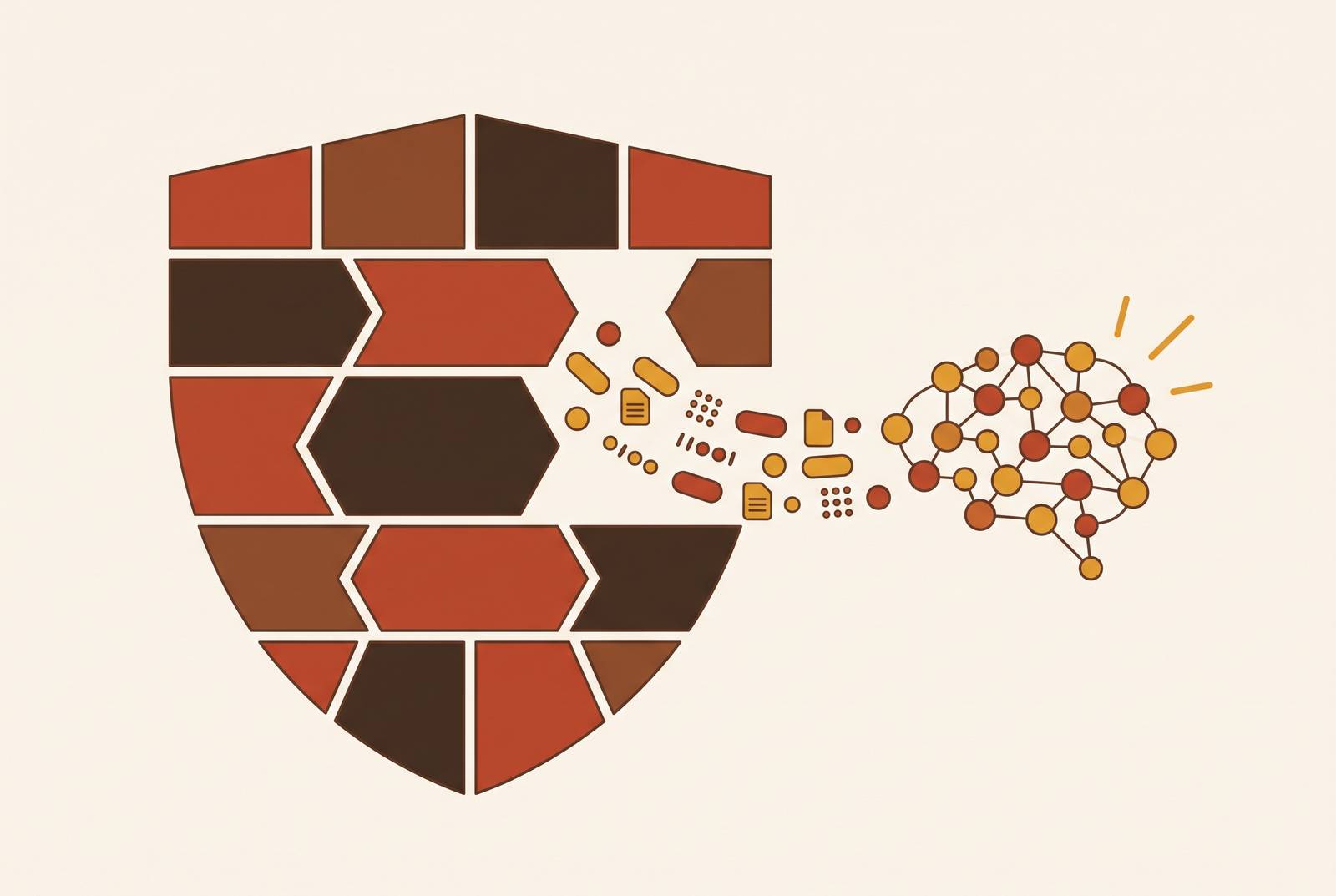
Legacy DLP rests on three assumptions, and GenAI breaks all three at once. It assumed data moves as files; GenAI moves data as live text inside a browser session that never generates an attachment or trips an endpoint event. It assumed sensitive data holds a shape that regex and fingerprinting can catch; a prompt describing customer churn in plain English doesn't hold still that way. It assumed the network edge or the endpoint was the right place to plant a control point; a personal ChatGPT account run through a browser tab sits outside that edge by construction, not by oversight.
The hand was already losing before GenAI showed up. Older DLP tools watched email, or web traffic, or endpoints, mostly in isolation from one another, leaving blind spots across Teams, SharePoint Online, and Google Workspace years before the first employee pasted a customer record into a chat window. GenAI landed on top of a blind spot that already existed and made the consequences much bigger.
Something like 80% of enterprise data is unstructured: emails, chat transcripts, contracts, scattered across SharePoint, OneDrive, and Slack. Writing rules by hand to cover unstructured content across dozens of GenAI applications, each with its own session format, only makes this worse, because a rule written today starts going stale tomorrow. False positives pile up, analysts stop trusting the alerts, and teams end up spending more hours tuning policy than chasing actual incidents. The tool was running the whole time. The visibility it needed never existed, and no amount of policy language fixes a blind spot at the architecture level.
The financial cost of leaving the gap open
IBM's 2024 Cost of a Data Breach report found AI-related breaches averaging $5.2 million, a 28% premium over conventional breaches; IBM's 2025 report separately put the global average cost per breach at $4.4 million. IBM's 2025 follow-up found breaches involving shadow AI running about $670,000 higher than other breach types. Two studies, two years apart, pointing the same direction: AI-related exposure costs more, by a margin large enough to change how a board weighs the risk.
Insider risk, the wider category GenAI exposure sits inside, tracks the same climb. Ponemon found the average annual cost of managing insider risk reaching $17.4 million per organization in 2025, up from $15.4 million in 2022.
Treating this as a next-quarter problem is a bet against a curve that is already climbing, and nothing above suggests it flattens on its own. The premium is the number that should end the argument inside any budget meeting still treating GenAI DLP as discretionary spend.
What detection architecture actually needs to cover the GenAI channel
Session-level visibility comes first, because there's no file left behind to inspect after the fact. That means capturing who did what, inside which application, what text went in, and what the model handed back, well beyond simply confirming a connection was made. Output deserves the same scrutiny as input: a model's response can surface inferred personal data, echo something from its training set, or return language that violates a compliance rule nobody thought to check before it left the screen. This has to happen in the browser, since that's where the exposure event actually occurs, and it's a layer legacy DLP was never built to watch.
Session visibility alone still misses the point, because a single paste, on its own, is often genuinely ambiguous. Is this someone doing their job, or someone moving data out the door? The signal lives in the pattern around it: a user who pulled a competitor analysis last week, accessed an M&A data room yesterday, and is now pasting financial projections into an unapproved chat tool is telling a story no single event tells by itself. Static rules can't assemble that timeline, and platforms like Candor Security, a behavioral DLP platform built around multi-source profiling across the enterprise stack, are specifically designed to do what static rules cannot. Behavioral analysis, reading across sources over time, can, and that's the piece most tools on the market still skip.
Detection should be grounded in data lineage and behavior, ahead of rules written in advance of the thing they're meant to catch. Better catch rates on unstructured material, contracts, proprietary research, the kind of content pattern-matching tools routinely miss, matter more than any single vendor's accuracy claim. None of that matters if the flag arrives as a black box. Analysts need the reasoning behind an alert, not a bare score from a model nobody can interrogate. Where the AI inference itself runs, on infrastructure that keeps a tenant's data inside that tenant's environment rather than feeding a shared model elsewhere, is part of the control architecture, and a significant part at that.
How current tools approach the GenAI DLP problem and where they differ
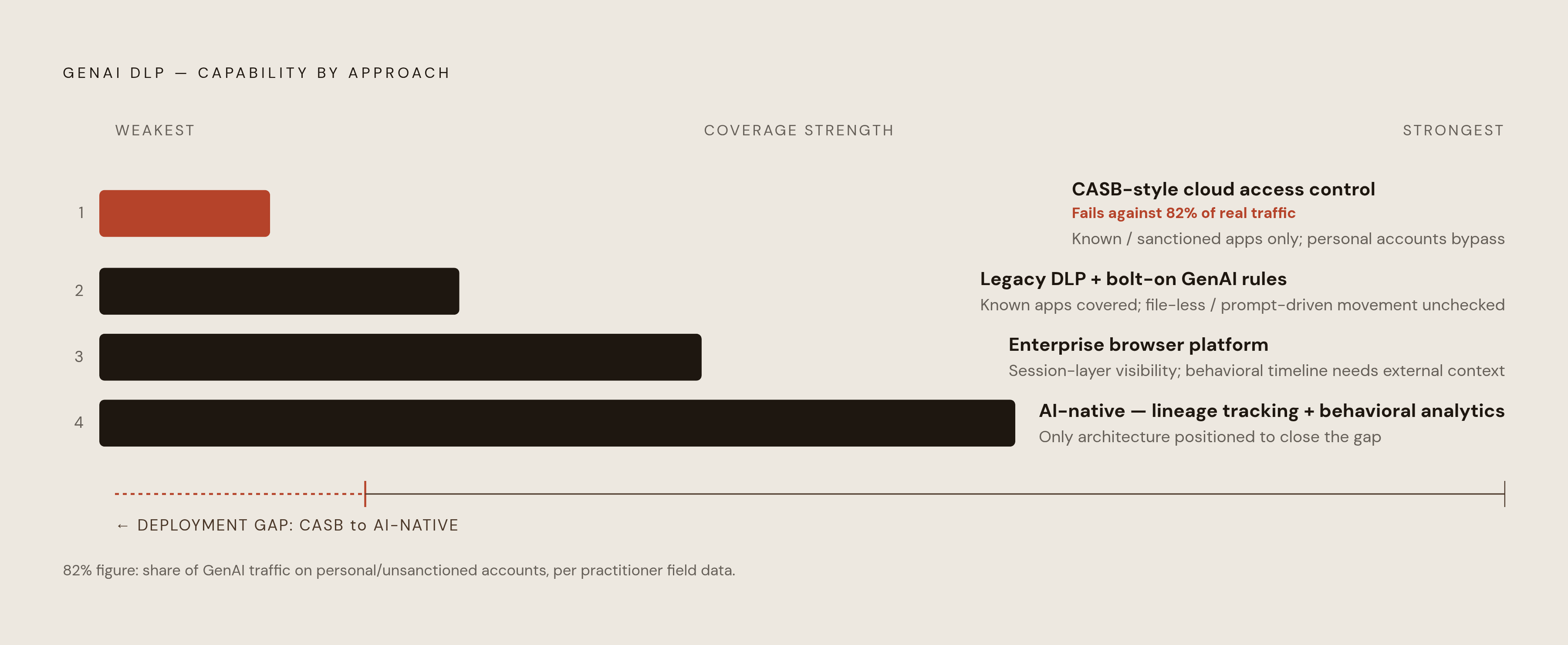
Four approaches are circulating among practitioners, and they are not equally capable. Ranking them plainly matters more than describing them evenly, because a buyer who treats all four as interchangeable is going to pick wrong.
CASB-style cloud access controls block or allow specific GenAI applications at the network or identity layer. That works against known, sanctioned tools and fails completely against personal accounts and anything uncatalogued. Since 82% of GenAI pasting runs through personal accounts, that means it fails against most of the actual traffic, which makes CASB the weakest of the four despite being the most common starting point. Enterprise browser platforms enforce policy at the session layer instead, catching the copy-paste and text-input events legacy DLP never sees. That's a real advance, though stitching those events into a full behavioral timeline usually means pulling in context from elsewhere. Some vendors are simply bolting GenAI-specific rule categories onto legacy DLP engines, which extends coverage for known applications but leaves the underlying mismatch, rule-based detection against prompt-driven, file-less movement, untouched. Rules bolted onto an old engine are still rules; they just have a newer coat of paint.
AI-native platforms, built around lineage tracking, behavioral analytics, and real-time classification, are the only category actually positioned to close the gap, because detection starts from behavior instead of matching content against a pattern written down in advance. That's the architecture worth building toward, weighed above the other three rather than alongside them as if all four were peers.
Deployment speed decides how much any of this matters in practice. A tool that takes months to tune leaves the organization exposed for the length of that tuning, and the exposure surface doesn't pause while a rule set gets refined. Gartner has noted that deploying private AI instances can cut data exposure incidents by 76%, which confirms that where the inference runs is itself a control decision, worth settling early rather than sorting out later. No single layer closes this gap alone; the strongest programs pair session-level visibility with behavioral context stitched across a user's full timeline.
What a practitioner-ready GenAI DLP program actually requires
Visibility comes before controls, full stop. No one writes policy for a data flow they can't see, so the first task is an honest inventory: which GenAI applications are actually in use, sanctioned and unsanctioned alike, and where sensitive data categories are actually going, by tool, by account, by team.
From there, behavioral context has to carry more weight than an ever-expanding rulebook. Every new GenAI application that shows up shouldn't demand a brand-new policy; detection needs to extend to new surfaces on its own, because applications are multiplying faster than any policy team can write rules for them. The unit worth analyzing is the user over time, ahead of any single data movement in isolation. The line between a careless employee and a deliberate insider only becomes visible once that timeline exists to read, and building that timeline is the actual work, deserving priority over any layer added on top of it.
Output deserves the same scrutiny as input. What a model hands back carries its own risk, independent of what the user typed in, and a program watching only the prompt is watching half the problem by definition. The fix runs deeper than bolting one more tool onto an already crowded stack. It means treating the browser session as the place where exposure now actually lives, and building everything outward from that fact.