Insider Risk Program Design Under CCPA and US State Privacy Laws
CCPA's 2026 rules now mandate how enterprises design insider risk programs.

The subject here is structural: CCPA's 2026 regulations on cybersecurity audits, risk assessments, and automated decision-making technology now define the minimum architecture a defensible insider risk program has to meet. They are already out of step with rules that took effect January 1, 2026. This piece works through where those rules reach into insider risk tooling specifically, and what a program has to show to survive contact with them.
2026: a structural shift in US privacy law
In prior years, security and legal teams had time to watch and wait. That window has closed. As of January 2026, nineteen states have comprehensive consumer privacy laws in effect, covering more than half the country's population, with Indiana, Kentucky, and Rhode Island all coming online on January 1, 2026 alone. The pace of adoption matters less than this: enforcement has caught up to legislation. In February 2026, the California Attorney General reached a significant settlement over opt-out failures, and Texas secured one against Google. Neither of those actions came from a theoretical reading of a statute still being drafted. They came from regulators applying rules already on the books.
The practical risk has also sharpened in ways that change how fast a company has to move once a problem surfaces. California, Colorado, and Rhode Island offer no cure period, so enforcement can proceed immediately, without the 30-day window other states give companies to fix a violation before facing penalties. Texas and Nebraska apply their privacy statutes, the TDPSA and the NDPA, with no revenue or consumer volume threshold. Any enterprise with employees or customers in those two states is covered unless it qualifies as a small business under federal SBA size standards, a much narrower exemption than the thresholds most other states use. The question a security team needs to answer in 2026 is no longer which laws are coming. It is what the laws already in force require of a program running today.
California sits at the center of that question, because its 2026 package goes further than consumer-facing disclosure rules and reaches straight into enterprise monitoring infrastructure. The rest of this piece works through why.
The three CCPA obligations that land directly inside insider risk programs
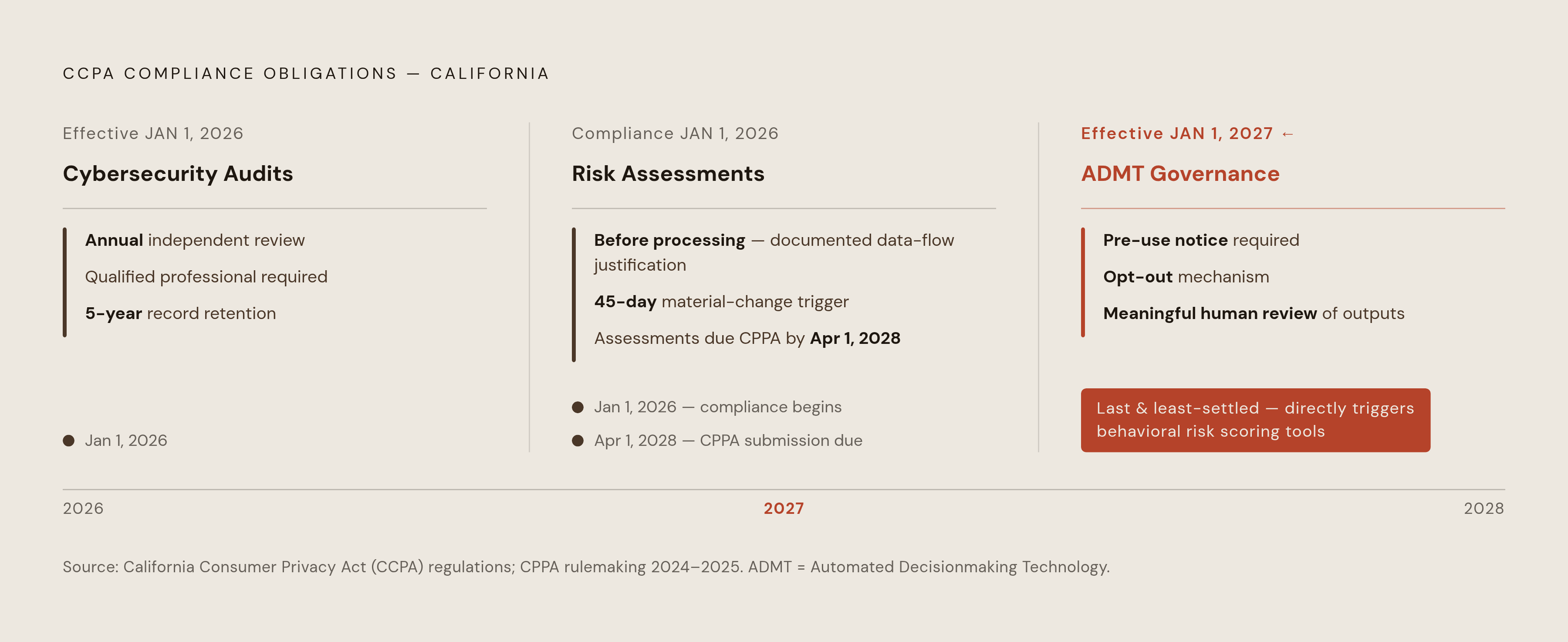
California's finalized CCPA regulations do more than add rights for consumers to exercise against businesses that hold their data. They create three procedural obligations, cybersecurity audits, risk assessments, and ADMT governance, that reach directly into how enterprises build and run behavioral monitoring and insider risk detection. The California Office of Administrative Law approved the CPPA's regulations covering all three areas on September 22, 2025. They took effect January 1, 2026, with one exception: ADMT compliance carries its own deadline of January 1, 2027.
The cybersecurity audit requirement applies to businesses presenting a "significant risk" to California consumers, which obligates them to run independent, annual audits performed by qualified professionals using recognized standards. Each year, the business submits a certification to the CPPA, but it keeps the detailed audit report internal. You have to retain both the certification and the underlying audit records for at least five years. Submission deadlines are phased by revenue, with larger businesses facing earlier deadlines and smaller ones given more time. Whatever the audit finds, the business has to document a remediation plan for identified gaps, including a timeframe for fixing them.
The risk assessment requirement covers a defined set of triggering activities: selling or sharing personal information, processing sensitive personal information, using ADMT for significant decisions, profiling consumers in employment or educational contexts through systematic observation, profiling consumers based on their presence at a sensitive location, and processing personal information to train ADMT systems. Businesses had to begin compliance by January 1, 2026, with assessments covering 2026 and 2027 due to the CPPA by April 1, 2028. Where processing is already underway, initial assessments are due by December 31, 2027. If a business already runs GDPR Data Protection Impact Assessments, those can satisfy the CCPA requirement, as long as they contain everything CCPA demands. Each submission to the CPPA needs a designated contact, the time period it covers, the number of assessments conducted, confirmation that the assessments address the relevant CCPA personal information and sensitive personal information categories, an attestation from executive management, and the name of the submitter. None of that reads like an internal memo circulated for good governance. It reads like a regulatory filing, because it is one, and it holds businesses to the kind of disciplined documentation a filing demands rather than the looser standard of a stated intention.
ADMT governance is the newest and least settled of the three, and it deserves the most attention here. Significant decisions under the regulation include those affecting finances, housing, education, employment, or health care. Advertising came up during the rulemaking process, but it was excluded from the final rule. Starting January 1, 2027, any business using ADMT to make a significant decision about a consumer must conduct a risk assessment, give the consumer pre-use notice, offer an opt-out, let the consumer access information about how the ADMT system works and what it produced, and provide a way to appeal the outcome. Where a human reviews an ADMT output, that review has to be meaningful: the reviewer has to actually understand what the system produced and hold real authority to change or correct the decision, not simply rubber-stamp it.
Where ADMT regulations intersect with behavioral monitoring and risk scoring
UEBA platforms, behavioral DLP systems, and AI-generated risk scoring tools almost certainly meet the CCPA's definition of ADMT. So if you run them against California employees or contractors, you trigger the formal assessment obligations described above, and you trigger them before the tool goes live, not after.
The specific ADMT trigger that applies to insider risk tooling covers using automated processing to infer or extrapolate a consumer's characteristics, intelligence, ability, performance at work, economic situation, preferences, behavior, or location, based on systematically observing that person acting as a job applicant, student, employee, or independent contractor. If you read that definition against a typical insider risk stack, you see the overlap right away. Tools that track application usage, log keystrokes, record website visits, measure active and idle time, or capture periodic screenshots fall inside that scope. Tools that use AI to generate a productivity score, assess an employee's engagement level, or flag a behavioral anomaly sit at the center of it.
None of this is confined to consumer products. The CCPA's risk assessment requirement names profiling in employment and contracting contexts, so a monitoring tool built for a company's own workforce is in scope just as much as one built to profile customers. The CPPA still has to decide whether personal information collected in the employment context needs its own, more tailored set of rules. That question remains open, and the uncertainty around it is a reason to document assessment decisions more carefully, not an excuse to wait for the rule to settle before doing so.
An insider risk platform that produces a behavioral risk score for an employee is performing the exact function ADMT describes: using computation to stand in for human judgment about that person's risk level. If you want to deploy a new behavioral detection system, or make a material change to an existing one, against California-based workers, you need a documented risk assessment completed first. Treating the assessment as something to backfill later is not a position any business can take once January 1, 2026 has passed.
The assessment itself also requires the team to weigh the negative impacts of the monitoring program against its benefits, covering discrimination, economic harm, reputational harm, and any interference with an employee's ability to make informed choices about their own work. Building that case in writing forces a security team to state why the security benefit of a given monitoring capability outweighs its privacy cost. That exercise is not only a regulatory formality. Done honestly, it is one of the more useful design reviews a monitoring program can go through, because it forces the team to justify scope and retention decisions they may never have had to defend out loud before.
What a risk assessment must contain to satisfy CCPA requirements
A CCPA-compliant risk assessment for an insider risk program is a governance document that has to state, specifically, the data flows involved, the business justification for each one, and the safeguards built around them, and the discipline of producing it pays off operationally even apart from the compliance obligation behind it.
The CCPA requires the assessment to cover the business purpose of the processing activity, the categories of personal information involved and how long each is retained, the sources of that information and the methods used to collect, use, and store it, the volume of consumers, meaning employees or contractors, affected, the disclosures made to them, and any third-party involvement from vendors or subprocessors. It also has to lay out the benefits of the processing to the business, to consumers, and to the public, alongside the negative privacy impacts and what causes them, along with the safeguards put in place to address those risks. Where ADMT is part of the picture, the assessment has to describe the logic the system runs on and how its outputs feed into actual decisions. Once the assessment is complete, the business records whether to proceed with the processing, who conducted the assessment, and documentation of its review and approval.
What actually goes to the CPPA is narrower than the assessment itself. The submission includes the organization's name and contact information, the time period the assessment covers, the number of assessments conducted, confirmation that the relevant CCPA personal information and sensitive personal information categories are addressed, and an attestation signed by executive management. The full assessment document stays with the business.
None of this is a one-time exercise. Assessments are subject to a three-year review cadence, and a 45-day material-change trigger means a platform upgrade, a new AI feature added by a vendor, or a new monitoring use case each independently restarts the clock on when the next review is due. If a material change happened in between, a security team cannot treat last year's assessment as covering this year's tool changes.
Before any of that documentation can be written accurately, the team needs a current data map: which systems process which categories of employee personal information, for what purpose, for how long, and shared with which third parties. That inventory work is the real prerequisite behind the assessment, and it is substantial on its own; no team scopes an accurate assessment from memory or from outdated architecture diagrams. Organizations that already run GDPR Data Protection Impact Assessments have a head start, since a DPIA can satisfy the CCPA requirement if it already contains every element CCPA demands, though that coverage has to be checked rather than assumed. And where ADMT is involved, the requirement that human review be meaningful, that the reviewer understands the output and holds real authority to change the decision, has direct consequences for how analyst workflows get designed and written down, not just for how the assessment describes them after the fact.
The cybersecurity audit requirement and the minimum structural components of a defensible insider risk program
The annual cybersecurity audit is not a paperwork exercise layered on top of a program that otherwise runs however it runs. It forces a security team to make specific, defensible control choices across its insider risk infrastructure, and the audit standard it has to meet ends up defining the floor for what that program has to look like.
Audits have to be run by qualified professionals using recognized standards, so you have to build the program against a standard an outside auditor will recognize, not assemble it ad hoc and explain it after the fact. For an insider risk program, the audit reaches into data classification and labeling practices, access controls, the scope and coverage of monitoring, detection logic and alerting, investigation workflows, incident response procedures, and vendor management for the monitoring tools themselves. An audit is not pass or fail. It produces a documented remediation plan that names the gaps found and the timeframe for closing them. The real deliverable is proof that the organization knows its own weaknesses and has committed to a schedule for fixing them.
The five-year retention requirement for audit records means a program has to be able to reconstruct its own historical state at each audit point, not just its current configuration. Most insider risk programs do not maintain that kind of version history today, and building it is a real structural change, not an incremental one. Combined with the risk assessment's material-change trigger, the audit creates a continuous governance rhythm: the annual audit anchors the yearly cycle, and any significant change to the program, a new tool, a new use case, a new data source, triggers an interim update to the risk assessment in between audits.
For insider risk programs specifically, the audit trigger is processing that presents "significant risk to the security of consumers." When organizations handle behavioral data, access logs, or AI-generated risk scores across large employee populations, they sit well inside that threshold. The design consequence follows directly: every control in the stack has to be explainable to someone outside the team that built it, not just effective at catching risk. If a behavioral detection system's logic cannot be described clearly to an external auditor, it fails the audit requirement no matter how well it performs at flagging real threats.
Sources
- Don't be Spooked by 2026 Privacy Compliance Regulations. View Our Treat of a Roadmap of New California and Colorado Requirements
- California Finalizes CCPA Regulations for Automated Decision-Making Technology, Risk Assessments and Cybersecurity Audits
- California Finalizes Regulations to Strengthen Consumers' Privacy
- California Finalizes Pivotal CCPA Regulations on AI, Cyber Audits, and Risk Governance: Wiley