Why Threshold Rules Keep Firing on Noise While Machine Learning Models Learn the Difference
Static rules miss context that machine learning models learn from behavior.
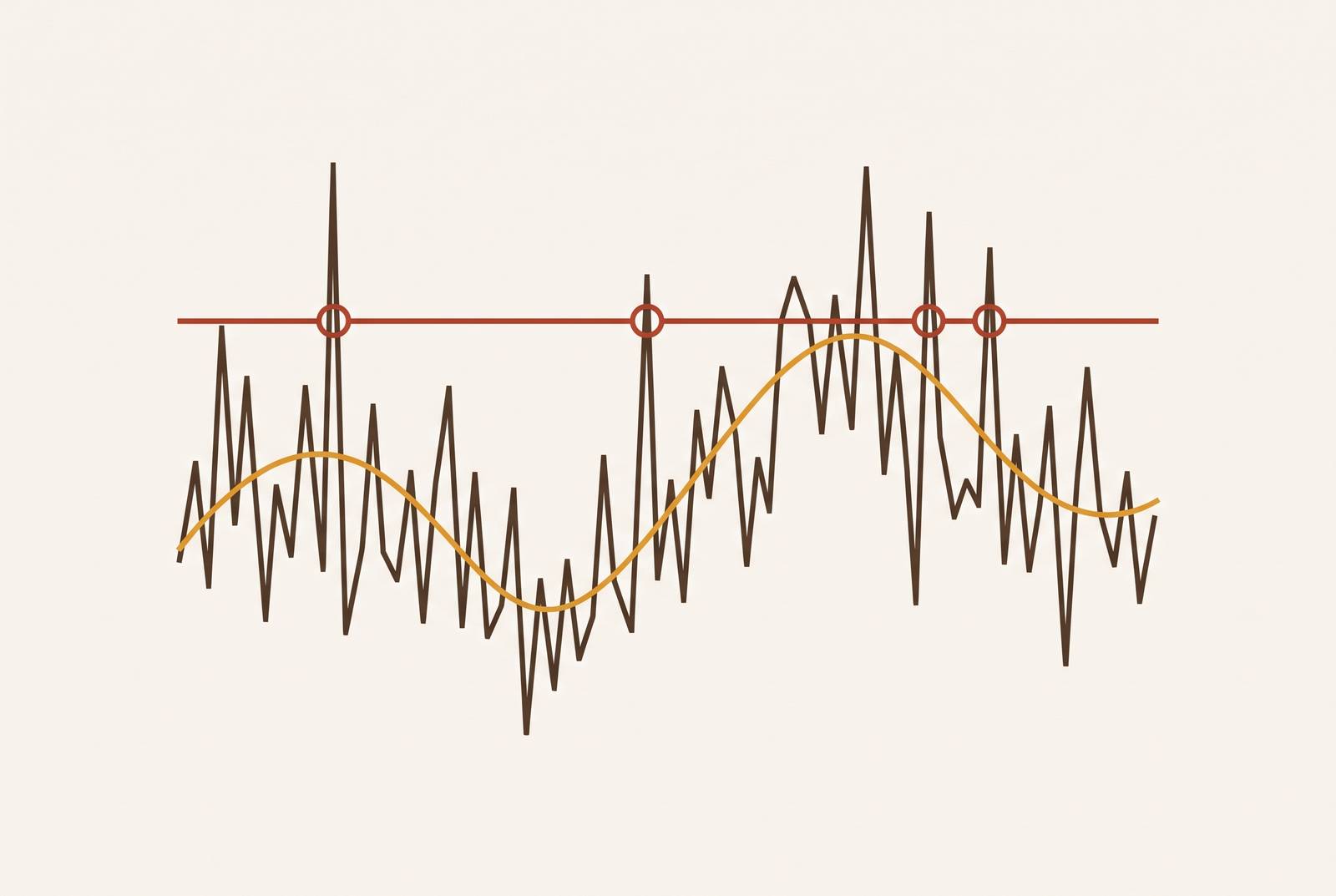
Threshold rules keep firing on noise because they judge each event on its own against fixed limits. Machine learning models can reduce that noise by learning normal behavior before judging deviation. Across insider threat detection and data loss prevention, useful signal depends on whether the system evaluates activity in the context of identity, role, history, and surrounding behavior.
Why static threshold rules are architecturally incapable of reading context
A static threshold rule tests whether an event meets a predefined condition. It does not remember what came before. Unless context is explicitly represented in that condition, the rule has no basis for distinguishing a long-tenured engineer from a new contractor or a departing employee. Each can trigger the same verdict by crossing the same line. Changing that line changes when the rule fires, but not what the rule understands.
“Anomalous login from new IP” illustrates the limitation. The verdict identifies a change in network origin, but it says nothing about the user's role, travel status, device profile, or the sensitivity of the asset being accessed. Those details are part of the evidence needed to decide whether the login is suspicious. A fixed condition can identify novelty without distinguishing normal variation from risk.
That distinction becomes harder as the environment changes. Rules written against last quarter's traffic patterns can misfire against today's load because they still use the same point of reference. Refining thresholds may bring them closer to current activity, but it does not create an entity-specific history against which future activity can be judged. The rule evaluates whether a condition is true, rather than whether the action fits the person and circumstances behind it.
How that architectural gap compounds into an alert queue analysts cannot trust
When detection omits context, analysts must supply it. An alert enters the queue before the system has worked out whether the change behind it needs to be investigated. After enough false positives, analysts learn that a triggered condition tells them little about whether there is a threat. That skepticism can extend to meaningful activity arriving through the same unreliable queue.
A software rollout or identity migration can make normal behavior look suspicious across several tools simultaneously. Without baseline knowledge, the same activity can appear as an endpoint alert, an identity alert, a SIEM correlation event, and a ticket. Four notifications still represent one investigation. Yet each notification adds to the queue an analyst must work through to find threats, including activity tied to a phishing campaign. Duplication increases workload without necessarily increasing understanding.
The danger is therefore more than wasted time. Operational clutter makes real threats harder to distinguish, while learned distrust weakens the value of the alerts that do deserve attention. Attrition compounds this detection problem because departing analysts take their knowledge of normal organizational behavior with them. The rules never possessed that knowledge in the first place. A queue built on isolated conditions depends on people to reconstruct context repeatedly, then becomes more fragile when the people best equipped to do so leave.
What machine learning does differently by learning normal before judging deviation
Unsupervised learning builds a statistical baseline of normal behavior for each user, device, and application. It evaluates activity against that entity's history. A significant deviation can warrant attention even when no universal threshold has been crossed.
The new-IP login provides a concrete comparison. A traditional rule alerts because the address is new, while a behavioral model can evaluate whether the address fits the user's travel patterns, device profile, and typical access times. The raw event has not changed. Its relationship to normal behavior has. A login consistent with those surrounding conditions can receive a different verdict from an otherwise similar login that departs from them.
Behavioral analytics extends this comparison across login frequency, access locations, file transfers, USB device usage, command execution, privilege escalation, and working hours. Signals can reinforce one another. An unusual login alone might not warrant attention, but the same login combined with abnormal data access and off-hours activity can produce a high-confidence alert. The model is scoring a pattern. Its ability to distinguish variation from deviation depends on the behavioral evidence available.
Nnaji et al.'s 2026 peer-reviewed study found that integrating ML with behavioral analytics enhances early insider threat detection and reduces false positives. Its Transformer Encoder model achieved an F1 score of 0.959 and a false positive rate of 0.012. Those results support the approach without establishing a universal operational outcome. The mechanism remains the central point. Learning what is normal provides a reference that an isolated threshold test does not contain.
Why insider threat cases expose rule-based detection's specific failure modes
Insider risk makes the limits of isolated-event detection especially clear because the actor can use legitimate access. Having permission to act does not by itself show whether the action is appropriate. Content rules may see an allowed transfer while missing the behavioral pattern that makes it dangerous. The distinction depends on who is acting, what has changed, and how the action relates to surrounding activity. This is precisely the evidence a context-free verdict leaves out.
The Intel case involving former employee Jinfeng Luo shows how blocking an attempt can leave a pattern unseen. Luo downloaded thousands of sensitive files just before termination. Intel's DLP blocked one attempt, but Luo used a personal network-attached storage (NAS) device to exfiltrate the data. The block was not a complete behavioral judgment. A rule acting on one device did not expose the surrounding pattern of pre-departure exfiltration across the second route.
Collusion exposes a related weakness across people. At a cryptocurrency firm, a third-party contractor sold customer data to threat actors and recruited colleagues into the scheme, leading to the termination of a large number of employees and the compromise of tens of thousands of customers. No individual event in the scheme looked uniquely suspicious. The relationships were the relevant signal. Peer-group behavioral baselines are designed to surface patterns across multiple entities, although that does not establish that a particular model would have detected this case.
BRG's analysis describes employees routing sensitive data through personal AI tools and productivity scripts using API tokens that can create persistent extraction channels. Personal devices can also bypass endpoint monitoring. These workflows expose the limits of controls built before the workflows existed, showing how missing context impairs both insider detection and data protection.
How the same structural gap runs through legacy DLP and why behavioral context changes the decision model
Traditional DLP relies on prewritten rules that identify known patterns, sensitive labels, or fixed destinations. Its starting point is what is moving. That approach can support an explicit content policy, but it does not by itself explain why an authorized person is moving the data. When an insider transfers unclassified intellectual property before leaving, the content may match none of the rules. The user's role, departure date, and prior behavior can supply the risk context that the transfer itself lacks.
This creates a gap between classification and business value. A company's most valuable information does not always have a sensitive label or match a regex. Intellectual property can be sensitive because of what it means to the business, rather than because its contents follow a recognizable pattern. A content rule cannot infer that significance from a missing label. Nor does an allowed destination establish that the movement is appropriate for the person making it.
Shadow AI widens this gap through paraphrased content, AI prompts, screenshots, and personal device transfers. These channels are hard to track with tools built before enterprise AI workflows existed. Tuning a known-pattern rule cannot supply visibility into a workflow the tool was not built to evaluate.
Combining behavioral detection with DLP controls changes the basis of the decision. Content and destination remain relevant, but they are evaluated with identity, role, and surrounding behavior rather than treated as sufficient evidence on their own. Neither side substitutes for the other. Behavioral analysis gives the context needed to judge activity, while DLP controls apply the data protection policy.
The genuine limits of ML-based detection and where threshold rules still belong
A learned baseline is not a complete account of intent. ML-based detection can fail both while it is being trained and while it is in use, including through subtle data manipulation and adversarial perturbations. A patient insider who moves slowly enough may never cause a statistically significant deviation. Normal-looking behavior can still be harmful.
Evaluation also remains a constraint on confidence. The field has no standardized benchmark datasets, performance metrics, or unified frameworks designed for finding insider threats early. A strong result in one study therefore does not settle how a model will perform across different operational settings. Evidence must retain its scope. The reported research performance supports behavioral detection, but it does not remove the need to distinguish a study result from an operational guarantee.
Rules retain a separate advantage in interpretability and auditability. A rule-triggered block can be documented in precise terms because its condition is explicit. A model's elevated risk score requires an explanation of the evidence behind it and a way to reconstruct the score. That obligation cannot be avoided by invoking accuracy.
The appropriate synthesis is a layered architecture. ML-based behavioral scoring belongs in detection priority and triage, where patterns seen in context can help sort stronger signals from weaker ones. Threshold rules still provide compliance audit trails and enforce policy with high confidence where the reasons for a decision must be clearly documented. These are different decision tasks. Preserving rules for defined policy boundaries does not resolve their contextual limits, just as using ML for pattern detection does not eliminate the need for clear, auditable controls.
What the detection architecture means for analyst workflow and mean-time-to-investigation
A context-poor notification asks the analyst to determine not only what happened but whether it merits investigation at all. A behavioral alert can arrive with the surrounding pattern already assembled, giving the analyst a stronger basis for judgment. That changes the starting point of the investigation. Along with a shorter queue, analysts have less work to do before they can focus on a credible threat.
Reducing mean-time-to-investigation is therefore as important as detection accuracy. A platform that identifies the right candidate event but leaves analysts buried in triage still requires too much human work to investigate it. More coverage should not automatically generate more human work. AI should investigate candidate events within the platform before they become human alerts. Adding staff alone does not repair a system that repeatedly omits the evidence needed for a verdict.
For lean SOC teams, retaining a behavioral baseline also reduces dependence on knowledge held only by individual analysts. A model retains its learned reference when someone resigns, preserving a systematic account of normal activity that static rules never learned. Analysts can then judge the pattern in front of them without having to piece together its background from separate notifications.
For a security leader evaluating detection investments, the decisive question is whether the detection architecture evaluates events in isolation or in the full context of identity, role, history, and behavior.