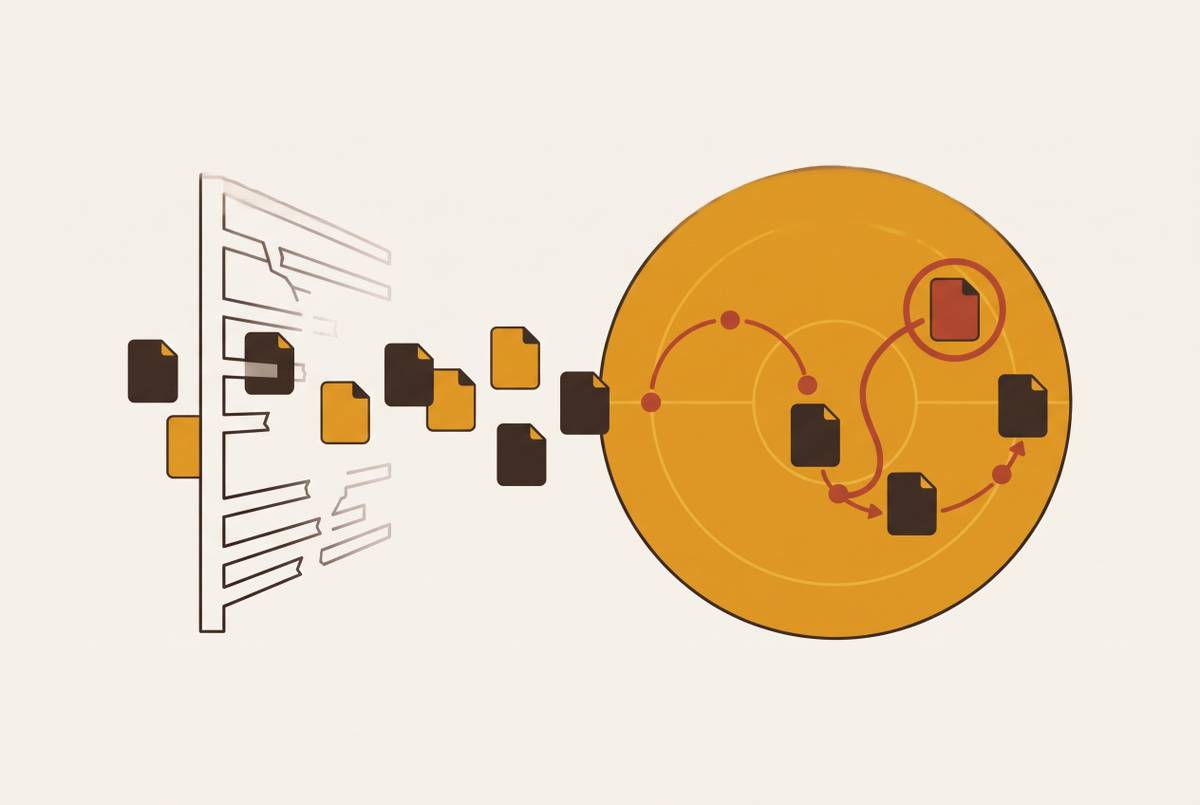
DLP Platforms Rated on Operational Stability — Tuning Burden, Alert Fidelity, and Time to Steady State
Behavior-informed detection shortens tuning time and builds analyst trust faster than static rules.

DLP platform selection should prioritize operational stability while accounting for feature coverage. Tuning burden, alert fidelity, and time to steady state reveal whether a platform can function as a reliable production control. Static, rule-based detection cannot perform well on all three simultaneously because it requires people to supply the context it lacks. Context-aware, behavior-informed detection changes how that work gets done, if its coverage and decisions hold up when checked.
Why operational stability — not feature coverage — should drive DLP platform selection
The platform is deployed, alerts are firing, and the security team is drowning in review work. Agents are installed and policies are configured, yet neither milestone proves that sensitive data is protected. The queue may be too noisy to act on, while brittle policies make enforcement difficult to trust. Deployment has succeeded, but the control has not. That gap is where a feature-led evaluation fails practitioners.
Coverage remains necessary, but it does not establish usefulness. Operational stability means producing actionable signals consistently, maintaining policy logic without constant manual correction, and keeping analyst effort proportional to risk. Tuning burden measures the effort needed to preserve usable output, while alert fidelity measures the share of alerts worth acting on and the trust they earn. Time to steady state measures how long those conditions take to achieve. These dimensions form an evaluation framework.
How rule-based DLP generates alert volume as a structural property, not a configuration error
A static rule evaluates a matching action without understanding the pattern around it. It can detect a file movement but cannot, from that match alone, distinguish routine work from unusual activity for the user's role or the final step in pre-departure exfiltration. The rule uses the same logic for every match that meets its conditions. Normal work becomes a source of alerts. Safetica's H1 2026 data shows that email, web, and instant messaging accounted for nearly three-quarters of data policy violation paths, placing detection in channels dominated by ordinary communication.
Channel-specific rules also depend on risk staying put. Safetica's Q2 2026 data shows that external USB declined significantly as a driver of unusual-activity flags while network activity climbed, with separate detection mechanisms catching the shift. A static destination rule would require a policy owner to respond to that migration. The same data shows AI tools exceeding 40% of risky application activity and overtaking job search as the top category. A policy that lacks that category cannot acquire it through more precise matching of existing destinations.
Tuning burden — why the effort required to keep a DLP platform useful never ends under a static-rules model
Static policies do not update themselves when work changes. New applications, channels, and business processes keep creating work to maintain policies after setup is done. Each safe workflow may need another exception, while each new route for risky activity may need another rule. Classification gaps compound that burden. Enterprise Strategy Group's DLP research found that roughly half of sensitive unstructured data had been discovered and only a portion of discovered data classified, limiting what label-dependent enforcement could recognize.
Policy ownership adds a human bottleneck to this technical dependency. Security, privacy, and business operations may disagree about what should trigger an alert, especially when rules cannot tell when data needs protection and when its use is ordinary. That disagreement extends the work beyond editing a policy. Organizations planning for weeks of tuning can spend months instead, exposing staffing assumptions made during procurement. Replacing a tool can also require policy recreation and renewed tuning rather than simply transferring an established control.
Context-aware detection reduces the need to encode every exception manually. With user behavior, data origin, and application context, policies can cover more activity and produce fewer matches that do not matter. Continuous discovery and classification through data security posture management, or DSPM, keep enforcement up to date on how sensitive data is. This reduces the dependence of ongoing policy ownership and maintenance on individually specified workflows, which otherwise leave the alert queue less reliable whenever tuning falls behind.
Alert fidelity — how analysts lose trust in the queue, and what that trust failure costs
When tuning cannot keep up, analysts see repeated false positives, duplicate notifications, and alerts with little context to help them investigate. Review becomes slower and less consistent, and habitual dismissal can replace risk assessment. The queue loses its value as a control. A serious event may then receive the same treatment as another repetitive notification, even though the underlying detection is technically correct.
The Federal Reserve case illustrates why authentic alerts are insufficient. A retiring employee transferred sensitive files to personal devices and email accounts over several years and triggered hundreds of DLP alerts near the end of employment. Potentially sensitive material and restricted documents appeared in the alerts, yet the activity was not stopped. The control failed to turn signals into intervention. This makes fidelity more than a false-positive ratio, because an escalating pattern must also become distinguishable and actionable.
Missing context creates a second failure path. Enterprise Strategy Group's research found that roughly a third of practitioners reported frustration with investigations and gathering context around potential true-positive alerts. Rippling's complaint against Deel illustrates the risk of legitimate-looking activity, alleging exfiltration of customer lists, pricing details, and competitive intelligence over four months, primarily through Slack, with Google Drive and Salesforce also in scope. Technical access did not establish a legitimate business purpose. Evaluating isolated actions cannot resolve the same question as examining behavior across systems over time.
High-fidelity alerts arrive with enough context to support a decision. Filtering out low-confidence matches before they reach analysts can keep coverage in place without loosening policy. But dependable output must also become sustainable. That raises the next evaluation question, namely how long the team must work before it can trust the queue consistently.
Time to steady state — what it actually measures and why it is the most underestimated cost in DLP procurement
Installation time is a poor proxy for control readiness. A platform is deployed when agents and initial policies are in place, but it reaches steady state when reliable output no longer demands disproportionate analyst effort. Default policies can produce volumes that make enforcement impractical. During the intervening period, teams may contend with excessive alerts or remain in monitor mode to avoid disrupting work. Calendar time and full-time-equivalent effort both accumulate before reliable enforcement begins.
The transition also depends on the investigation environment. When DLP, SIEM, EDR, and cloud security tools lack a shared data model, analysts become the integration layer. They must assemble the context required for a decision. Even a genuine alert can therefore leave substantial work unresolved after detection improves. Time to steady state must account for both that recurring labor and the date enforcement is enabled.
Discovery supplies a current picture of sensitive data and access, while behavioral detection reduces the need to write an exception for each safe workflow. Together, they shorten the path toward trustworthy signals and manageable effort. Neither makes installation synonymous with readiness.
A practitioner framework for rating DLP platforms on tuning burden, alert fidelity, and time to steady state
A buying assessment should begin with what happens when the environment changes. For tuning burden, the relevant questions concern whether a new application demands a new rule, who makes that change, and how long reliable coverage takes to follow. The assessment should also establish how the platform handles unlabeled data, including whether sensitivity can be inferred from content and context. Maintenance effort needs an explicit denominator. Weekly policy-maintenance hours as a share of analyst capacity, supported by reference-customer results after onboarding, expose work that deployment claims leave out.
For alert fidelity, aggregate accuracy is insufficient. Practitioners should check false-positive rates by channel, workflow, and data type, then look at the context that comes with each alert. A useful demonstration shows the triggering event, the user timeline, data origin and destination, and the surrounding pattern. It should also show whether repeated behavior produces progressive escalation. An end-to-end investigation walkthrough reveals how many steps require manual context assembly.
AI noise-reduction claims require evidence beyond a demonstration. Vendors report most of their own figures without a standard way to audit them, so reference customers' before-and-after alert volumes and true-positive rates give teams a firmer basis for judging the claims. Lower volume alone proves very little. For time to steady state, evaluation should distinguish agent installation, initial configuration, monitor mode, and reliable enforcement. It should also establish whether migration requires rebuilding policies and whether investigation integrates with the existing SIEM workflow or creates another silo.
Across all three dimensions, the architecture should explain its decisions in terms both analysts and policy owners can assess. Identity, role, behavioral history, data lineage, and continuous classification are relevant inputs, but their presence on a feature list is not enough. Their role in actual enforcement must be visible. Configurable enforcement across SaaS APIs, inline controls, and endpoints also lets coverage match the risk.
How architectural category predicts performance on each dimension — and where the tradeoffs live
Classic endpoint and network-centric DLP offers broad coverage and deep enforcement through content inspection at endpoints and traffic enforcement points. That breadth comes with substantial operating work. The architecture still needs traffic steering and policy-pattern management, and it relies on traffic reaching those points. Where detection is content-only, ordinary work that matches sensitive patterns makes alerts less reliable and calls for more tuning. Complex deployments and policy recreation during migration can consequently extend the path to steady state.
Inline SSE/SASE/GW DLP provides broad enforcement for cloud and web traffic, making it valuable where those channels concentrate risk. Its visibility still depends on the traffic path. Activity bypassing the enforcement point cannot be inspected there, regardless of policy quality. Within that boundary, tuning burden and fidelity depend heavily on the behavioral and identity context available at enforcement.
API-first and SaaS-native approaches generally reduce deployment and operating burden while supporting at-rest remediation through sharing revocation, redaction, and deletion. Their tradeoff is real-time prevention depth. API controls depend on what the application exposes, and remediation occurs after data has reached its destination within the application. They can serve as primary controls in cloud-native environments or complement inline enforcement in hybrid designs. Faster stabilization must therefore be judged against the timing of the protection required.
Discovery-led and DSPM-integrated approaches improve enforcement's understanding of what needs protection. Continuous classification can cut the alerts caused by unclassified or low-sensitivity content and spare analysts from having to work out how sensitive it is again and again. The critical distinction is whether discovery feeds enforcement directly. A separate audit function that informs periodic policy reviews does not provide the same current input to each decision. Discovery delivers its strongest fidelity and steady-state benefits when coupled to enforcement.
Behavior-informed and AI-native detection offers the strongest overall fit across the three dimensions when coverage is adequate. Looking at behavior, data origin, application context, and content together can reveal patterns that rules miss on their own and leave fewer exceptions to write. Explainability remains a separate condition of trust. With a black-box model, teams may go from doubts about noisy rules to doubts about why an alert was raised. For emerging surfaces such as AI tools, useful context includes the tool's name, the destination, account ownership, and data involved.
What a team should measure in their own environment before and after platform selection
Before selection, teams should baseline alert volume by channel and workflow together with confirmed true-positive rates. Weekly hours should distinguish triage, active investigation, and policy maintenance so that tuning does not disappear into background work. Measurement must also include the elapsed time from alert generation to completed triage and the share of sensitive data discovered and classified. These establish the starting operating conditions. Without them, vendor claims cannot be tested against the team's actual workload.
After deployment, teams should track how alert volume and the true-positive rate change through onboarding, along with how long investigations take and how often tuning is needed. A rising true-positive rate with stable or declining volume supports a finding of improving stability, while rising volume with a flat true-positive rate points toward unresolved tuning. If people still have to change policies often after onboarding, that also casts doubt on a claim of steady state. Success is a trustworthy queue, predictable maintenance, and investigation effort that the team can sustain in proportion to actual risk.