DLP Market Consolidation and What It Means for Buyers
Consolidation often trades integration headaches and stalled roadmaps for a false security upgrade.

The pitch is always breadth: one vendor, one contract, one console, fewer tools for the security team to babysit. What buyers get on the ground often tells a more complicated story. Consolidation can work as a procurement win dressed up as a security upgrade, and many buyers can't tell the difference until the contract is signed.
Acquired products rarely mesh cleanly with the acquirer's existing architecture, and that friction shows up during integration, not before the deal closes. Roadmaps go soft: acquired tools stall out, get quietly deprioritized, or get sunset outright as the acquiring company trims its now-bloated product line. Licensing gets restructured, often repackaging the same capability at a higher price once the deal is done. Once switching costs are high enough that the customer is functionally stuck, the price increases follow on schedule.
Symantec DLP under Broadcom is the case worth studying. Buyers have repeatedly flagged resource-heavy deployments, endpoint performance hits, and a maintenance load that didn't shrink after the acquisition; it just changed hands. The complexity moved to a new owner instead of disappearing.
None of this is abstract money. Enterprise DLP contracts run well into six or seven figures, so a bad platform call isn't a subscription anyone cancels next quarter. It's a multi-year commitment with real operational drag attached, and bundling capability rarely improves detection on its own. Most consolidation deals never touch the detection layer at all, and that layer is where the actual argument lives.
The architectural divide that consolidation papers over
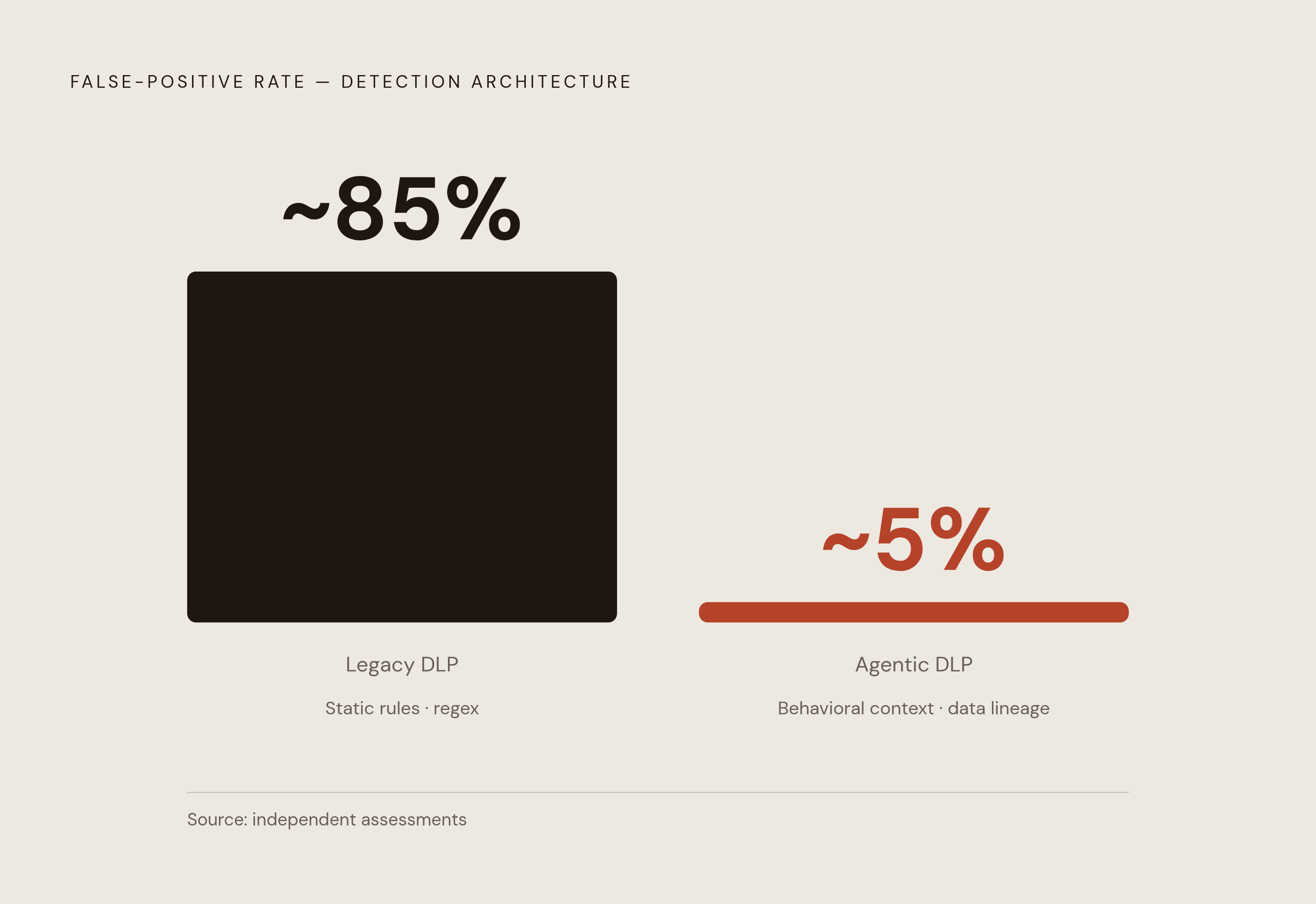
Two different questions sit at the center of DLP design, and which one a platform asks decides almost everything about how it performs.
Legacy DLP asks a narrow question: is this file leaving the system? Behavioral DLP asks a harder one: what is this data, who can access it, should they, and how does the risk shift as the data moves and gets reused elsewhere? Legacy architecture runs on static rules, regex pattern matching, and content classification triggers built for predictable data flows in predictable environments. That worked well enough when data lived in files moving through a small number of known channels. Pretending it still works today is the mistake most buyers make.
Static rules produce an alert flood in practice, and independent assessments put false-positive rates for these systems in the 80 to 90% range. When accuracy sits that low, analysts stop trusting the alerts, and the tool turns into shelfware nobody checks. Behavioral DLP looks at the pattern of user actions rather than just the content of the data itself, built to catch both malicious intent and honest human error, since most insider incidents, 53% by Ponemon's count, are negligent rather than deliberate.
There's a newer approach worth naming directly: policyless detection, where a system uses data lineage and behavioral context to judge whether a specific movement of data is actually risky, without needing a pre-written policy for that exact scenario. New or unclassified data gets protection the moment it appears, no policy update required first. Agentic approaches built this way return a verdict instead of a pile of alerts, and independent assessments show false-positive rates dropping toward 5% under that model.
Here's the buyer trap: a "next-gen" or "AI-powered" label slapped on a consolidated platform can just mean AI got bolted on top of the same rule engine that's been running for a decade. The real test is whether the AI makes the decision, or just re-ranks the output of a rule nobody's touched in years. Two platforms can use identical marketing language and sit on opposite sides of that divide, and consolidation is exactly what makes it hard to tell from the outside.
Why the insider threat problem exposes legacy DLP most sharply
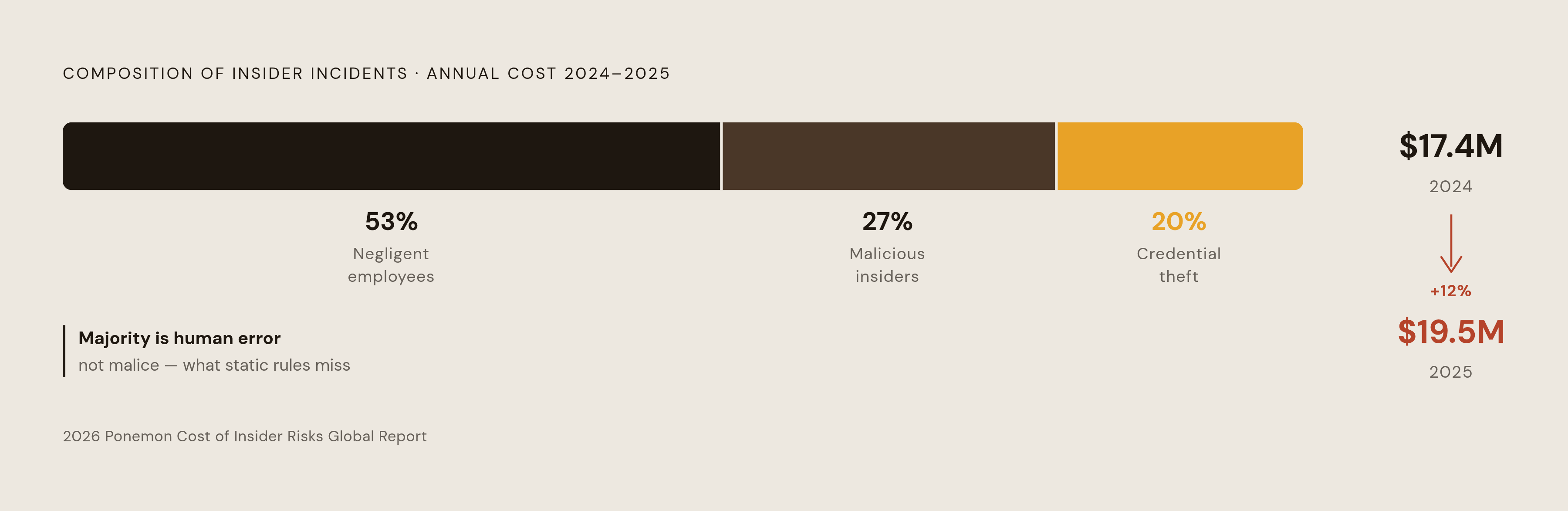
Start with the cost, because it tells the story before anything else does. The average annual cost of insider risk hit $19.5 million in 2025, according to the 2026 Ponemon Cost of Insider Risks Global Report, up from $17.4 million the year before.
The makeup of these incidents matters just as much as the price tag. Per Ponemon data, 53% of insider incidents come from negligent employees, 27% from malicious insiders, and 20% from credential theft. Most of these events don't look like attacks while they're happening, a distinction static rules are poorly built to catch.
A single data movement rarely carries the risk on its own. The risk lives in the pattern stretched across time: an employee gradually siphoning files over weeks, someone accessing systems they've never touched before right around a resignation date, or data shared in ways that look unremarkable individually but add up to something clear once the sequence is visible. Legacy DLP is structurally blind to that arc, since it registers the act of movement and misses the person behind it and the pattern building toward it.
That blindness carries an operational cost. Security teams inherit alert floods they can't triage in any meaningful way, they miss the handful of cases that actually matter, and skilled analysts burn hours chasing events that turn out to be nothing. The environment generating these incidents just shifted again, faster than most detection architecture has caught up to.
How shadow AI and generative AI tools have broken the assumptions legacy DLP was built on
Shadow generative AI use across enterprises rose 68% in 2025, according to Menlo Security. That is the data environment now, for practically every enterprise with employees who carry a browser to work.
Governance hasn't kept pace. Only 37% of organizations have any policy in place to manage or even detect shadow AI, per IBM. Most companies have no framework at all covering the channel where data is now leaking fastest. Sensitive information leaves through prompts typed into a chatbot, files uploaded to an AI tool, and workflow integrations nobody in IT signed off on, right alongside the file transfers legacy DLP was tuned to catch years ago.
Legacy DLP's static rules struggle to classify data moving through shadow AI tools, browser-based assistants, or agentic workflows that didn't exist when those rules were written. There's no regex for a prompt. Agentic DLP is built to cover endpoints, SaaS, cloud, email, web, and AI tools all at once, matching the actual coverage map now rather than the one legacy vendors built toward a decade ago.
The buyer implication is blunt: a consolidated platform that doesn't natively handle GenAI data leakage has just bundled yesterday's coverage into a bigger contract. The scope of what needs protecting moved faster than most acquisition roadmaps have.
What a sharper evaluation lens actually looks like in practice
Counting vendors, admiring a single-pane-of-glass dashboard, or measuring procurement convenience are administrative wins, and none of them say anything about whether the tool catches what it's supposed to catch. Buyers who rely on that scorecard end up grading the wrong exam.
The right questions follow directly from the architecture problem above. Does the platform make its detection call based on behavioral context, or does it just flag data movement and leave the analyst to hunt down context afterward? What's the measurable false-positive rate in an actual production environment, not a vendor's controlled demo? When a platform says "AI-powered," does the AI make the call, or does it just re-rank output from a rule that hasn't changed? Can it catch risk in GenAI and shadow AI channels, or only in traditional file-transfer and email paths?
Vendor viability belongs on this list too. Is the vendor a plausible acquisition target, and if so, what happens to the product roadmap and the existing contract if that deal goes through? Given that enterprise DLP deals run well into six or seven figures, the switching cost after a bad acquisition gets measured in years, not months.
Data privacy around AI inference deserves its own line of questioning: does the AI run on the vendor's shared infrastructure, or inside the buyer's own environment? A model trained on shared customer data carries a different risk profile than one doing isolated inference inside a single tenant. Integration depth matters more than integration breadth, too. A platform that plugs into identity systems, endpoint tools, SIEM, and HR data, and builds behavioral context across all of it, does a fundamentally different job than one that just piles alerts from a stack of point tools onto one screen.
How the major platforms stack up against these criteria
Broadcom's Symantec DLP carries deep legacy enterprise pedigree, but the post-acquisition record shows buyer complaints centered on resource-heavy deployment, endpoint performance drag, and a maintenance burden that didn't shrink after Broadcom took over. It added overhead instead of removing it. Anyone buying it for the name is buying yesterday's architecture at today's price.
Proofpoint's acquisition of Tessian brought behavioral machine learning into the email channel specifically, and it handles accidental data loss through misdirected email genuinely well. That strength narrows fast outside of email, though. It's a channel-specific tool wearing a platform's marketing.
Cyera runs DSPM-first, and the Trail Security acquisition, $162 million in 2024, folded AI-enhanced DLP into a data security posture management context. It fits organizations mainly worried about cloud data exposure and classification. It fits worse for those focused on user-behavior-driven exfiltration, and buyers shopping for insider threat coverage specifically should read that as a mismatch, not a minor gap.
Then there's the category of behavioral, AI-native platforms built from the ground up for insider risk, the one acquisition is least likely to replicate by bolting pieces together. Candor Security, which stitches behavioral context across the enterprise stack into a single user timeline, sits in this category. Their core job is stitching a user's activity across every source into a single timeline before anything reaches an analyst, so what shows up is a case with context, rather than a bare event. That behavioral picture depends on integration across identity providers like Okta, endpoint tools like CrowdStrike, collaboration platforms like Google and Microsoft, HR systems like Workday, and SIEM platforms like Splunk. Without those connections, "behavioral context" stays aspirational instead of real. Deployment speed matters too: a platform live within days rather than months starts producing signal before the threat landscape shifts again, and given how fast shadow AI adoption has moved, that window is not small. Private, isolated AI inference also answers the data privacy question that shared-model platforms can't, since customer data never leaves the tenant's own environment.
The sorting principle is simple, and buyers keep missing it. Platforms built for breadth and platforms built for depth in insider-threat detection answer different questions; they aren't competing for the same job, and the criteria above separate them far faster than any vendor briefing will volunteer.
What buyers should do differently before the next consolidation wave closes options
Consolidation isn't slowing down. Market growth, climbing regulatory pressure, and CISO demand to cut tool sprawl all point toward more acquisitions ahead, not fewer.
Buyers hold their leverage now, before a deal closes, while the field is still differentiated and vendors still compete on merit rather than resting on a bigger logo. Once the acquisition happens, the roadmap belongs to whoever bought the company, not to the customer who signed the original contract. That is the moment leverage disappears, and it disappears fast.
Detection quality should outrank procurement convenience in that evaluation, full stop. Trimming the vendor list by picking a broader platform with worse detection can leave a weaker security outcome wearing the costume of operational simplicity. Run an actual false-positive audit on any platform under consideration, incumbent or candidate. If the system throws off more alerts than the team can meaningfully review, whatever the consolidation saved in vendor fees gets spent right back in wasted analyst hours.
Map coverage to where data is actually moving today, meaning GenAI channels, shadow AI tools, and agentic workflows, rather than to where it moved when the current platform got bought years ago. Treat vendor stability as something to score explicitly, not something to assume. Ask directly whether a vendor is in acquisition talks, and negotiate contract language that protects roadmap continuity if a sale happens anyway.
Consolidation gets buyers a shorter list. On its own, it rarely gets them a better answer to the detection problem underneath. The organizations that come out ahead keep the detection question and the procurement question separate, and refuse to let a shorter vendor list stand in for a sharper one.