The Data Sources That Feed Dynamic User Risk Profiles and Which Insider Threat Platforms Wire Them Together
The quality of data fusion, not just collection, separates insider threat platforms.
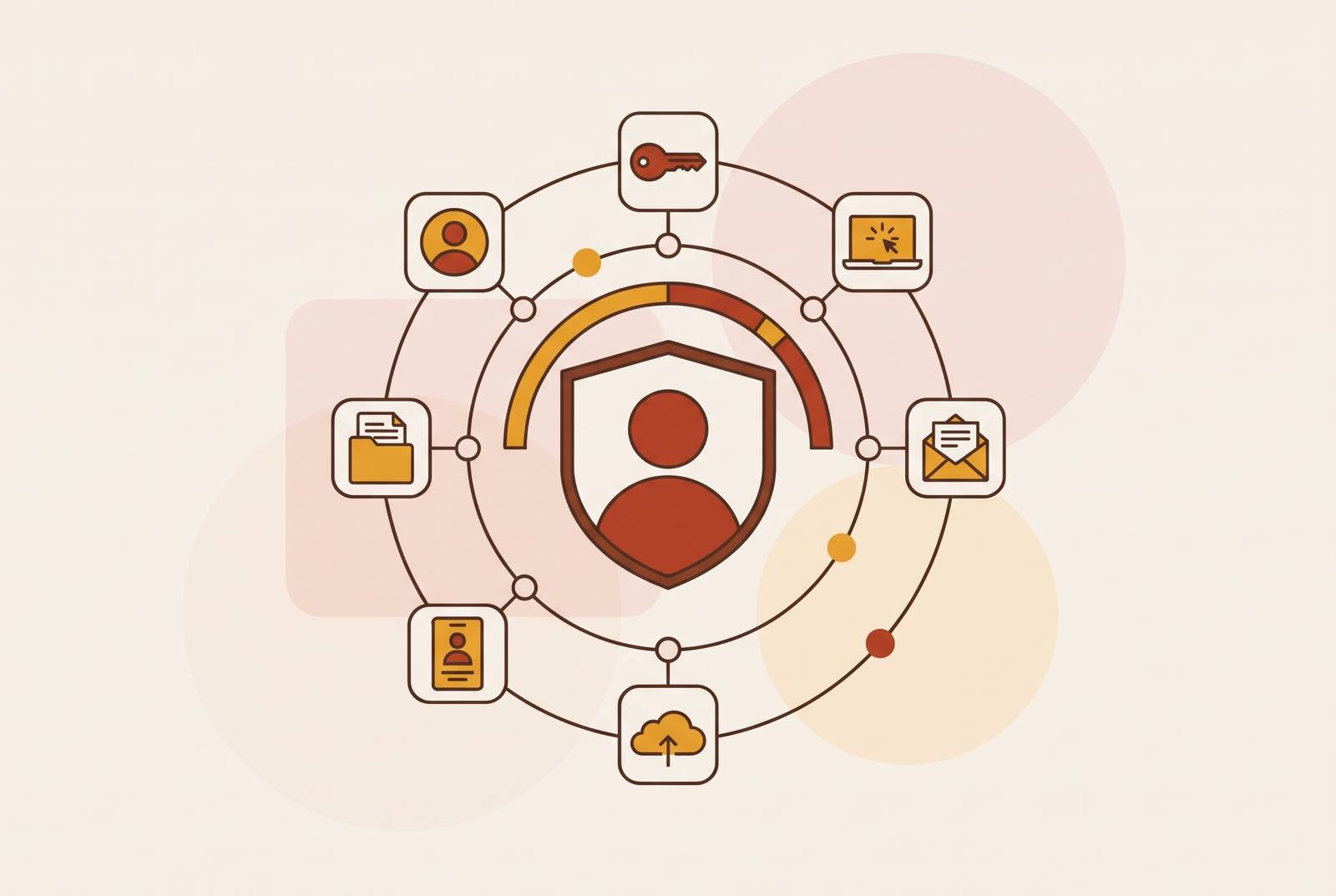
Dynamic user risk profiles depend on the quality of their telemetry, but source coverage alone does not make them accurate. The decisive difference among insider threat platforms is how deeply they fuse endpoint, identity, data-movement, SaaS, and contextual signals into one continuously updated model of each person. Evaluating that fusion gives security teams a practical basis for choosing the architecture their threat scenarios require.
Why static risk indicators fail against threats that evolve over time
Insider threats can develop through legitimate access as a user’s behavior changes over time. A point-in-time rule can identify a known violation, but it cannot explain the trajectory preceding it. Off-hours access, incremental exfiltration, and privilege creep may escape individual thresholds, while legitimate work that matches a rule generates false positives.
A Multi-Source Behavioral Analytics Approach for Real-Time Insider Threat Detection identifies reliance on rules or a single data source as a core limitation of available approaches. That limitation becomes more pronounced as SaaS sprawl, cloud data gravity, and AI-assisted workflows undermine assumptions about stable data patterns and centralized enforcement. Insiders now include contractors, embedded third parties, compromised credential holders, and autonomous AI agents with insider-level access, as well as employees. Rules can still fire while valuable information is left exposed. If the threat is behavioral and evolving, the profile tracking it must be behavioral and continuously updated.
What a dynamic user risk profile actually is and what it requires to work
A dynamic risk profile is a continuously recalculated model of a user’s behavior relative to their history, peer group, and relevant context. It is not merely a dashboard score. The multi-source study proposes combining rules for known violations with machine learning for deviations from established baselines. Action-level scoring must update in near-real time as telemetry arrives.
Those baselines depend on sound identity hygiene. Stale provisioning, shared service accounts, and unmanaged contractor access can produce chaotic profiles regardless of the analytics engine’s sophistication. Peer groups also need accurate role, department, location, and reporting-structure data. Otherwise, the comparison population itself distorts the result. Even a sound baseline is insufficient when risk exists from day one, remains statistically normal, or occurs entirely through authorized access, so content and context must inform the model.
From static to dynamic risk indicators in predicting and detecting insider attacks, presented at IEEE TrustCom 2025, looks at a new way to use Meta AI’s Llama-3.2 to infer personality-based risk indicators from what people write. The framework models those indicators as time series and applies ARIMA forecasting to anticipate behavioral deviations. Its focus extends beyond completed security events. It treats communication drift as a potential leading indicator, rather than relying only on evidence that an action has already occurred.
The telemetry sources that carry the most signal for user risk
Identity and authentication telemetry establishes who accessed systems, from where, and when. IdP and Active Directory sign-in events provide that foundation, while Windows and Linux authentication logs extend it into on-premise and hybrid environments. Privileged access changes and unusual authentication sequences add evidence of possible credential compromise. Endpoint telemetry supplies a different dimension of activity. File access, application usage, USB transfers, and process execution show what happened on a device after authentication, including activity that cloud-only profiling cannot see.
Data-movement signals show when information crosses a boundary through cloud uploads, transfers to personal storage, mass downloads, or email attachments. Their usefulness depends on both content depth and event coverage. A DLP signal grounded in content semantics is stronger than a regex match on a file name, while uploads to unmanaged AI services require specific instrumentation. SaaS audit trails extend this view across enterprise platforms. Microsoft Entra ID, AWS CloudTrail, and Google Workspace logs contribute activity records, but differences in format, depth, and latency require normalization before those records form a coherent picture.
Communication metadata adds sender, recipient, attachment, and message-volume patterns, while content-level analysis supports the emerging research into behavioral drift. Badge entry and exit records can contextualize logical access, while VPN and proxy data extend location and network context to remote work. HR feeds add role changes, departure notices, and who reports to whom, which technical logs cannot show. Fortinet’s 2025 Insider Risk Report identifies gaps across endpoints, cloud apps, and GenAI platforms, and notes that tools frequently lack the “who” and “why” behind data events.
How source fusion quality separates platforms from each other
Fusion begins where log collection alone stops. It requires normalization across formats and time zones, identity resolution across account identifiers, and latency management that preserves a near-real-time view. Those operations allow a platform to connect increased after-hours file access with a large upload to a personal account during an HR-flagged performance review. Each event supplies part of the interpretation. Separate alerts leave the analyst to establish whether the sequence represents one developing risk.
SIEM-native behavioral analytics uses the log infrastructure already in place. Splunk User Behavior Analytics applies unsupervised machine learning across users, devices, and applications against peer-group baselines. The standalone product reached End of Sale in December 2025, with UEBA capability now included in Splunk Enterprise Security Premier. IBM QRadar UEBA extends its SIEM with behavioral analytics across identity, authentication, access, network, endpoint, and application logs. This architectural approach benefits from established aggregation, but often needs significant tuning to turn anomalies into actionable risk scores.
Rapid7 InsightIDR connects user and entity behavioral context with vulnerability data, endpoint telemetry, and cloud signals through a broad integration library. Evaluate whether behavioral correlation happens at the platform layer or remains a post-hoc join across separate stores. A content-aware architecture adds another distinction by evaluating what data means, where it is going, who is sending it, and what surrounds the action in the user’s timeline. That joins understanding of the data and the person in a single decision, rather than treating sensitivity and behavior as separate findings.
Why HR integration is the highest-leverage gap most programs have not closed
HR data has unusually high contextual leverage because it changes the interpretation of activity already visible elsewhere. A mass download may look like routine backup work until the profile shows that the user submitted a resignation three days earlier. The activity itself has not changed. The new context changes its risk weighting, just as a role change, performance improvement plan, access-level promotion, or contractor onboarding event changes how subsequent behavior should be understood.
The same context also improves baseline construction. A reporting-structure shift or new role affects the peer group against which the user’s actions are compared, linking HR integration directly to identity hygiene. The Fortinet report says employees who are leaving are a top concern for the security leaders surveyed. Before a user leaves, they may have several download sessions that each stay within the normal range. Correlating the departure date with the cumulative pattern exposes a relationship that session-level scoring can miss.
The integration barrier is organizational as well as technical. HR systems often sit outside security ownership, data-sharing agreements require legal and privacy review, and manual coordination substitutes for automated feeds. The data can exist without reaching the profile. For programs with this gap, making HR a governed, integrated source is a concrete priority. Platforms that treat HR feeds as a first-class input are structurally better positioned to interpret pre-departure activity and role changes.
What alert volume tells us about the downstream cost of poor telemetry fusion
Alert fatigue comes from weak signals as well as a high number of events. When each source generates separate alerts, analysts must resolve identities, reconstruct timelines, and retrieve organizational context themselves. Adding more coverage this way can therefore create more work without giving analysts more to go on in each alert.
That extra work makes mean-time-to-investigation matter as well as detection accuracy. Even an accurate alert can cause delays if the evidence needed to assess it is spread across systems. AI investigation pipelines should correlate, enrich, and contextually score candidate events before presenting decision-ready cases to analysts. The aim is to get fewer false positives, alerts that analysts can trust more, faster triage, and lower dwell time.
The Fortinet report finds that most organizations lack confidence in their insider threat detection capabilities. Decontextualized alerts help explain that lack of confidence because analysts cannot readily distinguish an anomaly from a credible threat. Alert counts alone cannot establish fusion quality. The stronger test is whether broader telemetry coverage yields better-supported cases without automatically increasing manual reconstruction, and whether the evidence needed for a decision is assembled when the analyst engages.
Real exfiltration patterns that reveal which source combinations a platform actually needs
Flashpoint’s 2026 insider threat intelligence report describes a third-party contractor at a cryptocurrency firm who sold customer data to threat actors and recruited colleagues. The incident resulted in termination of a large number of employees and compromise of tens of thousands of customers. Contractor coverage is the diagnostic issue for platform evaluation. An employee-only model excludes people who may hold equivalent logical access but follow different working patterns. This scenario requires contractor provisioning data from HR/IAM, baselines that reflect contractor access norms, and data-movement monitoring that does not exclude contractor-owned endpoints.
A separate incident involved an insider at a cybersecurity organization sharing internal dashboard screenshots with an external threat actor group. Here, the exfiltration channel was not a conventional file transfer. The relevant combination is behavioral communication monitoring with endpoint screen activity context, because the information left through a screenshot shared externally.
The pre-departure download pattern requires correlating when a user is due to leave with how much data they move over time. Coverage must therefore match the threat scenario. For practitioners, these archetypes provide a basis for mapping source requirements to likely channels and actors, without assuming one combination is universally sufficient. They also distinguish a missing sensor from a missing correlation, since collecting the relevant event does not guarantee that it influences the user’s profile.
How to evaluate whether a platform actually fuses sources or just aggregates them
An evaluation should test the user profile the platform builds. Identity resolution is the first test. The platform should consistently connect IdP identifiers, endpoint agent IDs, SaaS account names, and contractor credentials to the same person. Evaluation should establish whether that connection persists across the behavioral timeline or whether analysts must reconcile separate entities after an alert appears.
Contextual scoring and content awareness test whether the model interprets the evidence it collects. A resignation or performance plan should change risk weighting without someone having to update a rule by hand. Content depth is equally important to the decision. The evaluator needs to establish whether the platform understands a document’s business meaning or relies only on labels and regex matches.
A platform should assemble a time-ordered record across instrumented systems before escalation, rather than make the analyst reconstruct it from individual alerts. Explainability makes that process open to scrutiny. The platform should show which signals contributed to a score and why, including the evidence used by AI investigation before a human alert was raised.
The Fortinet report calls for a governed approach spanning security, HR, legal, and IT. The evaluation should therefore check role-based access to investigation data, audit trails for legal hold, and how HR feeds are integrated. The deciding standard is whether the platform produces an attributable, contextual, and auditable risk picture before escalation, or merely gives analysts more sources to reconcile afterward.