Evaluating Insider Threat Platforms for Malicious vs Negligent Insider Distinction
The best insider threat platforms distinguish careless employees from deliberate attackers.
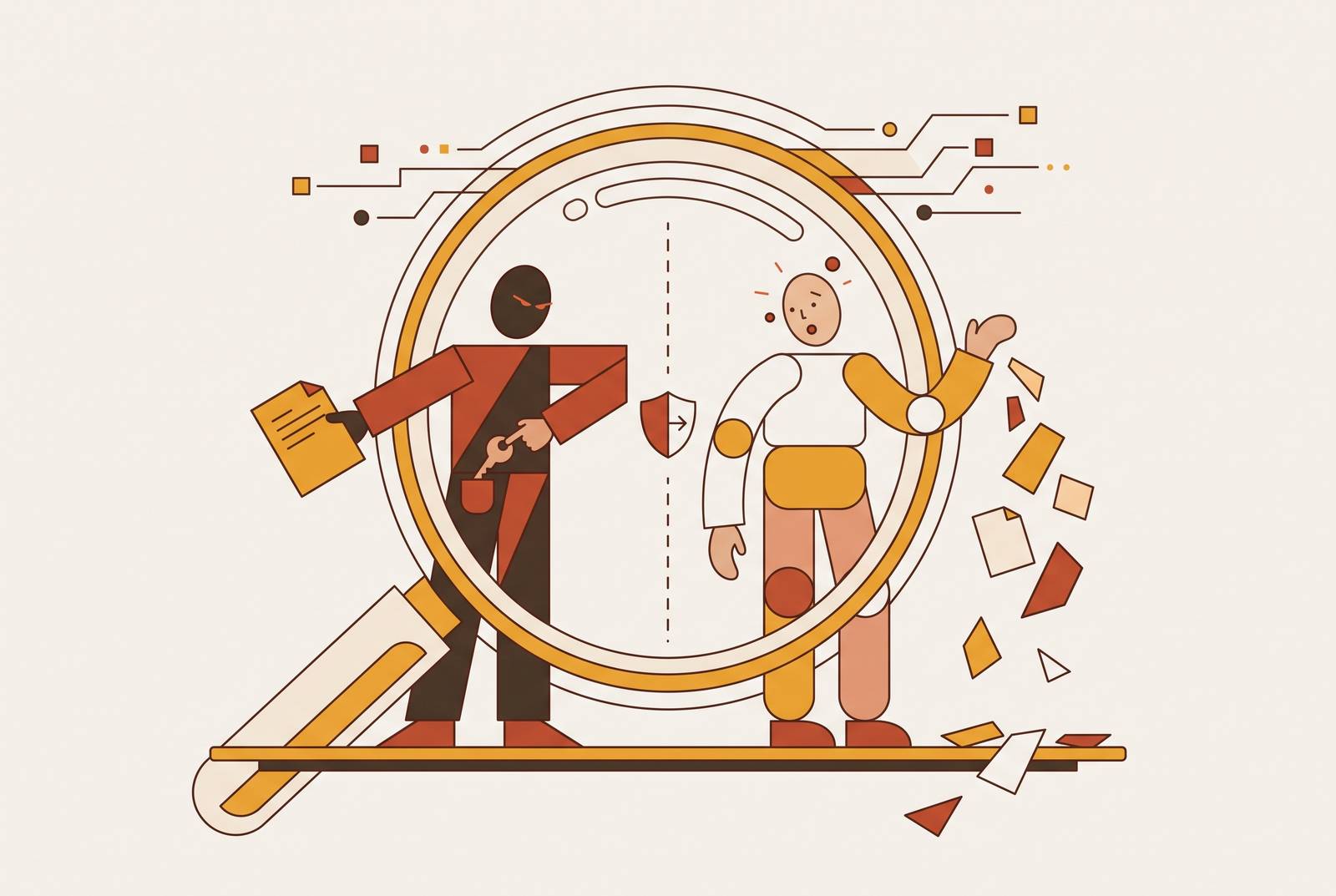
Insider threat platforms are not interchangeable, and the distinction that matters most is whether a platform can tell a careless employee from a deliberate one before an analyst ever opens the alert. To evaluate that capability, you need to understand the specific signals, architecture choices, and investigation workflows that separate intent. A platform that treats every event the same way will waste response resources on the wrong incidents and miss the ones that actually cause damage.
Malicious and negligent insiders look similar on the surface but require completely different responses
The insider risk field splits into three categories: malicious, negligent, and compromised. All three share one surface trait, legitimate access, but they diverge completely in motivation, mechanics, and the response each one demands. CISA's own definition of an insider threat covers anyone with authorized access whose actions, whether malicious, complacent, or unintentional, threaten the confidentiality, integrity, or availability of a system. That framing matters because it means a single data-movement event, viewed in isolation, could belong to any of the three categories depending entirely on why it happened, not what it looked like from the outside.
Vectra AI's insider risk management guide offers a useful way to hold these categories apart: insider threat is arson, and insider risk is every way a building can catch fire, including the frayed cables nobody noticed until the wiring failed. If a security team treats every fire as arson, it burns its containment resources on investigations that turn up nothing more than a careless employee, while the slow electrical faults, the unpatched habits and the unsanctioned tools accumulating quietly in the walls go unaddressed until they cause real damage.
The negligent insider is the largest category by volume: harm caused by mistakes rather than intent, a misdirected email, an unsanctioned SaaS tool, an employee pasting internal documents into a public AI assistant without thinking about where that text ends up. The compromised insider is a different animal entirely: a legitimate account taken over by an external actor through phishing or stolen credentials, where the "insider" doing the damage is actually an attacker wearing someone else's trusted identity. This category sits awkwardly between the other two and gets miscategorized often, particularly by platforms built to watch only data movement rather than the identity behind it.
A fourth category is forming now, and it doesn't fit the employee-badge model that legacy controls were built around: non-human identities, service accounts, and AI agents that carry standing privilege and can act on their own. These agents don't resign, don't get flagged by HR for a performance plan, and don't show up on any roster of people a security team is used to watching, yet they can move data with the same consequence as a human insider.
The North Korean IT worker scheme shows how far the word "insider" has already stretched past its old definition. The Coinbase incident in May 2025 shows the same blurring from a different angle: external attackers bribed a group of support agents, who then used their own legitimate access to pull customer data out of the system. That event was neither a careless mistake nor the work of a single disgruntled employee. It was a hybrid that straddled the categories the field normally keeps separate, and it is exactly the kind of case a platform built around one definition of "insider" will misread.
Collapsing both categories into a single alert stream produces the wrong response at the wrong time
When a platform pours negligent and malicious events into the same undifferentiated alert stream, every analyst has to treat every event with the same level of suspicion and the same escalation path.
The cost structure of insider risk makes this especially damaging: negligent insiders drive the largest share of total annualized cost purely through volume, but malicious insiders drive the highest cost per individual incident. Per-incident costs tell the same story from a different angle: StationX's 2026 insider threat statistics rank credential theft as the most expensive category per event, with malicious insider incidents next, and negligent incidents the least costly per event. The compromised category, in other words, is the most underestimated financial risk a security team faces per incident, despite frequently getting waved off as an IT hygiene problem rather than treated with the seriousness its cost justifies.
Two real cases show what happens when a platform can't make this distinction in time. The failure was as much about timing as detection.
Intel's case makes the same point from a different angle. A single-channel rule set stopped one door and left another wide open, because it had no way to recognize that the same person, blocked once, had simply tried again somewhere else.
Both cases share a structural pattern: the exfiltration looked authorized, moved through channels employees use every day, and happened during a window, the notice period, the final days before termination, when behavioral velocity naturally rises without tripping any simple rule. Vectra AI's 2026 State of Threat Detection found that 63% of SOC alerts go unaddressed. When a platform weighs negligent events and malicious events equally, the sheer volume of negligent noise drowns out the much smaller number of alerts that are real malicious signal.
A platform that cannot explain why it classified a specific event as malicious rather than negligent creates legal exposure in precisely the investigations where the stakes are highest.
The detection signals that separate malicious intent from negligence
Intent can't be read off a single event. It has to be inferred from the behavioral pattern surrounding that event: the data involved, the destination chosen, and the timing relative to known triggers in an employee's lifecycle, like a resignation or a termination date.
Channel selection is one of the clearest signals available. Volume and velocity matter just as much: bulk downloads concentrated into a short window, especially files that sit outside a user's normal working set, look nothing like the slow, gradual accumulation pattern a negligent user typically produces over time.
Multi-channel redundancy is where the Intel case becomes instructive for platform evaluation rather than just a cautionary story. A single-channel DLP tool has no way to see it. Scope creep adds another layer: accessing resources outside a user's normal role or permission scope, shortly before data moves out the door, is a precursor signal that negligent events typically lack.
Negligence carries its own distinct signature. The destination is usually a known, previously authenticated personal account, so it looks like ordinary sync behavior. The content moved matches the user's normal working set and role, and the event happens in isolation, with no surrounding shift in behavior that would suggest planning.
The compromised-user signal set looks different from both. It typically shows a sudden behavioral break: access at unusual hours, from unfamiliar locations or devices, at a velocity inconsistent with that user's own history, without any of the HR lifecycle triggers, resignations, performance plans, terminations, that tend to precede genuinely malicious employee activity.
Shadow AI tools sit right at this boundary, and they have opened a detection gap there. Only context, what was pasted, how often, from which accounts, following what access pattern, separates the two, and a rule that simply blocks the channel outright misses the distinction while generating enormous false-positive volume. Research from George Washington University found that context and sequence matter more than any single event. Reconstruction error measured against a model trained on benign activity surfaces anomalies in the data that no static rule set could enumerate in advance. Behavioral DLP systems built on that same logic, weighing timing relative to HR events, channel selection, and access velocity together, treat an employee downloading files before termination as part of an ordinary knowledge transfer differently from an employee downloading the same files to an encrypted personal cloud account while actively covering their tracks, because the pattern surrounding the event carries the diagnostic weight.
What to look for in a platform's detection architecture
Confirming whether a platform's underlying architecture can produce intent-differentiated signals comes before comparing features across vendors. A well-designed interface sitting on top of static rules will reproduce the same undifferentiated alert problem no matter how it gets configured.
The first question to ask is whether the platform models each user's behavior as a temporal sequence or evaluates events individually against a fixed threshold. Sequential models can surface goal-persistence of the kind seen in the Intel case, along with pre-departure velocity changes and role-scope drift, because they evaluate behavior across a timeline, while event scanners that look at one action at a time cannot detect these patterns. Ask a vendor directly what the unit of analysis is: the event, the session, the user timeline, or all three together.
The second question concerns HR and identity data. Can the platform ingest resignation notices, performance-improvement-plan status, termination dates, and role changes, and use them to weight a user's risk dynamically as those events occur? Without that integration, the departing-employee window, which is the highest-leverage moment for malicious exfiltration, stays invisible to the risk model. Ask which HR systems the platform integrates with natively, and separately, ask how fast a lifecycle event changes a given user's risk posture.
Third, ask about cross-channel identity resolution: does the platform tie behavior across endpoint, email, cloud storage, SaaS, and AI tools back to one single user identity? The Intel case makes this question non-negotiable: a DLP tool that blocks one channel and can't see the same actor try a second device is only a partial control. Ask whether a user blocked on one channel and immediately trying a second gets connected to the same risk timeline, or treated as two separate, unrelated events.
Fourth, ask about content understanding versus regex or label matching. Can the platform assess what a piece of data actually means to the business, source code, design files, strategic documents, without requiring that data to carry a pre-existing classification label? Much of an organization's most valuable intellectual property was never formally labeled, and a platform that can only act on labeled data is protecting a fraction of what the business actually has at stake.
Fifth, ask about coverage for shadow AI and non-human identities. Can the platform detect sensitive data moving through browser-based AI tools, and can it monitor service accounts and AI agents that carry standing privilege on their own? Legacy DLP tools were built for predictable, well-defined zones of data movement, and modern workflows now move sensitive information through channels that static rules were never built to classify.
Sixth, ask about the explainability of the platform's verdicts. When a platform classifies an event as indicative of malicious rather than negligent behavior, can it show the actual reasoning, the specific signals involved, their sequence, and how each was weighted? HR and legal proceedings need auditable evidence, and a black-box classification that can't be explained creates exactly the kind of exposure a security team is trying to avoid in the cases that matter most. Ask what an analyst actually sees when an alert opens: a bare score, or a reconstructed timeline with each signal labeled.
Behavioral profiling systems, among them Candor, can ingest HR lifecycle data, access logs, and user activity patterns at the same time, which makes it possible to weight an identical data-movement event differently depending on whether it happens during a routine workday or inside the two-week window before an employee's last day. Rules-based systems collapse that distinction because they treat every event the same regardless of when it occurs.
Investigation Workflow Design and Detection Capability
Accurate detection is necessary, but it isn't enough on its own. A platform that surfaces the right signal but still requires an analyst to assemble the full case from raw telemetry has simply moved the delay from detection to investigation rather than removing it.
A structural cause drives the volume of alerts a platform generates. When a platform can't pre-classify events by intent, every candidate event turns into a full human investigation: Vectra AI's 2026 State of Threat Detection found that SOC teams lose an average of 2.5 hours a day to manual triage. If a platform needs months of operationalization before it produces trustworthy signals, it leaves a security team flying blind for that entire stretch, and the departing-employee window that matters most doesn't pause for a six-month rollout.
Lean SOC teams face a related constraint. A platform that demands deep expert tuning to reach full capacity underdelivers the moment headcount gets tight, and a team running a complicated platform at partial capacity only gets a fraction of the value that platform was designed to provide. A platform built on behavioral context rather than static rules can surface the distinction between intent categories before an alert ever reaches the analyst queue, so it cuts down the volume of negligent noise that buries malicious signal and routes response effort toward the threat type that actually needs it.
Explainability and investigation workflow are tied together directly. If an AI verdict arrives already attached to a labeled, auditable timeline, it can move straight into an HR or legal proceeding. A verdict that arrives as a bare score forces the analyst to rebuild the case from scratch anyway, which erases the time savings the platform was supposed to deliver. When evaluating a platform's investigation workflow, check whether it assembles the full behavioral story, role changes, peer activity, temporal clustering around lifecycle events, inside a single interface. If platforms force analysts to cross-reference multiple logs or separate baselines to explain why one event was classified as malicious rather than negligent, they slow investigation velocity down and introduce classification drift the longer they're used, and what the analyst sees in the first moments after an alert opens, along with what still has to happen before that analyst can decide whether to escalate it, is the real test of any vendor.