The Label Adoption Problem Is a DLP Architecture Problem Not a Change Management Problem
Effective DLP requires content understanding and behavioral context, not flawless user labeling.

DLP that does not rely on sensitivity labels or regexes combines content understanding with identity, behavior, destination, and data lineage to make enforcement decisions. Label adoption exposes a DLP architecture problem because protection fails when it requires an upstream label that may be missing or lost. Training can improve labeling, but the structural fix is enforcement that can make a correct decision about an unlabeled file.
Why DLP programs fail at the architecture level, not the user level
Sensitivity labels give enforcement tools a clear policy signal, and user training helps people use that signal the same way each time. The limitation arises when the signal becomes a prerequisite for protection. A DLP policy engine must understand what data is before deciding what may happen to it. If that understanding depends entirely on a label, missing metadata leaves the engine without the information its decision requires.
At egress, that dependency becomes acute. The tool must resolve sensitivity after data has been joined, renamed, truncated, exported, or reformatted. Blaming users mistakes the missing input for the architectural choice that made it indispensable. Classification must start before enforcement by finding what data the organization already has. That is a scoping decision.
Where classification actually breaks down: ownership gaps and taxonomy overreach
Classification often falls between established responsibilities. Security owns the tool, legal owns the rules for retention, and department heads own the files. None of those responsibilities alone settles who must classify the data or maintain that classification as its use changes. Work in this ownership gap does not reliably get scheduled. The resulting omissions reflect an organizational boundary.
Taxonomy complexity compounds that gap. Schemes with six or seven levels can require extensive per-data-type guidance before employees can distinguish adjacent tiers under real workload. Government-style classifications may be a poor fit for how businesses work. When the vast majority of assets are tagged "Internal", the distribution can indicate that people are minimizing friction. Enforcement then consumes a signal shaped by cognitive defaults.
The propagation gap: why classification coverage is not the same as classification protection
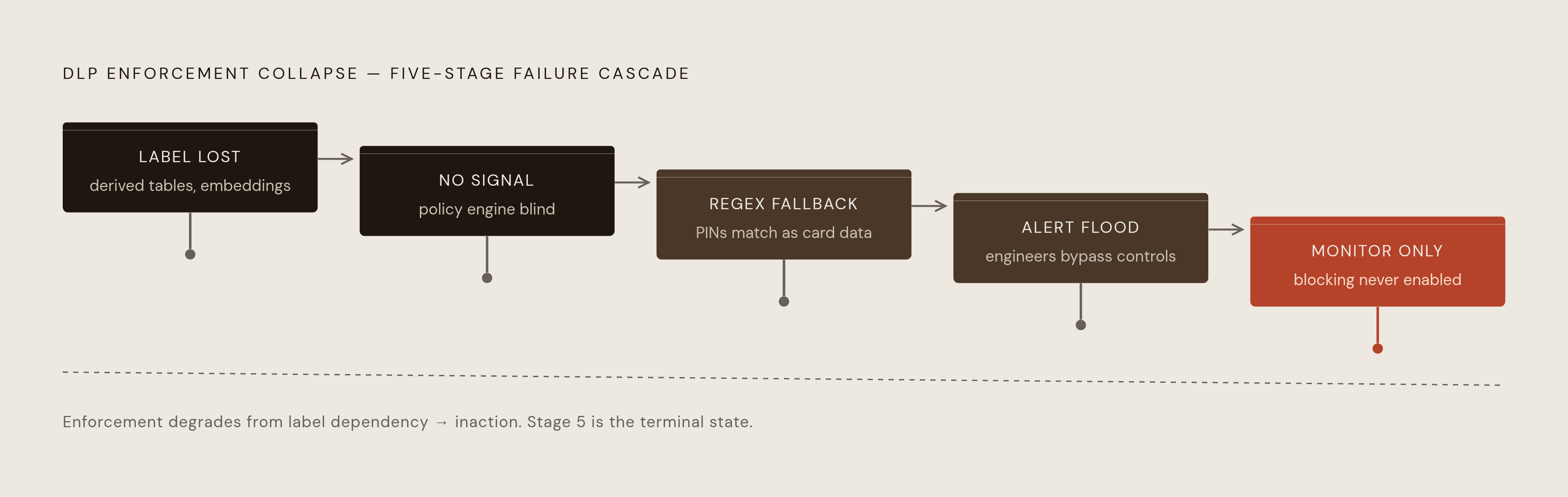
Even correct labels cannot fully protect data if they stay behind when it moves. A label assigned at ingest must retain its provenance and follow lineage into derived tables, exports, embeddings, and AI indexes. When that inheritance breaks, a classified source can produce an unlabeled derivative. Covering the scanned estate well says little about how well data is protected outside it. Reporting against the discovered estate exposes gaps that a scan-based denominator conceals.
Discovery itself can miss personal Dropbox shares, old email attachments, and spreadsheets on unmanaged file servers. These shadow sources widen the distance between a classification catalog and the data people actually use. Across that wider estate, approaches such as Candor's data and behavioral profiling can surface sensitive information even when labels do not follow exports or derivatives. When classification metadata also fails to reach the enforcement layer, teams must build the policies again inside DLP. That duplication adds effort and creates inconsistencies without repairing propagation.
What label-free enforcement produces: content-only policies and the false-positive spiral
Missing labels produce poor enforcement when the fallback is content-only pattern matching without content understanding supported by context. A regex matching 16-digit sequences can trigger on product serial numbers, conference call PINs, and order confirmation numbers as readily as card data. The match establishes resemblance. Without contextual signals, the policy cannot reliably separate ordinary work from dangerous movement.
Those ambiguous matches create a self-reinforcing workload. High alert volumes leave less time for tuning, while untouched rules keep generating noise. When blocks are wrong, engineers are more likely to work around controls, and the business is less willing to help with classification work. Programs can consequently remain in monitoring-only mode because blocking is too disruptive. The spiral is structural, even though tuning can improve individual rules, because the engine keeps asking patterns to supply context they do not contain.
The SOC cost: alert fatigue as a predictable output of the architecture, not analyst failure
The SOC inherits the ambiguity that the policy engine could not resolve. As alerts grow faster than the time available to investigate them, analysts must choose between a quick review and a queue that keeps growing. It takes longer to start investigating critical events when they are buried among weak matches. Mean-time-to-investigation, or MTTI, captures this delay more directly than alert count. Poor signal quality adds to dwell time even when analysts work quickly.
Adding analysts can increase capacity, but it does not change the evidence attached to each alert. Persistent noise still consumes attention and contributes to burnout. Gartner's 2025 Market Guide for Data Loss Prevention projects that organizations incorporating intent detection and real-time remediation will realize a one-third reduction in insider risks by 2027. That projection points toward a different decision model. The intervention is to change what enforcement and alert creation depend on, rather than expand staffing or tune the same inputs indefinitely.
What DLP does not rely on sensitivity labels or regexes
Context-aware, content-intelligent DLP can use labels as evidence and can act without them. It combines content understanding with identity, behavior, destination, and lineage. Its decision concerns whether this movement is normal for this user, with this data, in this context, at this time. The architecture can therefore evaluate an unlabeled file without reducing the decision to a predefined pattern.
Instead, continuous classification supplies a current understanding of the data, while contextual signals explain the movement. Those signals include whether transfers are internal-to-internal versus internal-to-external, the recipient domain, the user role, and sensitivity labels when the data has them. A bulk download followed by an external upload carries different risk from a single file transfer. Sensitive intellectual property also requires content understanding because its business meaning may not match a regex or classification tier. Distributed enforcement applies that understanding across the places where data moves.
What real exfiltration looks like when enforcement depends on labels: four case archetypes
Three incidents illustrate four architectural failure patterns, namely pre-resignation staging, delayed deprovisioning, destructive activity, and bribed-contractor exfiltration. United Arrows announced in March 2026 that a former employee had leaked personal information of thousands of business partners. Before resigning December 31, 2025, the employee uploaded a client list through the internal cloud server's external collaboration function and sent the link to a personal email address. This staging preceded offboarding. The relevant detection signal was the movement and destination.
The OPEXUS incident in February 2025 illustrates delayed deprovisioning. The U.S. Senate HELP Committee stated that two terminated engineers still had access to the government contractor's internal systems and allegedly deleted approximately 96 government databases and exfiltrated EEOC files. Retained access created an interval in which termination had not yet translated into revoked permissions. A sensitivity label alone does not describe that change in access context.
The same incident illustrates destructive activity as a separate enforcement concern. Deletion is not merely another form of outbound file transfer, and a label-dependent egress rule does not by itself address it. Access and behavior telemetry are necessary to assess this pattern. The case does not establish which DLP controls were deployed or prove that a particular platform would have prevented the damage.
The Coinbase incident, spanning December 2024–May 2025, illustrates bribed-contractor exfiltration. Cybercriminals bribed customer support contractors to siphon sensitive customer data, including government ID images, account balances, and financial records, over months. Authorized access became the means of exfiltration without requiring a change in the data's label. Longitudinal behavior matters because individual access events may appear legitimate in isolation. Together, these incidents show why identity, device, and content telemetry must form one movement pattern and why the monitored population must extend beyond employees.
What context-aware, behavioral DLP requires from the underlying data architecture
Behavioral inference requires a foundation of continuous discovery, lineage-aware classification, and unified identity context. The program must know where sensitive data resides and who can access it before it can judge movement reliably. Recording that a file was accessed is insufficient. Monitoring must capture who accessed it, from where, on what device, and whether it was shared or exfiltrated. Those relationships give an event the context needed for a decision.
Label propagation still helps enforcement within this architecture, though enforcement can also draw on other evidence. Inheritance into derived tables, exports, embeddings, and AI indexes must be architectural. Enforcement surfaces also require explicit design across SaaS, cloud, endpoints, browsers, and AI or agent workflows. Classic file policies do not automatically translate into controls for prompts, sessions, or agent tool calls. A continuous truth layer must link its catalog to those distributed enforcement points.
How modern DLP platforms approach context-aware enforcement without label dependency
Candor builds its architecture around behavioral profiling and content analysis across the enterprise stack. Its enforcement decisions incorporate what information means, where it is going, who is interacting with it, and the surrounding activity. A correctly labeled file is not the prerequisite for assessing risk.
Its modern DLP controls cover sensitive data leaks and shadow AI, with decisions based on data, destination, account ownership, and context. For shadow AI, the approach includes intervention before sensitive data leaves. The platform investigates candidate events before sending alerts to people, which cuts the triage work that content-only rules create. Its insider risk scope includes negligent employees, malicious insiders, compromised users, contractors, third parties, and AI agents. Candor states that most organizations are live within a single week, depending on whether they select an on-premise or cloud deployment.
Material Security offers a cloud-workspace-focused approach for Google Workspace and Microsoft 365. Its API-driven discovery maps how data is related and finds shadow sources, while its contextual classification draws on user behavior, how people work together on documents, and business relationships. Its classification approach prioritizes mislabels around the most sensitive data sets and uses actual data-use telemetry to guide policy changes. This scope is optimized for cloud workspaces rather than broad enterprise DLP across all channels and insider risk patterns.
DSPM-integrated and discovery-led platforms provide another architectural route. They connect continuous classification to distributed enforcement through SaaS APIs, inline SSE/SASE, browser and session controls, and endpoints. With that link, teams have fewer policies to build again by hand because classification and enforcement systems are separate. Across these approaches, the central criterion is whether upstream labeling remains a single point of failure. Practitioners should establish whether a platform can make a correct decision about an unlabeled file and what happens when it cannot.
What security teams should change first when the architecture, not the users, is the problem
The first change is sequencing. Run discovery before tuning policies so that rules are based on the data the organization has and how it moves, without relying on assumed data flows. Discovery can find SSNs in unstructured HR file shares or source code in shared marketing drives. Report coverage against the discovered estate. This makes missing coverage visible before more effort goes into improving labels on already scanned assets.
Next, simplify the taxonomy before expanding enforcement. A four-tier model reduces the cognitive load that encourages default use of "Internal", improving label quality without pretending to remove label dependency. Layer behavioral and contextual signals before widening content-only policy scope. Adding pattern-matching rules creates more chances for false positives when the decision model stays the same.
Finally, measure MTTI with detection rate and extend the insider risk perimeter to contractors, third parties, and AI agents. The test is how quickly a meaningful signal reaches an investigated conclusion. Training and change management can help people improve how they classify data. As remedies for label-dependent enforcement, however, they target the wrong layer. The structural dependency must be eliminated through an architecture that can make a correct enforcement decision about an unlabeled file.