Building the Business Case for Replacing Legacy DLP
Why legacy DLP fails in modern data environments and costs millions to replace.

Replacing a legacy data loss prevention platform used to be a line item, something a security leader signed off on between patch cycles. That's no longer true. The money involved has outgrown the "IT operations" line and now sits next to cyber insurance renewals and audit findings on the board agenda. Mordor Intelligence puts the DLP market at $33.26 billion in 2025, growing to $111.98 billion by 2031, a 21.17% compound annual growth rate. Numbers like that don't describe a niche tool category getting a refresh. They describe infrastructure being torn out and rebuilt.
Capital allocation tells the story better than any analyst note does. Palo Alto Networks paid roughly $25 billion for CyberArk, making identity security a core pillar of its platform rather than a bolt-on. Zscaler spent close to $651 million on Red Canary to wire endpoint telemetry into AI-powered detection and response. Fortra absorbed Lookout's cloud security business specifically to bring data security posture management into Digital Guardian. None of these deals reads like a company patching an architecture it still trusts. Each reads like a company that decided the old architecture can't be patched, only replaced, and backed that decision with nine or ten figures.
Treating this like a normal refresh cycle, the kind a firewall swap or an endpoint agent upgrade might get, is the wrong read. This is a financial and operational risk decision, and the business cases that survive inside large organizations are the ones that translate technical failure (false positives, coverage gaps, analyst fatigue) into language a CFO or a board risk committee already speaks. The cases that stay technical don't make it out of committee.
Where the legacy DLP model breaks
Legacy DLP rested on three assumptions that made complete sense when someone wrote them down. Data lived in known, finite locations: endpoints, email servers, network gateways. Sensitive data could be identified through signatures, fixed patterns like a government ID format or a credit card string. And blocking movement at defined inspection points, chief among them the network perimeter, was enough to stop loss before it happened. For a centralized, on-premise enterprise, those three assumptions held up fine.
They don't hold now, because the ground underneath them moved. Data flows through SaaS platforms, cloud stores, collaboration suites, AI copilots, and third-party API integrations, often without anything that resembles "movement" in the network sense the old model was built to watch. An employee doesn't need to email a file to a personal account anymore. She grants an AI assistant read access to a shared drive, or a contractor's integration token pulls records through an API nobody flagged for inspection. Legacy DLP was built to watch a perimeter, and the perimeter isn't there to watch anymore.
Most of what actually matters, contracts, proprietary research, source code, product roadmaps, was unstructured data from the start. It lives in documents, chat threads, wikis, and repositories. A signature-based tool catches the data type it was told to look for and misses almost everything else, because it has no way to flag a research file that only becomes sensitive depending on who's trying to move it, and when.
That's the real failure, and it's structural, not incidental. Sensitivity in a modern enterprise is contextual: the same spreadsheet is harmless in one workflow and a compliance violation in another, depending entirely on who's touching it and why. A deterministic rule engine can't hold two contradictory truths about the same file at once. Behavior can.
The financial cost of legacy DLP's failure modes, translated for executives
Executives don't need convincing that breaches are expensive. IBM's Cost of a Data Breach Report 2025 sets the global average at $4.44 million. Read that as a floor for this conversation, since it averages across incidents of wildly different severity.
The more damning number is what happens when data sits somewhere nobody catalogued. IBM's research attaches a 16% premium to breach costs when shadow data, meaning information in unmanaged or undiscovered locations, is involved. That's a direct line from "our tool doesn't see this repository" to a specific, quantifiable increase in what a breach costs when it happens.
Insider incidents carry their own price tag, and it's steep. Ponemon's research puts the global average annual cost of insider-related incidents at $17.4 million. North America rose from $22.2 million in 2024 to $24.0 million in 2025. SentinelOne's citation of the same Ponemon data shows large enterprises, over 75,000 employees, averaging $24.6 million annually, against $8 million for organizations under 500 employees. The gap between large and small organizations is substantial, and it widens as data environments grow more complex.
Then there's a cost that rarely makes it into a board deck, because it doesn't look like a breach. Plenty of DLP programs get deployed and then quietly sit in monitor-only mode for months, sometimes years, because security teams worry that turning on enforcement will break a legitimate workflow and flood the help desk with tickets. The tool sits there, technically deployed, generating alerts nobody acts on. A policy sitting on a shelf isn't a control, and it costs money every day it stays that way: in analyst hours spent triaging noise, and the enforcement gap it leaves wide open is a direct result of that inaction.
The insider threat problem legacy DLP was never designed to solve
The volume of insider incidents has more than doubled in under a decade. Reported figures show discovered incidents rising from 3,269 in 2018 to 7,490 in 2025, a 129% increase spanning nearly a decade rather than one bad year or one high-profile case. Trend lines like that reverse only when organizations change how they detect the problem.
The distribution has shifted too. Sixty-eight percent of organizations now report between 21 and more than 40 insider incidents, up from 57% in the prior period measured. Insider risk has stopped being the rare, headline-grabbing event and turned into a routine operating condition, the kind of thing a security team budgets for the way it budgets for phishing.
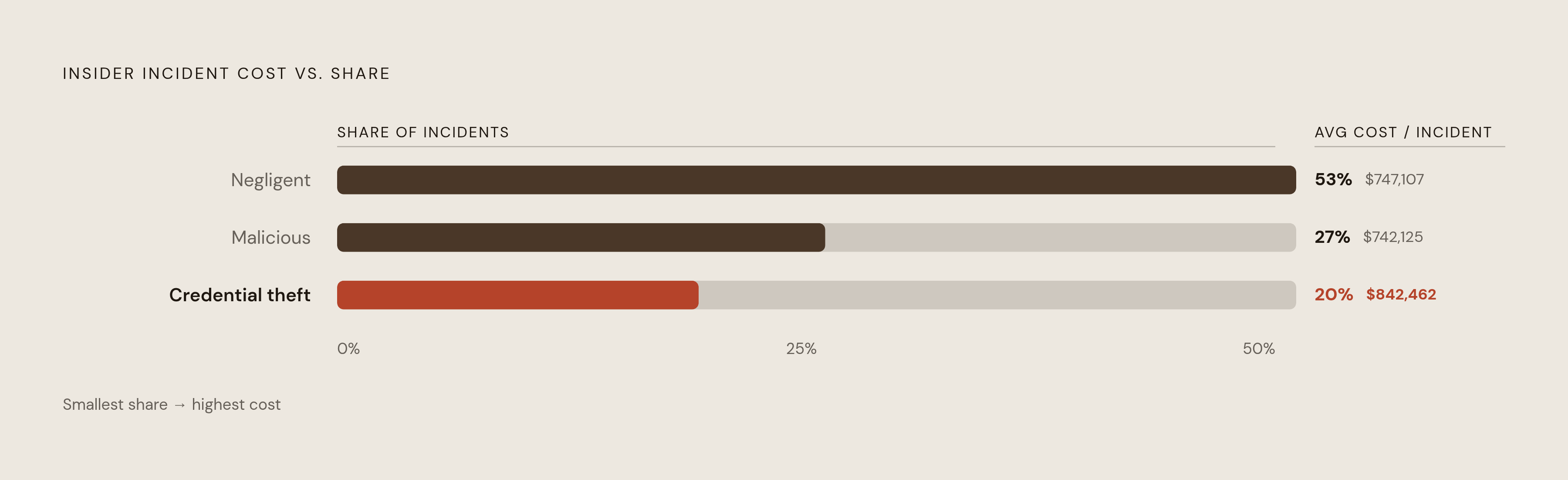
Breaking incidents down by cause shows why a static rules engine struggles here. Negligent insiders account for 53% of incidents, averaging $747,107 each. Malicious insiders make up 27%, at $742,125 on average. Credential theft and compromised-insider cases are the smallest share, 20%, but the most expensive by far at $842,462 apiece. A legacy DLP system treats the employee who mistakenly CC'd the wrong client the same way it treats an attacker operating inside a stolen credential: both trip the same rule, or neither does, and both land in the same queue. A system built around behavioral baselines routes each to a different response path, because negligence, malice, and compromise look different once the system watches how someone actually behaves instead of matching a file against a pattern.
The confidence numbers are the most uncomfortable part of this picture. For 93% of organizations, insider threats are as hard or harder to detect than external attacks, which is a startling admission given how much security spending has historically pointed outward. Research finds 72% of organizations lack full visibility into how employees interact with sensitive data day to day, and only 14% said they felt fully confident in their ability to detect insider data loss. Call it what it is: a visibility gap wearing a tooling gap's clothes, and exactly the gap legacy DLP was never built to close.
Why AI-native and behavioral DLP changes the math
The shift is a change in the question being asked. Legacy DLP asks whether a piece of content matches a known pattern. Behavioral, AI-native DLP asks whether this action, by this user, involving this data, at this time, in this context, looks like something that user would normally do. That's a different question entirely, and answering it takes a different kind of system.
These platforms build a behavioral baseline for every user: which applications they typically touch, what kinds of data they access, when they work, how much they usually move in a session. Once deployed, these systems build baselines over an initial observation period before deviation-based detection becomes fully operational. Once it exists, the system stops hunting for a signature and starts watching for deviation, an unusual transfer volume, an odd hour, a repository nobody on that team normally touches.
The false-positive rate is where the payoff appears first. AI-powered platforms have demonstrated reductions in false positives of up to 90% compared to rule-based systems, while improving detection rates at the same time rather than trading one for the other. Read that number as recovered analyst capacity. Every alert an analyst doesn't have to chase manually is an hour spent investigating something real, instead of retuning a rules engine that keeps flagging normal behavior as a threat.
Gartner's forward-looking numbers point at where this is headed. The firm projects a 33% reduction in insider risk from organizations that add intent detection and real-time remediation by 2027, and separately projects that 70% of CISOs at large enterprises will have unified insider risk management and DLP into a single program by that same year. Convergence between these categories is happening whether or not any given organization opts in. The ones still running two disconnected systems, one for insider risk, one for data loss, end up rebuilding under pressure later instead of by choice now.
Structuring the internal business case for a replacement decision
A strong technical argument usually dies inside a large organization by staying a technical argument. A security team can build an airtight case about coverage gaps and false-positive rates and still lose the room, because the room is thinking about regulatory exposure, litigation risk, competitive harm from stolen IP, and audit findings, not detection architecture. Translate the case into that language, or it won't survive contact with the board.
Four failure modes belong in the executive summary, and each one needs a number attached, not an adjective. False positives translate into analyst hours consumed, then into a fully loaded FTE cost and the opportunity cost of whatever those analysts weren't doing instead. Coverage gaps need mapping by name: which channels, GenAI prompts, SaaS APIs, cloud collaboration tools, the current tool simply doesn't see, measured against where the organization's data actually flows day to day. That gap sits on the balance sheet as uninsured exposure, priced or not.
Analyst overload deserves its own line, specifically because monitor-only deployments are common and easy to bury in a status update. A tool that logs activity without enforcing anything functions as a log, not a control, and a log is the first thing an auditor or a plaintiff's attorney finds. Document that as a policy-practice gap rather than burying it in a footnote.
Unprotected crown-jewel IP needs names, not categories: source code, M&A due diligence documents, clinical trial data, unreleased product roadmaps, whichever two or three assets would do the most damage to that specific business if lost. For each one, state whether the current DLP tool can detect unauthorized movement of that asset today. In most legacy deployments the honest answer is no, and that honesty is what makes the case land with a board that has heard vague reassurances before.
The cost comparison that matters is total cost of ownership, not sticker price against sticker price. Set legacy license cost, plus tuning labor, plus false-positive analyst hours, plus professional services fees, plus the incident costs the tool failed to prevent, against a modern platform's full cost including deployment and integration. Framed as sticker price against sticker price, legacy DLP looks cheaper almost every time. Framed as total cost against total cost, it almost never does.
Research indicates that a large majority of organizations now either have an insider risk management program in place or are actively building one. That's a baseline expectation at this point, not a leading-edge move, and an organization still running on legacy architecture is fast becoming the exception rather than the norm.