Data Risk Assessment Frameworks for Enterprise Security Programs
Compliance checkboxes miss the behavioral patterns that cost enterprises $19.5 million yearly.

Data risk assessment frameworks are supposed to prevent the loss of what a company can least afford to lose, yet the record shows something more troubling: organizations pass audits, complete every checklist item, clear compliance reviews with clean marks, and still watch their most valuable intellectual property walk out the door. The World Economic Forum's Global Cybersecurity Outlook 2026 puts a number on this pattern of anxiety: more than 87% of organizations reported AI-driven cybersecurity threats on the rise, and a meaningful share of them have already experienced data leaks tied to these emerging tools. That scale of concern should, in theory, be met by frameworks built to catch it. It mostly isn't.
The root cause isn't mysterious once you look at how these frameworks actually get implemented. Most of them function as location-and-label exercises: find where the data sits, assign it a classification tag, apply controls keyed to that tag, and call the job done. What almost none of them ask, at least not systematically, is what a given piece of data actually means to the business, or who is touching it and why. A spreadsheet full of numbers can be exactly as sensitive as a signed term sheet, depending entirely on context that a classification tag can't capture.
The financial evidence for this gap is not abstract. The 2026 Cost of Insider Risks Global Report from the Ponemon Institute and DTEX Systems found the average annual cost of insider-related incidents reached $19.5 million per organization. That figure amounts to more than nation-state espionage or a zero-day exploited by a foreign intelligence service. It's the risk category these frameworks were explicitly designed to catch, and they're still missing it at a cost north of the annual budget of many mid-sized security programs.
What follows is not an argument to discard these frameworks. The argument is that a framework centered on data meaning, access context, and human behavior does something categorically different from one centered on data location and a policy checklist, and the $19.5 million gets lost in that gap. This piece is written for practitioners who already have some framework coverage in place and want to know precisely where the holes are and how to close them, not for anyone starting from zero.
The limits of standard data risk assessment framework models
Every version of it is trying to answer the same four questions: where does the data live, how is it used, who can get to it, and what happens if it's exposed or misused. The answers differ by framework, but the questions don't change.
NIST CSF 2.0, published in February 2024, has become the most widely adopted cybersecurity framework globally, and its formal addition of a sixth function, Govern, is not a cosmetic update. The formal addition of the Govern function shifts the framework from asset protection toward explicit cyber risk ownership, enterprise risk tolerance alignment, and board-level decision accountability, meaning CISOs are now expected to show how cybersecurity decisions inform strategic decisions, not just demonstrate control coverage.
FAIR, or Factor Analysis of Information Risk, takes a different angle entirely: it's a quantitative model built to express risk in financial terms, and that capability matters more each year as AI accelerates the speed of business decisions past what qualitative, gut-feel risk assessments can keep up with. The logic is blunt but correct: risk that can't be measured can't be prioritized, defended to a board, or funded.
HITRUST CSF organizes its controls into 14 categories, tailored by an organization's size, system complexity, and risk profile, with the explicit goal of unifying overlapping compliance requirements so audit fatigue doesn't eat an entire security team's calendar. It's become something close to the de facto standard for demonstrating data protection maturity in healthcare and adjacent regulated industries. ISO/IEC 27001 remains the formal assurance mechanism most recognized for signaling ISMS governance to customers and regulators, and it's genuinely strong on repeatable control management and auditability, but by 2026 it needs company: on its own, it falls short on continuous control effectiveness and on the risks AI-driven systems introduce. It has to be complemented by frameworks built for dynamic risk. COBIT covers governance and management of enterprise IT more broadly, useful where technology governance and information-related risk are the central concern. ISO/IEC 42001, the first formal AI Management System standard, treats AI itself as a governance and risk discipline with oversight running from design through retirement, and organizations without AI governance meeting that level of rigor are going to find it increasingly hard to explain their approach to a board or a regulator.
No enterprise of any real size runs on a single one of these models. The current best practice is hybrid: NIST for structural backbone, FAIR for financial quantification, internal policy overlays for data lifecycle specifics, with the exact blend shaped by regulatory exposure, organizational size, and operational complexity. And here's the boundary that matters for everything that follows: these frameworks define process, governance, and control categories extremely well. None of them, on their own, provide the behavioral and contextual signal that answers whether the right person is touching the right data, for the right reason, in a pattern consistent with how they've always worked. That gap is structural, and it's the subject of the next three sections. NIST RMF is a 7-step process (Prepare, Categorize, Select, Implement, Assess, Authorize, Monitor) that integrates cybersecurity into the system development lifecycle, is widely adopted beyond federal use, and is strong on structure and repeatability.
Data classification and inventory limits that leave crown-jewel IP exposed
Nearly every framework above starts from the same assumption: inventory the data, classify it, apply controls keyed to the classification tag. It's a sound starting point. It is not, by itself, sufficient, because a company's most valuable information frequently carries no tag.
Intellectual property becomes sensitive because of what it means to the business. Proprietary research, an unreleased product design, a competitive strategy memo, the terms of a key customer relationship: none of these arrive pre-labeled as "crown jewel," and legacy classification tools built around structured-data patterns consistently miss this entire category of unstructured content, contracts, research notes, IP documentation, where AI-powered approaches can recognize the content itself in ways rule-based systems structurally cannot.
DSPM is a visibility and classification discipline: it discovers where sensitive data lives, classifies it, and identifies misconfigurations and over-exposure. DLP, by contrast, is a control discipline built to monitor and govern how data moves.
There's a timing problem layered on top of all this. Cloud-first and SaaS-heavy organizations spin up new data stores, new third-party integrations, and new sharing patterns faster than a periodic classification cycle can realistically track. A scalable enterprise risk management framework has to be intelligence-driven and continuously updated rather than refreshed on a quarterly or annual cadence, because by the time the next scheduled review happens, the map is already out of date. Once an organization accepts that the classification label alone is insufficient protection, the honest next question is what else belongs in the risk picture. The answer is access context and human behavior, and that's where the framework has to extend next. Per Cyberhaven, these are complementary: knowing where data lives does not control how it moves, and controlling movement without understanding content produces false positives and missed threats.
Access context and behavioral signals that complete the risk picture
A single data access event is almost never, by itself, the actual risk. The risk lives in the pattern across an entire user's timeline, and any framework that evaluates events in isolation is missing the story that matters.
Access context adds three dimensions a static classification tag can't provide. Device and channel: is the access happening through an approved workflow on a managed device, or through some unexpected path nobody provisioned for that purpose? Time and cadence: does this instance fit the person's established rhythm of work, or is it a clear departure from it? Destination: where is the data actually going, and does that destination match what the access was authorized for? Put together, these signals let a detection system distinguish routine, authorized work from a genuine departure. When a system knows a given employee typically touches finance files only on a managed device through one approved workflow, it can flag the moment that pattern breaks, and without that baseline, every single action gets judged blindly against a static rule that has no idea what normal looks like for that person.
Behavioral baselines, though, have real limits, and a mature framework has to plan around them rather than pretend they don't exist. Risk can exist from day one: a new hire who arrives already compromised, or already intent on causing harm, has no history to deviate from. Risk can also stay statistically unremarkable for a long time: an employee with years of tenure exfiltrating data in small, steady volumes may never register as a deviation because each individual action looks ordinary. And risk can occur entirely inside authorized access, when someone with legitimate permission to a dataset simply uses that permission for a purpose it was never granted for.
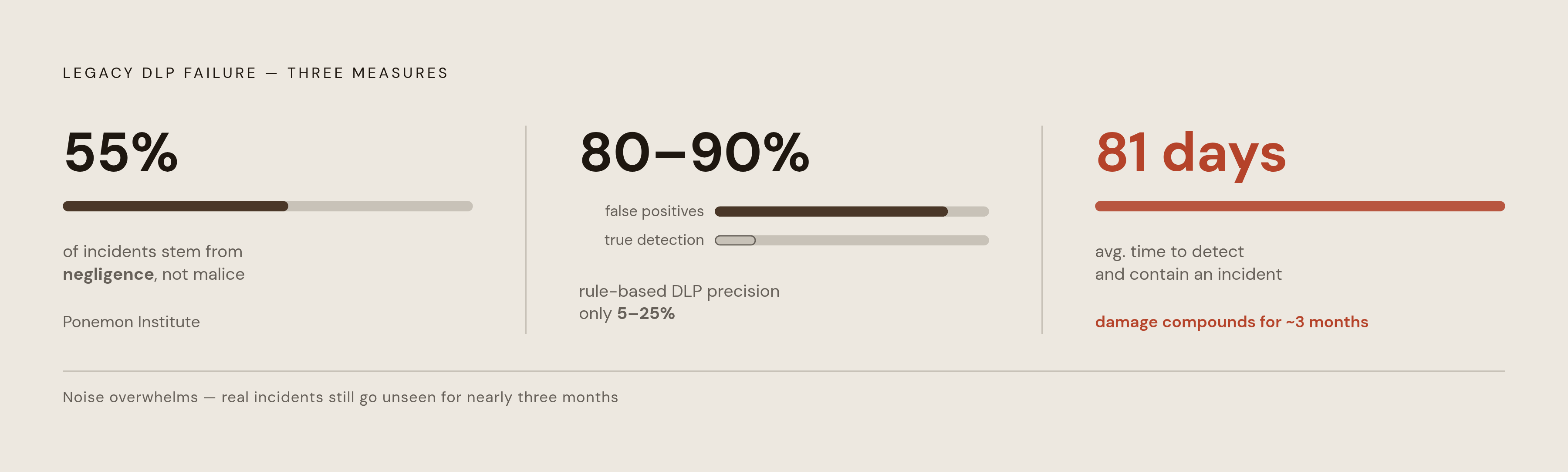
Insider threat is commonly misread. Per the Ponemon Institute's Cost of Insider Risks report, 55% of insider incidents stemmed from negligence, not malicious intent. A framework tuned only to catch bad actors is, by definition, missing the majority of the exposure it's supposed to cover.
None of this can live in one department's hands. HR, legal, corporate security, compliance, and IT each see a different slice of the same person's risk profile, and early indicators of a problem routinely appear in one function long before they become visible anywhere else. Left siloed, those functions let behavioral shifts and contextual clues go unnoticed simply because nobody was positioned to connect them. Any framework serious about this has to build the cross-functional wiring in from the start.
None of it should come at the expense of privacy, and a well-built framework treats that as a design constraint rather than an afterthought bolted on post-launch. That means documenting the minimum monitoring actually necessary, applying data minimization and pseudonymization where feasible, keeping security analytics separated from personal information, and maintaining policies employees can actually read and understand. GDPR and CCPA impose real, binding constraints here, and a mature framework accommodates them by design rather than treating them as a compliance tax paid after the fact.
What legacy DLP controls catch and cannot catch
Incumbent DLP platforms are not regex-only relics. Major vendors document fingerprinting, exact data matching, optical character recognition, machine learning models, and trainable classifiers running alongside pattern matching. The criticism of legacy DLP isn't that it's technically unsophisticated.
The more accurate distinction is architectural. Legacy DLP was designed around static rules and around human data movement that follows predictable channels, email, file transfer, removable media. Those deployments still generate heavy false-positive volumes whenever the classifiers and policies they rely on lack enough context or tuning to distinguish signal from noise. Rule-based, pattern-matching DLP has been associated with a baseline detection precision range of 5%–25%, alongside false-positive rates in the 80–90% range. AI-powered approaches, by contrast, report reductions in false positives of up to 90% against rule-based systems in some accounts, with detection precision figures reported around 95% and false-positive reductions near 99% in others. The practical consequence of the older numbers is straightforward: when most alerts are noise, an analyst team's limited investigation hours get burned chasing false signal instead of real risk. That's a framework design failure, not a tooling inconvenience.
The sharper blind spot is structural rather than a matter of tuning. Legacy DLP has no concept of an AI prompt. It was built to watch file transfers, email attachments, and clipboard activity, not to inspect the content of a conversation someone is having with an AI assistant. And the volume moving through that channel is no longer a fringe concern: enterprise adoption of endpoint-based AI agents grew 276% over the past year, adoption of endpoint coding assistants more than doubled from roughly a fifth to half of enterprises in 2025, and an estimated 39.7% of the data employees share with AI tools qualifies as sensitive. Banning these tools outright doesn't solve the problem, and neither does visibility alone; effective control depends on evaluating the data itself, its destination, who owns the account sending it, and the surrounding context, with intervention happening before the sensitive material actually leaves.
Buyers should also be wary of the term "next-gen DLP." In most cases it means AI layered on top of a legacy rule engine, sorting and prioritizing alerts faster while the underlying detection model stays exactly the same. Agentic DLP is a different architecture altogether, one where AI rebuilds the detection engine itself so the model, not a static rule set, makes the call. The labels sound nearly identical; the underlying architecture is not. Any framework evaluation should ask which of the two it's actually looking at.
Time matters as much as accuracy here. The Ponemon Institute's 2025 Cost of Insider Risks Global Report found insider-driven incidents took an average of 81 days to detect and contain. That's not a rounding error; it's a window during which damage compounds and cost climbs. Mean-time-to-investigation deserves a place next to detection accuracy as a framework KPI, reported continuously. The AI tool blind spot is a structural gap.
Building the integrated risk picture: a framework structure that covers the gaps
Start with governance, because nothing downstream works without it. NIST CSF 2.0's Govern function should sit as the backbone, defining who owns data risk, what the organization's actual risk tolerance is, and what gets escalated to the board. ISO 27001 maps naturally onto ISMS structure and auditability, and FAIR handles the financial quantification of what a specific crown-jewel IP loss scenario would actually cost.
From there, the framework needs four layers built on top of that governance foundation. The first is data understanding: the inventory has to capture business criticality alongside technical classification, covering which datasets actually create enterprise value, which are competitively sensitive, which simply can't be replaced. Unstructured content, contracts, research, unreleased product IP, needs content-aware discovery rather than a classification tag applied after the fact. DSPM handles continuous posture visibility; DLP handles movement control. They're different jobs done by different tools, and the framework should treat them that way rather than expecting one to substitute for the other.
The second layer is access context: who touches data, through what path, in what pattern. Least-privilege access, enforced with regular permission audits, belongs here as a baseline requirement, not an aspiration. Identity lifecycle monitoring needs to run continuously, screening at onboarding and staying active through the full length of employment or a contractor engagement, extending past corporate-owned endpoints into wherever work actually happens.
The third layer is behavioral pattern detection, built around the timeline rather than the isolated event. Signals from user behavior, identity and access systems, and outside threat intelligence need to correlate against each other, because the goal isn't flagging an action, it's understanding the reasoning behind it. The framework has to account for day-one risk, statistically ordinary risk, and authorized-access misuse, not only deviation from an established baseline. External open-source intelligence adds a layer internal telemetry alone can't reach: continuous monitoring of outside indicators, newly created or reactivated public accounts, shifts in sentiment, AI-assisted attribution, can reveal risk patterns that stay invisible if the framework only looks inward.
The fourth layer is AI and shadow AI governance, and it can no longer sit at the edge of the framework as a side project. AI agents and MCP-connected tools can initiate data movement on their own, programmatically, across SaaS platforms, endpoints, browsers, and agent workflows, and the framework has to govern that movement with the same seriousness it applies to a human clicking send. ISO/IEC 42001 provides the governance standard for AI systems that influence security controls: who owns AI risk, how AI decisions are monitored, and when and how intervention occurs. For any organization with EU exposure, the EU AI Act adds a regulatory layer demanding ongoing inventory, classification, and monitoring of AI systems rather than a policy written once and filed away.
None of these four layers function if responsibility for the overall program sits in one department. HR, legal, corporate security, compliance, and IT need a defined governance structure for sharing the risk picture, not an ad hoc escalation chain that only activates after something's already gone wrong. The enterprise risk management component needs explicit, written tolerance levels for data risk, agreed at the leadership level, not left as a set of implicit technical thresholds nobody outside the security team has actually seen or approved. It closes the space between what those models were built to govern and what actually walks out the door.
Sources
- Scalable Enterprise Risk Management Framework for 2026
- Risk Management Framework: A Complete Guide for 2026
- ISACA Now Blog 2024 A Simplified Approach to Cost Effectively Boost Security Around Digital Crown Jewels
- Enterprise data risk management: Board oversight framework
- Traditional DLP vs Modern DLP: Why Legacy DLP Fails in 2026
- AI DLP: Stop Sensitive Data Exposure in AI Tools
- Five Reasons Why Legacy Data Loss Prevention Tools Fail to Deliver