CASB vs DLP Functional Boundaries in the Enterprise Stack
CASB and DLP protect different layers and neither covers the gaps the other leaves.
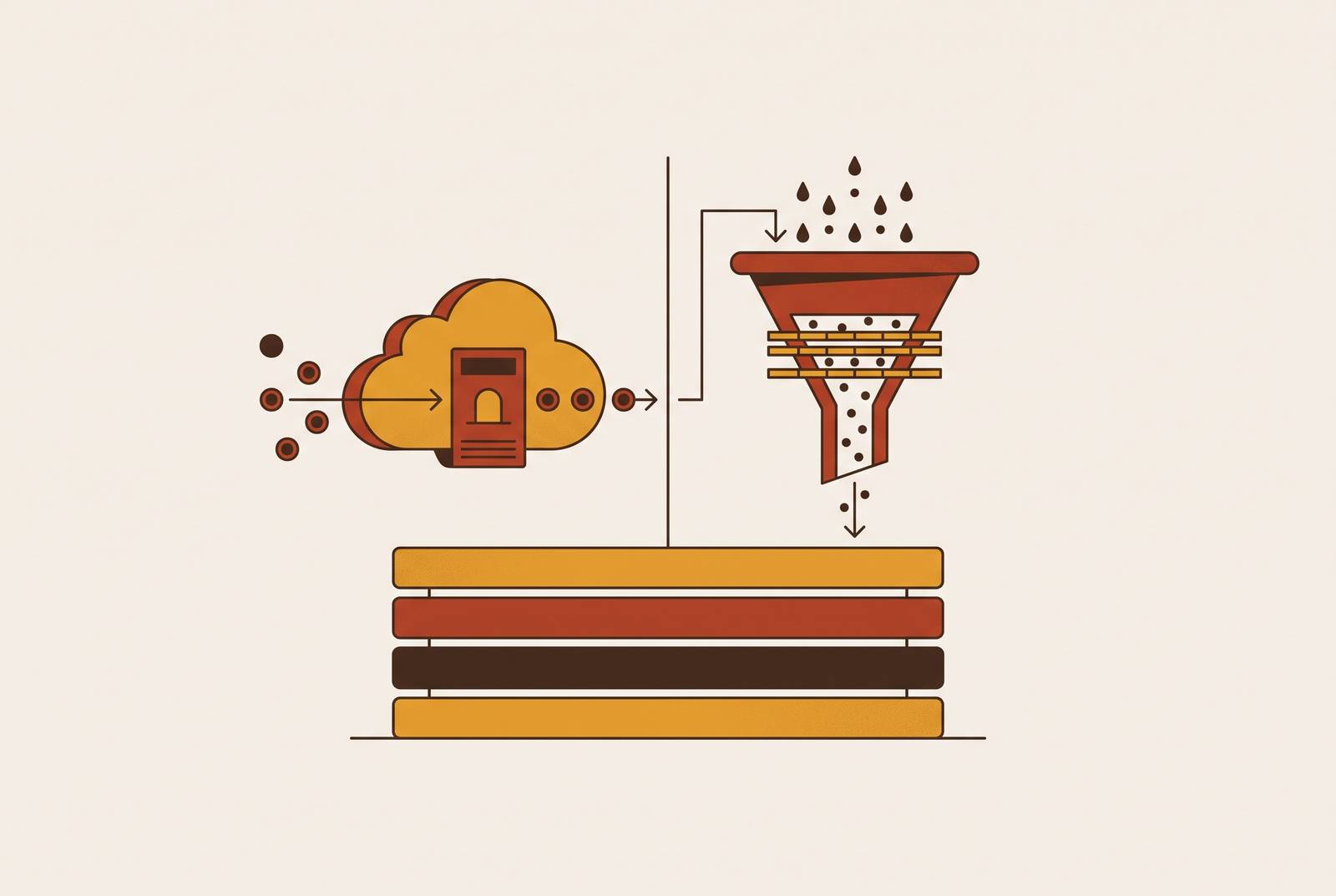
CASB and DLP occupy different layers of the same problem, and most enterprises license both without ever mapping where one hands off to the other. CASB governs cloud access: who is connecting to which service, from where, under what identity. DLP governs data movement: what content is leaving, and whether its sensitivity justifies stopping it. Most teams buy both and assume the overlap cancels out the gaps. That assumption is the single most expensive mistake a security team makes when building this part of the stack.
Protecting data at the access layer and protecting data at the content layer are different jobs, done by different mechanisms, with different failure modes. Conflating them isn't a rounding error. It's the reason incidents get discovered 81 days late instead of on day one.
What a CASB actually controls, and where its authority stops
A CASB's job is governing access and visibility at the cloud service layer. Which SaaS apps are employees actually using, including the ones IT never approved? How are they authenticating, and is this session coming from a sanctioned corporate account or something else? Four functions answer those questions: visibility into shadow IT, compliance enforcement for regulated data categories, controls applied at the session and application level, and threat detection tuned to anomalous access or account takeover.
Where it stops matters more than where it starts, and this is the part vendors gloss over. A CASB can see that a file moved into a cloud service. It cannot open that file, classify what's inside it, or apply policy based on the actual sensitivity of the content. It answers questions about the destination, the service, the user, the session. It has nothing to say about the payload, and no amount of tuning changes that fact.
That means no native reach into endpoint behavior, no visibility into on-premise file systems, nothing on data that never crosses a cloud service the CASB sits in front of. Deployment mode narrows things further. Inline deployment, forward or reverse proxy, gives real-time session control, but only for traffic actually routed through it. API-based deployment gives broader visibility into cloud app content and configuration, but no ability to block anything as it happens. Pick one over the other and the real choice is which gap gets lived with: inline misses whatever doesn't pass through it, API misses the moment of enforcement entirely.
What DLP actually controls, and where its authority stops
DLP's job is the data itself: classify it, track where it goes, enforce policy on content rather than destination. It runs across three planes. Data in motion covers network traffic, email, and web uploads, inspecting the actual payload rather than just where it's headed. Data at rest scans repositories, file shares, and storage systems for sensitive content sitting somewhere it shouldn't. Data in use runs through endpoint agents that watch what a user does with a file in real time: copying it, pasting it, printing it, attaching it to an outbound message.
DLP is strongest exactly where CASB is weakest, since it knows what the data actually is. Its blind spot, though, mirrors CASB's from the other direction. Traditional DLP has limited built-in awareness of which cloud service sits on the receiving end of a transfer. It can flag that something sensitive is leaving; it often can't tell whether the destination is a sanctioned enterprise app or someone's personal cloud storage account.
Legacy DLP also depends on managed endpoints and network traffic it can actually inspect, and that dependency is structural, not a tuning problem. A remote worker on a personal laptop, a home network, or an app nobody vetted sits entirely outside its field of view. On-premise DLP was built for a network perimeter that no longer contains the data it was designed to protect, and cloud deployment now accounts for the majority of DLP market revenue for exactly that reason. The market moved. The architecture, in a lot of deployments, did not, and that lag is where coverage quietly rots.
The functional boundary where the two tools meet — and where gaps open
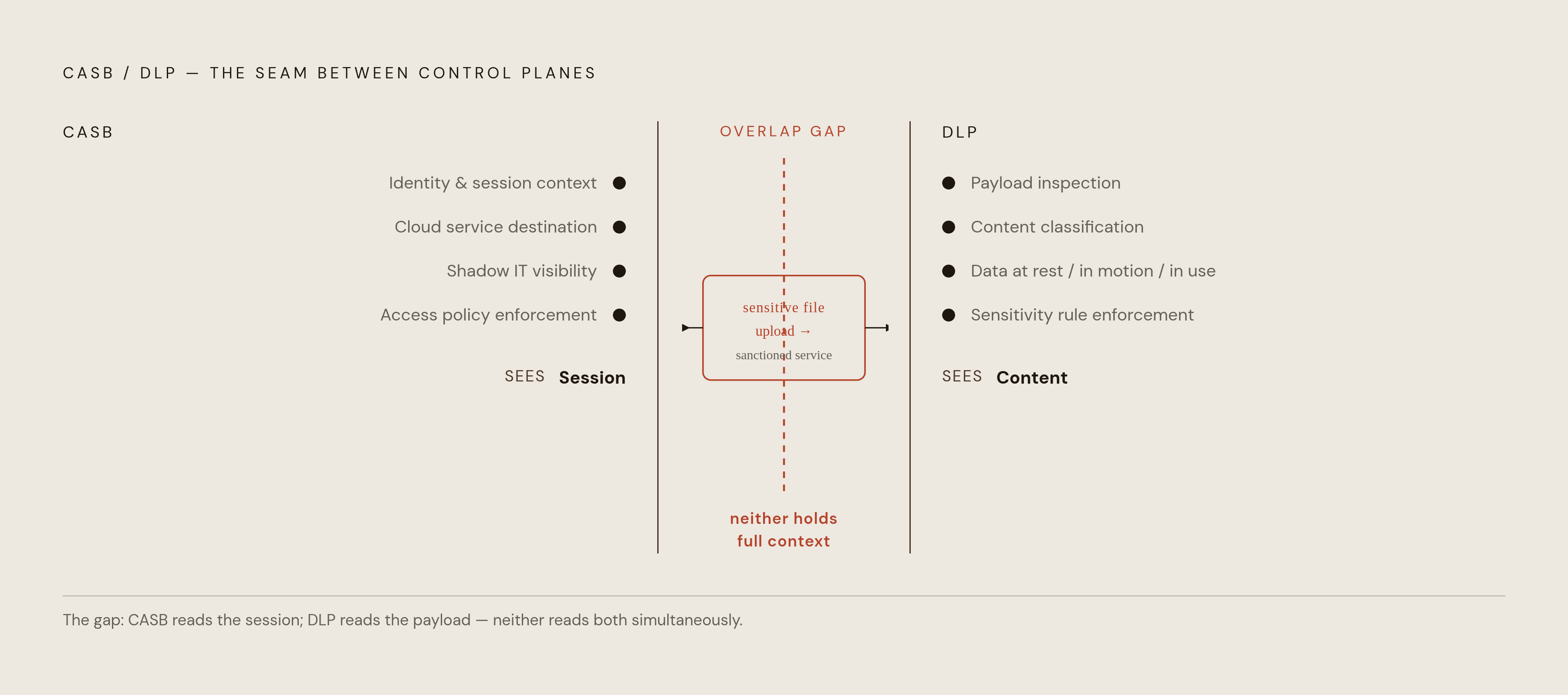
State the boundary cleanly: CASB governs the destination, access, identity, service. DLP governs the payload, content, classification, policy. Neither owns the full transaction, and that split reflects how the tools were designed, not an oversight anyone can patch later with a config change.
The overlap zone is where most enterprises wrongly assume they're covered. A user uploads a sensitive file to a cloud service; CASB sees the session and the destination, DLP sees the content and the potential violation. Put both readings together and there's a complete picture. Apart, each is half a story, and most incident postmortems find the stack was only ever reading half.
Three scenarios show where that half-story breaks down. First, the compromised-but-compliant attack: an attacker with stolen credentials accesses sensitive files through a legitimate SaaS platform and uploads them through a sanctioned service. CASB sees authorized access. DLP sees an upload to an approved destination. Neither flags anything, because neither holds the context the other one needs.
Second, the unmanaged endpoint. An employee moves data off a personal device on a home network. DLP's endpoint agent was never installed there. CASB's proxy was never in that traffic's path. Both tools are simply absent from the scene, full stop.
Third, shadow AI, arguably the fastest-growing version of this problem right now. Employees paste proprietary data into a generative AI tool. Legacy DLP struggles to classify intent or inspect encrypted AI traffic, and CASB may not even recognize the AI service as a risk destination in the first place. The failure modes are consistent across the industry: encrypted AI traffic evades inspection, intent is invisible to policy engines, and shadow AI tools go unrecognized as risk destinations entirely.
The thread running through all three: both tools evaluate a transaction in isolation. Neither correlates signals across endpoint, session, and cloud activity over time, so neither can see a pattern building across multiple steps. Relying on DLP alone leaves cloud activity under-watched. Relying on CASB alone leaves endpoint behavior under-controlled. Pick one dependency, and that's one specific way to get burned.
How vendor packaging conflates the boundary further
Vendors sell CASB and DLP as separate tiers rather than one capability, and that packaging is exactly why buyers assume coverage that isn't there. Major vendors routinely separate data protection and cloud access controls across different product tiers and add-on modules, meaning buyers must assemble coverage across multiple SKUs rather than receiving it in a single base offering.
The commercial consequence is blunt: enterprises license one tier and assume the coverage extends further than the contract says. The gap stays invisible until an incident exposes it, and 78% of organizations reported struggling with DLP tooling in 2024, a figure that reflects the strain of managing tools that share neither a data model nor an alert surface, as much as any technical shortfall in the tools themselves.
Vendors are responding, to be fair, by folding CASB, DSPM, and DLP into single consoles, aiming to cut false positives and shorten deployment. Worth watching. But consolidation on its own doesn't resolve the functional boundary just described. It can just as easily move the gaps inside one interface, harder to spot precisely because they no longer sit between two products with two separate invoices. The real question for anyone evaluating a bundled platform is whether the combined product shares behavioral context across both control planes, or just displays two alert streams side by side and calls that integration.
Where behavioral context changes what either tool can do
The gap between CASB and DLP isn't only a coverage gap. It's a context gap. Neither tool knows what a user was doing before the transaction it observed, or what they do after, and that omission is where the real damage hides.
A single data movement is almost never the risk by itself. The risk lives in the pattern around it: what got downloaded last week, which repositories got cloned, whether someone searched for exfiltration tools beforehand. None of that sits inside a single CASB session log or a single DLP policy trigger.
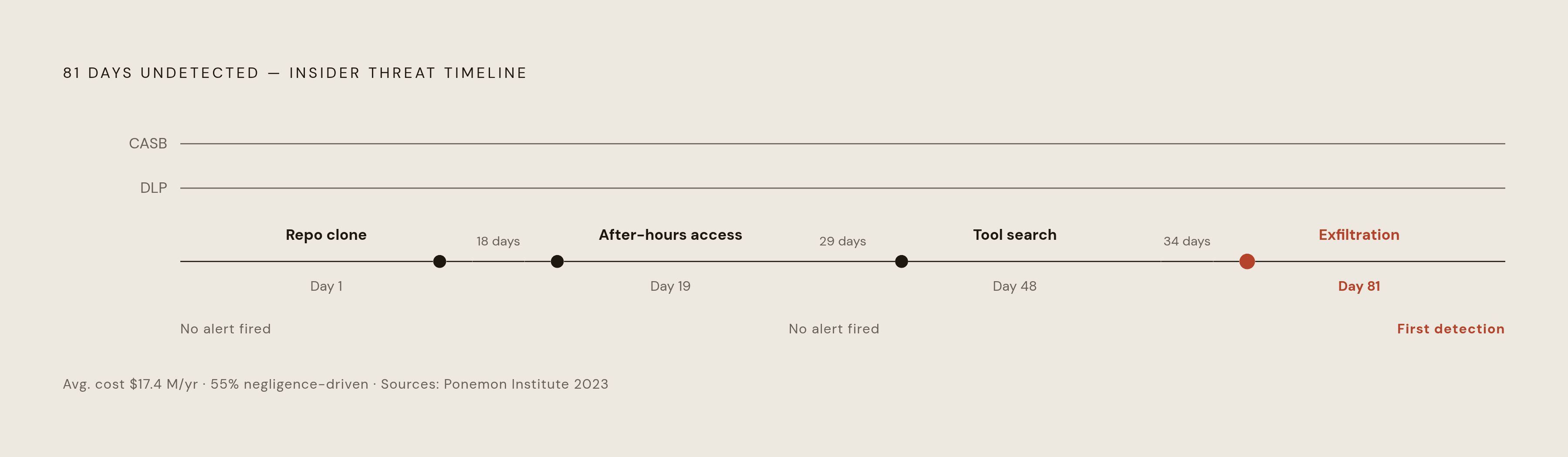
Insider threat is the clearest stress test for this limitation. Insider incidents cost organizations an average of $17.4 million annually, according to the Ponemon Institute Cost of Insider Risks report, and take an average of 81 days to detect and contain. Those two numbers describe, in blunt terms, how thoroughly both tools miss the behavioral arc of an insider case as it unfolds over weeks. And 55% of incidents stem from negligence rather than malice, which matters because neither CASB nor DLP can tell a careless employee from a malicious one without some baseline of what normal looks like for that specific person.
That's likely why 62% of organizations now favor behavior-based tools for insider threat detection, per separate Ponemon Institute research: a shift away from static rule-based monitoring that amounts to an admission of what CASB and DLP alone cannot answer. Behavioral analytics adds what neither tool provides on its own: a baseline of normal activity built per user rather than per policy rule, and correlation across endpoint, cloud session, identity provider, and HR system, each of which CASB and DLP see only in fragments. It separates a legitimate file share from staged exfiltration based on the sequence of actions rather than any single action in isolation, and it cuts false positives sharply in the process. Legacy rule-based systems run false-positive rates in the 80 to 90% range, while AI-native approaches that make the call directly, rather than ranking a rule engine's output, bring that closer to 5%.
Hold the compromised remote worker in mind as the archetype: quietly pulling data out while performing what looks, day to day, like ordinary work. No single CASB or DLP trigger fires. The signal exists only in the pattern: mismatched geolocation, after-hours repository cloning, remote access tool usage stacking up over weeks. That's a behavioral signature, not a transaction, and no transaction-level tool was ever going to catch it.
How to map CASB and DLP coverage against real exfiltration patterns
The practical test is straightforward: take known exfiltration archetypes and run them against the current stack, asking which tool would have caught it, and at what point in the timeline.
Start with the IP theft insider. In documented cases, insiders have exfiltrated sensitive files over extended periods before detection. The question for a CASB/DLP stack isn't whether the final upload would have tripped something. It's whether the cumulative pattern of access and staging that preceded it would have triggered anything at all, and in most stacks, the honest answer is no.
Now consider the compromised credential case. Consider the compromised credential case, where attackers access a sanctioned cloud platform using stolen but valid credentials rather than a technical exploit. CASB should be the primary control here, since it's fundamentally an access problem. But credential-based access to a sanctioned platform routinely passes CASB's checks without incident, because the credentials are, on paper, legitimate. That pushes the real backstop onto content-level DLP and behavioral anomaly detection, tools that were only ever a secondary layer in this scenario.
Consider, too, ransomware with exfiltration built in. Data exfiltration now accompanies the overwhelming majority of ransomware attacks, with average exfiltration volumes running into the hundreds of gigabytes per victim and That reality exposes how much of the outcome rides on detection speed, not on how broad the policy coverage looks on paper.
The exercise itself is simple to describe, harder to run honestly. For each archetype, name which control plane, access-and-session versus content-and-endpoint, sees it first. Name the handoff: does a CASB alert actually feed the DLP policy engine, or do the two run in separate queues nobody correlates? Name what behavioral context would separate the malicious version from an ordinary false positive, then check, without flattering the current stack, whether it can produce that context at all.
Sector data shows how uneven coverage stays even among well-funded teams. Banking and financial services held 27.54% of DLP market revenue in 2025, facing the highest stakes and typically running both tools, and still reporting the same coverage gaps described throughout this piece. Healthcare is the fastest-growing DLP segment, at a 24.51% compound annual growth rate through 2031, often without the CASB maturity to match.
Building a stack where CASB and DLP reinforce rather than duplicate each other
The goal is making each tool's output legible to the other, and to the analyst reading both, while avoiding the trap of collapsing CASB and DLP into a single product that just hides the same seam under one login screen.
Start with a shared data model, not a shared alert feed. CASB and DLP need to run against the same user identity graph, so a session CASB flags and a content violation DLP flags tie to the same person and the same timeline, instead of sitting as two disconnected events that happen to share a timestamp.
Assign each tool to the plane it's actually strong at, then close the space between them on purpose. CASB owns cloud access governance. DLP owns content classification and policy enforcement. The space between, the behavioral pattern running across a user's full timeline, needs a third layer, because neither tool was built to provide that on its own.
Test for the seam, not the tools individually. The most dangerous failure sits at the boundary between the two systems: a stack that scores well on every individual benchmark can still miss a coordinated insider case that moves across both planes without ever fully tripping either one. As of a July 2024 Forrester "State of Data Security" report, only 13% of enterprises had fully deployed data security capabilities in the cloud, against 83% using endpoint DLP. Most stacks are endpoint-heavy and cloud-light, far from where data actually moves today.
A behavioral layer built to close that seam needs to pull in signals from CASB and DLP alongside identity, endpoint, and HR sources, and build an actual timeline of user activity across all of them, rather than relying on a rule that fires once and stops. It should surface cases with context already assembled, so the analyst is deciding rather than starting triage from zero. It should run on infrastructure isolated to the tenant, so behavioral data about employees never leaves the environment it came from. And it should deploy in days, not months, because a gap that takes a quarter to close is a gap that stays open through an entire budget cycle.
CASB and DLP both cover real ground, and neither is optional. The mistake enterprises keep making is treating the pair as a finished solution rather than two pieces of a larger detection architecture, one still missing the behavioral layer that actually ties them together.