Data Retention and Deletion Requirements for Behavioral Monitoring Logs
Balancing security investigations against privacy law's demand to delete data promptly.
Behavioral monitoring logs record something that no firewall ever will: a specific person's departure from their own established pattern. A firewall log notes that a connection happened. A behavioral log notes that a particular employee logged in at 2 a.m., a week before resigning, and that this timing broke sharply from everything the system had learned about how that person normally works, and that same detail is what makes the log valuable to an investigator and a target for a data protection regulator.
Behavioral DLP tools exist to study how people interact with data over time, tracking context and pattern rather than scanning content for keywords or classifications. A packet capture tells you what crossed the wire. A behavioral log tells you who touched what, when, from where, and how that compares to weeks or months of their own prior activity, which puts far more personal detail into a single record than a network event ever carries.
That richness has a structural cost. Behavioral baselines only work with longitudinal history: separating the analyst who runs the same sensitive report every Tuesday morning from the departing employee who starts downloading files at midnight depends entirely on having enough historical record to know what "normal Tuesday" looks like for that one person. Cutting the history short leaves the system with no established pattern to compare against, so it can't tell the two apart.
None of this sits comfortably next to privacy law. Regulators have made clear, through enforcement rather than guidance, that holding personal behavioral data longer than its purpose justifies is itself a violation, independent of whether any breach occurred. Most enterprises have not built a framework that resolves this. They have accumulated behavioral telemetry for years without a clear answer to how long any of it should live, and that gap is what the rest of this piece works through.
How over-retention and under-retention each create distinct, real harms
There is no safe default here. Keeping everything forever and deleting on a short clock both produce documented damage, in different directions, and neither failure is hypothetical.
Start with over-retention. Behavioral monitoring data ranks among the most sensitive categories an organization can hold: years of activity trails, screenshots, and file-access histories tied to named individuals. A breach exposing that archive carries reputational and legal weight far beyond a leak of ordinary timesheet records, because what's exposed isn't just data, it's a detailed record of how specific people behave.
GDPR's storage limitation principle, Article 5(1)(e), turns simple inertia into a compliance failure. Telling a supervisory authority "we haven't gotten around to deleting it" carries no legal weight, and the retention schedule tends to be among the first documents an inspector asks to see. Data piles up automatically, but deletion needs someone to decide on a policy, write a schedule, and build a system that actually enforces it. Most enterprises have the first two pieces in place and lack the third.
France's CNIL fined Free Mobile €27 million in early 2026 over retention failures, and a Polish bank, ING Bank Śląski, was fined in 2025 for processing data past the point its stated purpose justified. Neither case involved a stolen record or an intrusion. The violation, in both instances, was time itself: data held longer than the law allowed. Retention obligations don't stop at the enterprise's own servers, either. Vendors processing behavioral data on a company's behalf are supposed to delete it once their contracted retention period ends, and the enterprise remains on the hook for making sure that actually happens, a gap that most retention policies never even address.
Now flip to the other failure. Under-retention destroys the evidence an investigation needs, right when that evidence matters most.
The case against Sohaib Akhter, convicted May 7, 2026, shows what retained, tamper-resistant logs make possible. Akhter and his twin brother Muneeb deleted roughly 96 government databases within hours of being fired in February 2025. Prosecutors built their case on logs that survived that deletion event. Without those surviving records, the act could not have been traced back to either brother or proven in court at all.
Healthcare organizations face a version of this problem built into the infrastructure they use by default. Consider an organization that keeps only a short window of AWS CloudTrail data, while the attack under investigation began months before anyone noticed. HIPAA's Security Rule called for six years of documentation in that scenario, but the cloud platform's own default settings had already erased the evidence long before the investigation started. The forensic trail didn't get stolen.
What the major compliance frameworks require for log retention
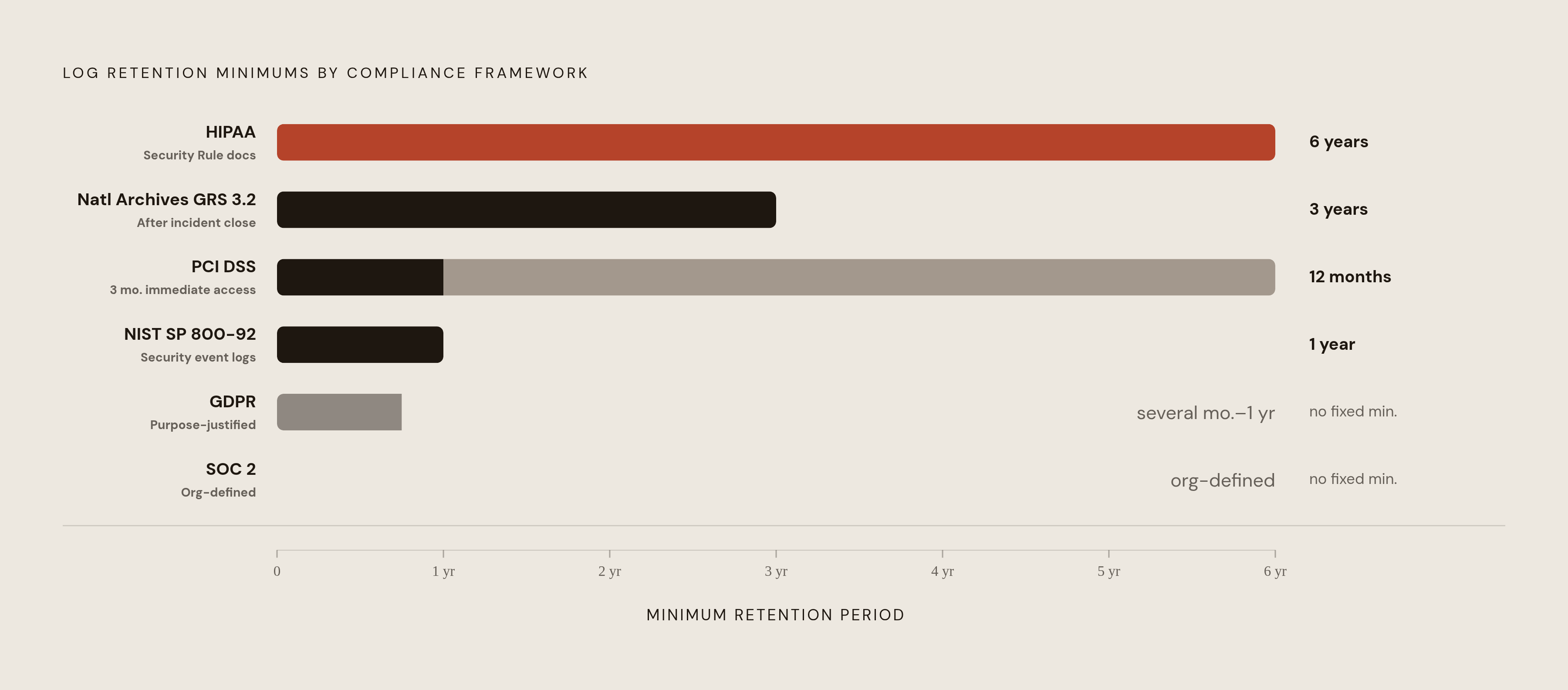
No single number satisfies every regulation an enterprise operates under, and that's the practical starting problem. Each framework sets its own floor, on its own logic, and the gaps between them are where most retention policies quietly fail.
PCI DSS asks for twelve months of total retention, with the most recent three months available for immediate, active analysis. HIPAA requires six years for policies, risk analyses, and related Security Rule documentation, and logs showing access to protected health information may need comparable retention depending on the state. NIST SP 800-92 sets a floor of one year for security event logs, with longer retention expected for anything tied to a significant incident investigation. The National Archives' General Records Schedule 3.2 calls for three years on incident handling records, counted from the point all follow-up actions are closed out.
GDPR sets no fixed number, breaking from this pattern. Instead, organizations have to define, document, and justify a retention period against an active lawful purpose, with the storage limitation principle turning any retention beyond that purpose into a violation on its own. Authentication and security logs have no prescribed GDPR retention period, and organizations must justify any retention against a documented purpose, with CNIL recommending a baseline of several months to around a year for traceability logs, longer retention common in practice where risk or legal obligations justify it, and application logs typically held for a shorter period, an industry practice informed by CNIL guidance rather than a GDPR-prescribed duration, within the range regulators like CNIL treat as reasonable.
SOC 2 takes a similar approach to GDPR's flexibility. The AICPA's Trust Services Criteria set no fixed retention duration, but they do require organizations to define their own timelines, apply them the same way across every system, and document any exception. Auditors show up expecting evidence collected across the actual observation period.
The EU AI Act adds a wrinkle for anyone who planned around the original date. High-risk logging obligations originally carried a short retention floor due in August 2026. The Digital Omnibus on AI, in force since July 27, 2026, pushed those obligations back, to December 2027 for standalone systems and August 2028 for systems embedded in other products. Anyone who built a compliance timeline around the original date now has an extra runway, but the underlying obligation hasn't gone away.
Preservation and retention are not the same activity, a distinction the frameworks rarely spell out explicitly. Preserved logs have to stay unaltered for evidentiary purposes, and routine retention and destruction schedules need to pause entirely once litigation becomes reasonably foreseeable. A schedule built only around compliance minimums will happily delete the one log a litigation hold needed kept.
GDPR's storage limitation principle and behavioral monitoring data
GDPR's storage limitation principle does more than cap how long data can sit on a server. It ties every day of retention to an active, documented purpose, and behavioral monitoring data runs into that requirement harder than almost any other category an enterprise generates, because its purpose is genuinely difficult to pin down and easy to drift past.
Three questions have to get answered, continuously, for every behavioral log an organization keeps.
The first is what the purpose actually is. Personal data can only be retained as long as the reason it was collected stays live. Holding onto behavioral analytics data because it might feed a model that hasn't been built yet gives no lawful basis for retention. Holding it to investigate one specific, named security incident does, but only for as long as that investigation stays open.
The second is whether the data is still necessary, not whether it might someday be useful. Security teams need to be able to state, in concrete terms, why a log sitting deep into its retention window is still doing work toward the original purpose. Assuming it might come in handy later doesn't meet that bar.
The third question turns on identifiability. Data that's been genuinely, irreversibly anonymized falls outside GDPR's scope altogether and can sit indefinitely. Pseudonymized data doesn't get that exemption: if a separately held key can re-link the record to a person, it remains personal data, fully subject to retention limits, and the bar for what counts as real anonymization (as opposed to pseudonymization dressed up as anonymization) is high and needs to be documented, not just asserted.
The lawful basis an organization picks determines how firm that endpoint is. Legitimate interest, the basis most employee monitoring programs rely on, comes with a proportionality test attached: the monitoring has to be necessary for the stated security purpose, and the retention period has to match that purpose rather than stretch indefinitely on the argument that some future threat might justify it later. Legal obligation, by contrast, gives a much cleaner answer, because an external law sets the number directly. Where a framework mandates six years, that mandate overrides a deletion request outright. Where no external mandate exists, the organization is the one that has to define and defend its own period, with nothing external to hide behind.
Article 30 turns all of this into a paper trail regulators can demand to see. It requires organizations to keep records of processing activities, covering the purposes of processing, the categories of personal data involved, who receives it, and the retention period attached to each activity. The retention schedule itself functions as a compliance artifact that has to exist and be producible on request. An auditor doesn't want a document describing good intentions. They want operational evidence that the schedule is actually enforced.
One practical move reduces exposure without gutting a log's value: never write raw personal identifiers into a log that doesn't need them. Hashing, masking, or tokenizing identifiers at the point of log creation shrinks the privacy surface immediately, while leaving the investigative substance of the log intact.
Behavioral analytics tools and their retention windows
The value of a behavioral log rises with how much history sits behind it, and most platforms ship with retention settings far too short to support the investigations they're built to enable.
Behavioral DLP works by analyzing patterns across a user's timeline, not by flagging isolated events. A single download or a single late-night login rarely means anything on its own. The risk sits in the pattern, and a pattern that started building six months ago cannot be reconstructed from a 90-day retention window, because the earlier data simply isn't there anymore.
This is precisely the mechanism that lets behavioral analytics tell apart the data analyst running a routine Tuesday-morning report from the departing employee downloading files at midnight right after handing in a resignation letter. The system flags the second case and lets the first pass without friction, but only because it has enough history to know what that first employee's normal Tuesday actually looks like. Shrinking the retention window removes that baseline and the system's ability to tell the two apart.
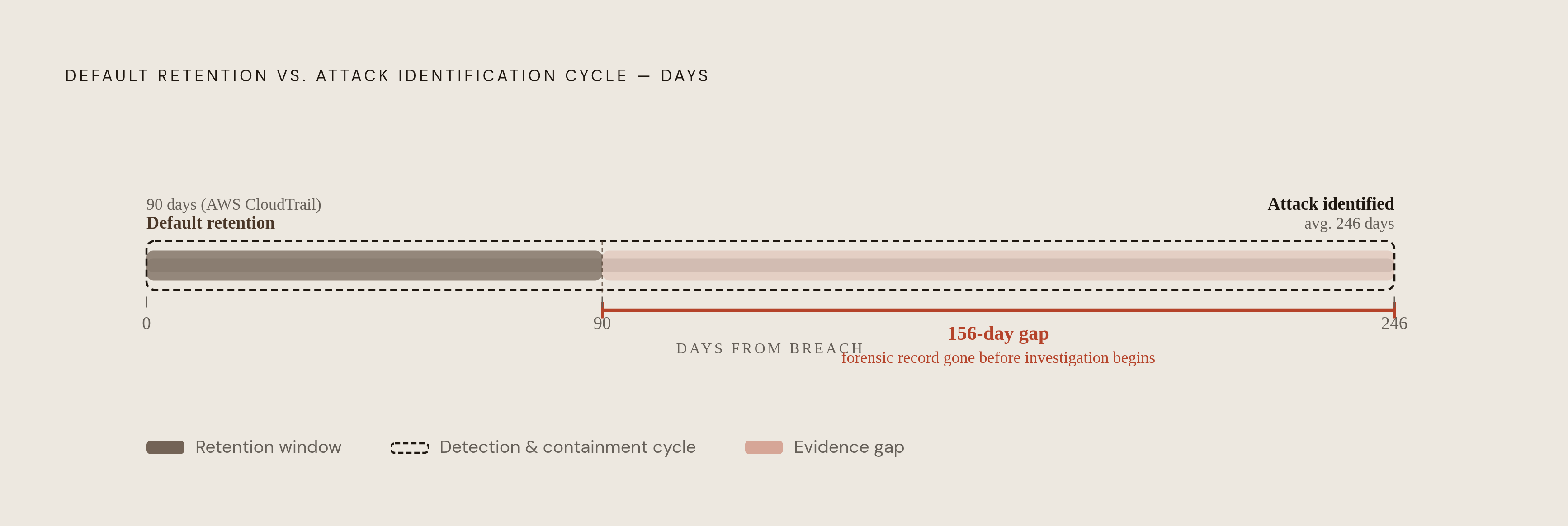
Credential-based insider attacks make the stakes concrete. Because attackers using valid, stolen credentials look like legitimate users on the surface, these attacks take among the longest of any category to identify and contain, averaging 246 days according to Splunk's research on user-entity behavior analytics. A retention window shorter than that 246-day cycle means the forensic record is gone before anyone even realizes an investigation is needed.
Cloud platform defaults make this worse in practice, not better. Default retention settings across most major platforms fall short of every compliance framework discussed above, and treating a default setting as adequate coverage amounts to accepting under-retention across the entire environment without ever making that decision on purpose. A 90-day CloudTrail default running up against an attack that started four months earlier leaves the forensic trail already gone at the exact moment the investigation needs it.
A real objection deserves a real answer: longer retention means more data, more alerts, and more analyst hours spent triaging events that turn out to be nothing. For a SOC already drowning in signal-to-noise problems, stretching retention further sounds like it makes an existing problem worse.
The constraint isn't the volume of data sitting in storage, but the absence of automated triage standing between that data and a human analyst's queue. Top 2026 security investment priorities include AI and ML-driven capabilities and automating threat triage and investigation, because human throughput, not log volume, is the binding constraint. Extending retention without addressing that triage gap does create more noise. Extending retention while fixing the triage gap gives investigators the history they need, without asking analysts to read through more of it by hand.