Integration Complexity When Connecting Insider Risk Platforms to Enterprise Identity Stacks
Identity data fragmentation and latency make insider risk scoring unreliable.

What the enterprise identity stack looks like in 2026
Connecting an insider risk platform to an enterprise identity stack is not the integration project most buyers think they're signing up for. The premise sounds simple: point the platform at the identity provider, pull user context, correlate it against behavior, mark the integration complete. What actually happens is that the platform inherits a partial, stale, and structurally ambiguous picture of who a user is, what they're authorized to do, and how that authorization has shifted over time. A Cybersecurity Insiders survey found that 59% of organizations expect the integration of identity and behavioral data to matter more to insider risk management over the next two years than AI analytics (54%) or platform consolidation (43%). That number says the problem is widely felt. It does not say anyone has solved it. What follows is about the specific friction points, in data freshness, identity fragmentation, privilege modeling, and signal timing, that decide whether an integration that looks finished on a slide actually produces a risk score anyone can act on.
Calling it "the identity stack" gives it more coherence than it earns. A pile of mismatched furniture is a stack too: each piece was bought separately, for a separate reason, and none of them were built to sit on top of each other. Credentialgovernance.avatier.com maps enterprise IAM architecture in 2026 across seven layers: authentication (MFA), authorization (least privilege and just-in-time access), lifecycle (HRIS-driven provisioning and deprovisioning), governance (identity governance and administration, or IGA), posture (identity security posture management, or ISPM), detection (identity threat detection and response, or ITDR), and cloud entitlement (CIEM). Each layer defends against a different attack pattern, and the same source lists five patterns the stack has to cover as a whole: credential compromise, entitlement accumulation, shadow access surface, insider misuse, and privileged session abuse. No single layer covers all five. That split isn't an oversight. Each product category came from a different vendor solving a narrower problem, and nobody built the seams.
For an insider risk platform trying to plug in, the easiest integration to build, pulling authentication logs from an identity provider, gives visibility into one of seven layers. It says nothing about entitlement accumulation, nothing about shadow access, nothing about governance state. And the underlying problem is not small. Dark Reading's identity security predictions put the average mid-sized enterprise (500 to 19,000 employees) at 1,062 applications needing IGA coverage. Each of those applications is a potential source of identity signal the insider risk platform is very likely not receiving. Calling an insider risk platform "integrated with identity" usually means it's talking to one or two layers of a seven-layer stack, and the gaps between those layers are exactly where the context that matters goes missing.
Identity fragmentation and the structurally incomplete picture of the user
Nobody configured this wrong. The layers don't talk to each other because nobody built them to.
Living Security's analysis notes that network security tools, identity management systems, and endpoint protection agents each collect useful information, but they rarely talk to each other, so the resulting fragmented view makes it nearly impossible to connect the dots on a complex insider threat. The org chart around these tools makes it worse, not better. Identity-related threats now span multiple domains: IT administrators see the identity systems but lack threat context, while SOC analysts understand threat hunting but rarely know IAM and governance structures well. The people best positioned to read the identity data are not the people reading the behavioral alerts.
What that split does to a user profile is the real damage. A platform might know who authenticated, from IdP logs, without knowing what that user is actually entitled to access, since that requires IGA data it never received. It might know which files got touched, from endpoint or DLP telemetry, without knowing whether that access fell inside the user's authorized scope, since that requires reconciling IGA against CIEM. It might read a user's current role off the HRIS feed without knowing that a role change two weeks ago should have already pulled access to a sensitive repository, since that requires lifecycle data that never arrived either.
Each missing layer fails in two directions, and the second direction is the dangerous one. A user doing something unusual in a system they were just granted access to looks like anomalous behavior without IGA context; add the context back and the access was expected, the alert was noise. Run the logic in reverse: it gets worse, because a user accessing something they were entitled to but should no longer be looks completely normal without lifecycle event data attached. That's the exact shape of pre-departure exfiltration, where someone on the way out acts inside permissions that are technically still live because nobody revoked them in time.
Data freshness and the latency gap that defeats real-time risk decisions
Insider risk platforms need to score behavior close to the moment it happens. Enterprise identity systems update on batch schedules, approval workflows, and manual processes that introduce a lag measured in hours or days. That mismatch is the single most consequential friction point in the whole integration, because it doesn't just delay the data. It corrupts the decision made on top of it.
Offboarding is the obvious one and is where the gap most predictably appears: a termination event can land in the HRIS system well before it propagates to every downstream application, so a user's access stays live in some systems after separatio... Offboarding is the obvious one: a termination event can land in the HRIS system well before it propagates to every downstream application, so a user's access stays live in some systems after separation while the insider risk platform gets no signal the person's status ever changed. Role changes cut the opposite way: a promotion or lateral move often expands access immediately through auto-provisioning, while revoking the old role's access sits in an approval queue for days. Contractor and third-party access often lives in a separate directory entirely, managed by hand, with no real-time feed into the primary identity provider. Just-in-time access grants, meant to be temporary and tightly scoped, may not even register with the platform if it's reading a static snapshot instead of a live entitlement feed.
The pre-departure window is where this latency does the most damage. Research indicates departing employees are significantly more likely to take data before resigning than at any other point in their tenure, and the resignation itself is usually what triggers the identity system to update. The highest-risk window and the least accurate entitlement snapshot arrive at the same moment. It's how identity data flows, structurally, every time.
There's a slower version of the same failure. The 2026 Cybersecurity Insiders report notes access privileges accumulate faster than anyone reviews them, and an insider risk platform inherits that backlog whether it wants to or not, scoring behavior against an entitlement picture that was already stale before the behavior happened. A platform that can't pull real-time identity lifecycle events, as opposed to authentication logs alone, will misclassify in both directions: false positives, where normal behavior gets flagged against a stale "anomalous" access profile, and false negatives, where genuinely risky behavior reads as routine because the entitlement change behind it hasn't caught up yet.
Why access context is harder to normalize than it looks
Different systems don't just hold different data about a user's access. They represent the concept of access itself in incompatible terms. Active Directory speaks in group membership and directory-based permission policies. Cloud IAM platforms across AWS, Azure, and GCP speak in role-based policies and resource-level entitlements that don't map cleanly onto AD groups. Each SaaS application runs its own permission model, Salesforce profiles, GitHub teams, Jira project roles, often with no API exposing the full entitlement picture to anything outside the application. PAM systems stack session-level controls and privileged account vaults on top of all of it, and that layer frequently doesn't turn up in a standard directory query either.
An insider risk platform sitting above this pile gets handed signals that were never built to be compared side by side. "Admin" in one system is not the same access level as "admin" in another, and no amount of dashboard polish papers over that.
Entitlement accumulation makes normalization harder over time, not easier. Users who move teams, pick up new projects, or survive a reorg keep piling up access across systems, and because each system models permissions its own way, no single query reveals the full scope of what that user can actually reach. Insider risk scoring built on "their role" is scoring against a picture that's incomplete at best and flatly wrong at worst.
Privileged access management deserves the most attention here, because the stakes are highest and the integration work is hardest. Ponemon's research found PAM integration can cut insider risk costs by an average of $6.1 million, yet getting PAM session context into a form an insider risk platform can actually use to enrich a behavioral timeline takes real integration work, and a lot of deployments skip it entirely or half-build it.
Contractors sit in their own blind spot. They often live in a separate directory, provisioned through a separate workflow, sometimes with no HRIS record for the insider risk platform to anchor an identity to. What the platform ends up tracking is an unresolved identity generating behavior against a blank risk profile, about as useless as a risk score gets.
Then there's the newest wrinkle: agentic AI. Endpoint AI agents now operate inside enterprise systems under service account identities that behave nothing like human accounts. Standard UBA behavioral baselines, built on assumptions about human work patterns, simply don't apply to a service account running around the clock. Normalizing privilege models for non-human identities is a live, unsolved problem.
Context latency in behavioral scoring: when the risk signal arrives too late to act
Catching a risk signal two days after the triggering event doesn't address insider risk. It documents it, after the fact, for the record.
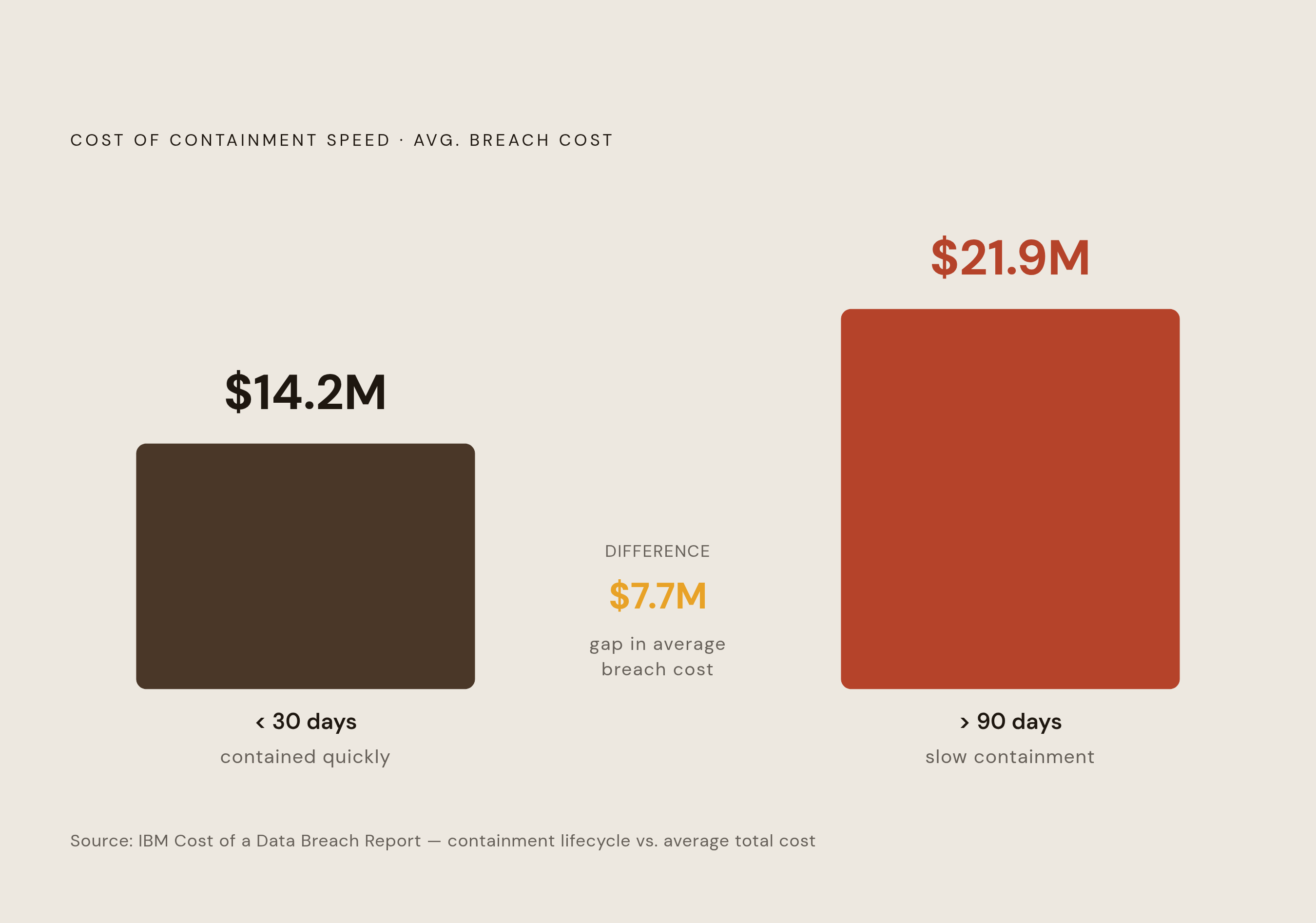
The financial stakes are concrete. Ponemon's figures show incidents contained within 30 days cost an average of $14.2 million, while incidents taking longer than 90 days cost $21.9 million, a gap of $7.7 million that tracks almost exactly with how fast a platform can move from raw identity signal to an alert someone can act on.
Two failures stack on top of each other here, not one. A behavioral event fires, say a large file download at 11 PM. The platform queries identity context to score it, but that identity data is a batch snapshot pulled the previous night, and the snapshot shows the user as a standard contributor. In reality, that user got elevated access to a sensitive repository three hours earlier, and the snapshot has no idea. From there the platform has two moves, and both are wrong. It scores the download as low-risk, missing the entitlement change entirely, or it flags the download as anomalous because the access looks out of pattern against stale data, throwing a false positive. Neither one produces a correct, actionable score inside the window where anyone could actually step in.
Tool sprawl doesn't fix this. It arguably makes the symptom look worse before it looks better. The 2026 Cybersecurity Insiders survey found a third of organizations run five or more insider risk tools, yet two-thirds still name detection accuracy as their top challenge. Stacking tools on top of a fragmented identity picture produces more alert volume, not more clarity.
Behavioral baselining carries a subtler failure inside it: a platform that flags anomalies against a statistical baseline cannot, by definition, catch risk that falls inside that baseline. A user who's always had broad access, and still does, can walk out with data without tripping a single anomaly, because the baseline was built on the assumption that broad access is just how this person behaves. The lack of context about why that access still exists or whether it should never appears anywhere the risk could be caught. Cybersecurity Insiders reports only 23% of organizations feel strong confidence in their ability to catch insider threats before serious damage occurs, and that number is what happens when every friction point described above lands on the same platform at once.
What a working integration requires, and where most implementations fall short
A minimum viable identity integration for an insider risk platform is not one API connection to one identity provider. It's a live, normalized feed pulled from multiple layers of the IAM stack, built so the platform can enrich a behavioral event with accurate context at the moment the event happens.
That takes a few things working together, not just one. Lifecycle events, terminations, role changes, access grants, access revocations, need to arrive as real-time events instead of nightly directory syncs. Entitlement data needs a normalization layer that translates AD groups, cloud IAM roles, and SaaS application profiles into one unified access context the platform can actually score against. PAM session activity needs to surface into the insider risk platform directly instead of staying locked inside the PAM tool, because otherwise the highest-risk access tier in the whole organization is the one with the least behavioral visibility attached to it. Non-human identities, service accounts, AI agents, contractor accounts, need defined handling logic: a behavioral model suited to how they actually operate, or an explicit, documented exclusion, not silence. And the signal needs to flow both ways. A risk score that only moves from the identity system into the platform gives detection. A risk score that can flow back, triggering an access review or a step-up authentication challenge, gives something closer to prevention.
Most deployments never get there, and the shortfall follows a pattern common enough to call typical. Authentication log ingestion from the primary identity provider covers login events but says nothing about entitlement state. An HRIS feed covers department, manager, and employment status but not the scope of what that role can actually reach. No lifecycle event streaming means role changes and offboarding updates appear in the behavioral timeline hours or days late. No PAM integration leaves privileged session context entirely off the behavioral timeline. No normalization layer means cloud IAM entitlements, SaaS permissions, and contractor identities sit unresolved indefinitely, and nobody ever circles back to fix it.
Part of that shortfall traces to how expensive the underlying identity work is. Dark Reading notes that onboarding applications into IGA has historically been slow and costly, often requiring outside consultants and custom connectors built one application at a time. The same friction that slows IGA adoption caps how much of the entitlement picture ever reaches the insider risk platform.
UBA integration shows the ceiling clearly. Ponemon ties UBA integration to an average cost reduction of $5.1 million, a strong case for adoption on paper. But UBA is only as accurate as the identity context it scores against, and UBA running without live entitlement data is pattern-matching with no ground truth to check itself against: a detector with no map of what normal is even supposed to look like.
Vendors routinely sell these integrations as available without disclosing the engineering effort, data model normalization, or ongoing maintenance required to make them work for real risk scoring. Buyers should demand proof against their own identity stack.
Platform architecture and whether identity integration scales or degrades over time
An integration that works on day one doesn't necessarily keep working. An identity stack isn't static: applications get added, IGA coverage expands or contracts, contractors rotate in and out, and cloud entitlements shift on a schedule engineering teams set, not security teams. A platform architecture built around point-to-point connections to specific identity systems accumulates the same kind of debt as the entitlement sprawl described earlier. Every new application onboarded into IGA, every new cloud account added to CIEM, becomes another connector to build and maintain, and the maintenance cost compounds the same way unreviewed access privileges compound.
The architectures that hold up under that pressure treat a normalization layer as a first-class component, not something bolted onto an existing behavioral engine after the fact. A platform built to treat identity context as a live, evolving feed, rather than a one-time enrichment pulled at setup, can absorb a new SaaS application or a new PAM vault without triggering a fresh integration project every time. That decision gets made well before an organization ever asks whether the integration is producing accurate risk scores. By the time detection accuracy visibly suffers, the answer usually traces back to a choice made at the design stage: identity was treated either as infrastructure the platform depends on continuously, or as a box checked once during procurement and never opened again.