Realistic DLP Deployment Timelines at Fortune 500 Scale
Realistic timelines demand 18-24 months, not the three-to-six-month fantasy vendors pitch.

Fortune 500 companies routinely get sold a DLP rollout timeline of three to six months. That number describes almost nothing about what actually happens when a company with a large workforce, forty business units, and three decades of accumulated file shares tries to find, classify, and protect its sensitive data. The real obstacle is structural: how much data there is to find, how many stakeholders have to agree on what "sensitive" even means, how deep the integration work runs, and how long it takes people to change how they work. Each problem compounds the next, and the honest version of that chain is what separates a working DLP program from a monitor-only purgatory that never actually blocks anything. Most vendors who sell the three-to-six-month number know it applies to a single business unit at best, and they sell it anyway.
IBM's Cost of a Data Breach Report puts the average breach in the US at $10.22 million, a record. A DLP program stuck watching without acting doesn't stop that number from climbing, and pretending a monitor-only deployment counts as protection is the single most expensive mistake in this whole process. What follows is a phase-by-phase account of why the standard timeline collapses at enterprise scale, and what a realistic one looks like instead.
What the data discovery phase takes at enterprise scale
Nothing about policy, enforcement, or integration matters until someone answers a basic question: what data needs protecting, and where does it live? At a company with decades of legacy systems, acquired subsidiaries, and file shares nobody has cleaned up in years, that question doesn't have a fast answer. Any timeline that assumes otherwise is wrong from the start, full stop.
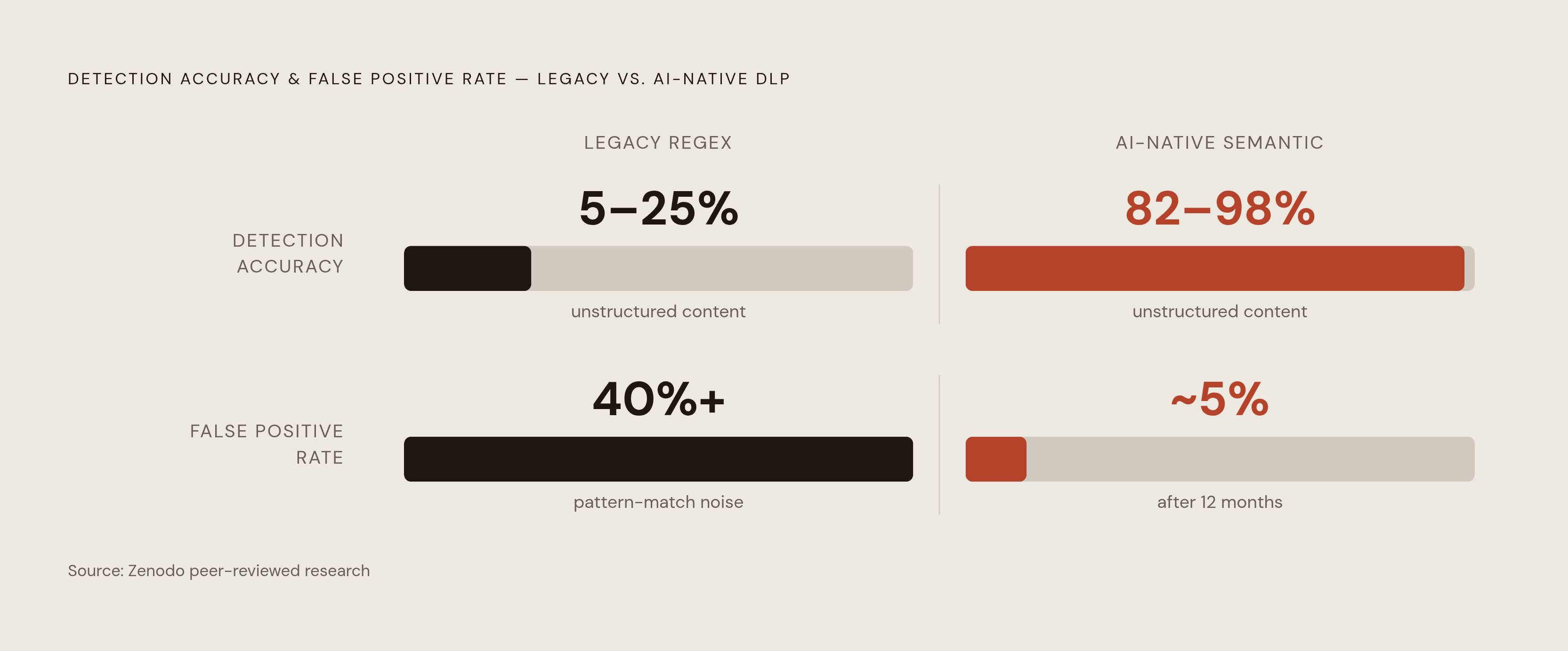
Unstructured data is where discovery breaks down hardest, and it's not close. Peer-reviewed research published on Zenodo found that legacy DLP classification systems hit only 5% to 25% accuracy on unstructured content. Most of what a legacy tool tells you about a Word document or a PDF sitting on a file share is closer to a guess than a finding. The data that matters most, the actual crown-jewel intellectual property a company depends on, usually has no label at all. Its sensitivity comes from business context that a regex pattern was never built to read.
Discovery also runs into an organizational wall. Legal, finance, engineering, and HR each define "sensitive" differently, and none of those definitions map cleanly onto a shared taxonomy someone can hand to a DLP engine. Then there's the cloud gap: Forrester's "The State of Data Security" report found that 83% of enterprises have endpoint DLP deployed, but only 13% have fully deployed data security capabilities in the cloud. A Fortune 500 company starting cloud DLP for the first time is building a second program from scratch, in parallel, which roughly doubles the discovery scope.
Discovery and policy design can't run side by side in any real sense, whatever the project plan says. Every time a new data type or storage location turns up mid-cycle, it forces the team back to scoping decisions it thought were already closed.
Policy design across business units, where timelines quietly collapse
A Fortune 500 company is dozens of business units, each with its own workflows, risk appetite, regulatory obligations, and idea of what normal looks like on a given Tuesday. Getting them to agree on a DLP policy is closer to treaty negotiation than to configuration. Treating it as a configuration task is exactly where most timelines go wrong, and it's the most common mistake on this list.
Engineering wants source code protections that legal has no framework for evaluating. Finance operates under SOX and PCI obligations that marketing has never had to think about. HR data carries its own legal protections that sit entirely outside standard DLP categories. Writing static rules against specific keywords, patterns, or file types requires someone to list everything that matters in advance, and at this scale, that list is never finished. It goes stale the moment the business changes, which is constantly.
Compliance template libraries take some of the edge off but don't touch the underlying problem. Vendor platforms launched in 2025 have shipped with large libraries of pre-defined classifiers spanning scores of regions, which says something about how much regulatory surface a global enterprise has to account for. Those templates cover regulatory minimums, nothing more. They say nothing about the unlabeled IP that has no regulation attached to it at all, and that's usually the data an enterprise cares most about losing.
There's a newer wrinkle no policy library was built for. Microsoft's Cyber Pulse report found that 80% of Fortune 500 companies now run active AI agents, and 29% of employees have already turned to unsanctioned AI tools for work. That's a policy surface most existing DLP deployments were never designed to see, let alone govern. Policy design has no fixed end date. It's iterative and political, and treating it like a one-time deliverable is where the biggest schedule overruns come from.
Integration debt: what connecting DLP to the existing stack costs
Most legacy DLP tools were built to run on their own, without native ties into SIEM, UEBA, or automated threat platforms. Every alert has to be manually cross-checked against other systems before anyone can tell if it matters, and that turns a five-minute triage into a half-hour hunt.
The integration scope at Fortune 500 scale is wide: endpoints across Windows and macOS, managed and unmanaged devices, cloud storage and dozens of sanctioned SaaS tools per business unit, email and collaboration platforms, and now AI tools like enterprise LLMs and coding assistants. Add identity providers, HR systems, and access management platforms, since those supply the user context a DLP decision actually depends on. Skip that context and an alert tells a security analyst almost nothing.
The pace of change here is brutal. Palo Alto only added support for GitHub Copilot and its Business and Chat variants to its Enterprise DLP product in August 2024, which shows how fast new exfiltration paths open up and how far behind integration work can fall. Performance overhead adds its own friction: agent-based endpoint tools that eat too much CPU or memory generate pushback from IT and end users alike, and modern Windows DLP solutions are evaluated against a memory footprint threshold under 200 MB.
Some deployment approaches shorten this phase meaningfully, and this is where the smart money goes. Agentless, API-first architectures can surface sensitive data exposure before a legacy agent-based tool has even finished installing across the fleet. Platforms built to work with what's already in place, instead of ripping it out and replacing it, cut integration time by using controls that already exist rather than fighting them.
The monitor-only phase nobody budgets for
Almost every Fortune 500 DLP deployment sits in monitor-only mode for months after the technical rollout finishes, because nobody wants to be the person who turned on enforcement and blocked a VP from closing a deal. That fear is not irrational. But treating it as a permanent excuse instead of a phase with an end date is how a company ends up with a DLP program that watches everything and stops nothing.
The Zenodo research found legacy DLP systems generate false positive rates above 40% on complex data types. A well-tuned enterprise DLP program should sit below 5%. The distance between those two numbers is the entire job of the monitor-only phase, and it's a bigger job than most timelines admit.
Monitor-only mode also has an operational hole in it. A violation firing at 2 a.m. often has nobody watching to investigate, verify, or contain it. The system produces data. It doesn't produce a response, and those are not the same thing no matter how the dashboard looks. Layer that onto the fact that security teams already field thousands of alerts a day, with a large share going unaddressed, and an undertested DLP policy on top just speeds up analyst burnout instead of cutting risk.
Vendor deployment guides rarely name this phase directly: the space between "deployed" and "protecting," where most of the real time goes. Behavioral baselining by user, role, and business unit. Exception handling for the legitimate workflows that move sensitive data around every day. Sign-off from each business unit before enforcement flips on. Organizations that budget three months for deployment and assume enforcement follows automatically often find themselves still watching, not blocking, a year later.
Change management and user behavior: the variable that technical planning ignores
Ponemon's research found that 55% of insider incidents come from negligence. Fortinet's Insider Risk Report found only 26% of organizations feel fully prepared to handle accidental data leaks, even though negligent insiders account for the majority of insider incidents. Technical planning treats users as a fixed variable, something to configure around rather than negotiate with. That's backwards, and it's where most enforcement rollouts stall.
Change management at this scale means running training across dozens of business units with wildly different risk profiles and technical comfort levels. It means telling people what DLP watches, what sets off an alert, and why, because skipping that step turns enforcement into a source of confusion and quiet resistance. And it means coaching people in real time at the moment of a potential violation, rather than just silently blocking and logging, since that's what makes employees see a tool as a security partner rather than surveillance.
Shadow AI is where change management is failing right now, and it's not close to fixed at most companies. The 29% of employees turning to unsanctioned AI tools, per Microsoft's Cyber Pulse report, mostly aren't trying to create risk. They're using tools that are faster or more capable than whatever's been sanctioned. Roll out enforcement before people understand the policy, and the result is a flood of exception requests that stalls the whole program right as the team tries to exit monitor-only mode. Behavior isn't a one-time checkbox either. New hires show up, tools change, AI agents multiply, and change management just keeps running at a lower simmer indefinitely.
The timeline for each phase when planned honestly
Phase one, data discovery and scoping, is usually the longest stretch of the entire program. It covers inventorying data types, locations, and which business unit owns what; auditing the gap between endpoint coverage (which most enterprises have) and cloud coverage (which very few have fully built out); and classifying the crown-jewel IP that has no label and no regulatory hook to hang a policy on.
Phase two is policy design and stakeholder alignment: cross-functional workshops by business unit, mapping policy to existing compliance obligations, and building AI and shadow AI governance now rather than deferring it, given that 80% of Fortune 500 companies are already running active AI agents.
Phase three covers technical integration and a controlled rollout: connecting the DLP platform to SIEM, identity, and HR systems, turning on monitor-only mode for the highest-priority data channels first, and setting a performance baseline before expanding further.
Phase four is tuning, baselining, and enforcement readiness. That means driving false positives down from that 40%-plus starting point toward something near the 5% threshold where enforcement stops being operationally reckless, building behavioral baselines by user population and role, and working through exception handling with sign-off from each business unit.
Phase five is enforcement activation and change management: a graduated rollout, coach before block before full enforcement, sequenced by data type and business unit, with training and real-time coaching infrastructure live before enforcement goes broad.
Add it up honestly, and full coverage at Fortune 500 scale is measured in years, not months. Meaningful protection in specific channels can happen much sooner, but only if someone triages the scope deliberately instead of trying to do it all at once. Any vendor who tells you otherwise is selling phase three and calling it the whole program.
AI-native detection's effect on feasibility in each phase
The classification engine that underlies a DLP program sets the ceiling for how fast the tuning phase can go, and this is where the legacy-versus-modern gap stops being theoretical. Legacy regex-based inspection runs 5% to 25% accuracy on unstructured content, with false positives above 40% on complex data, per the Zenodo research. LLM-driven semantic inspection, by contrast, reached 82% to 98% detection accuracy across content types in the same research, with false positive rates reduced by 3.5% to 5% after twelve months in production. Starting closer to that 5% threshold from day one means the monitor-only and tuning phases don't stretch nearly as long, which is the whole game.
Behavioral context also cuts against the hardest part of policy design: enumerating every case in advance. If a platform understands that a given user only touches finance files from a managed device through an approved workflow, it can flag a departure from that pattern without needing a rule that predicted every possible variant of normal access ahead of time. That's a meaningfully different starting point than writing a static rule for every case up front, and it's why the enumeration approach was always going to lose.
Gartner made the architectural gap explicit in its report "How to Overcome DLP Challenges Posed by Generative AI," stating that conventional DLP cannot effectively manage GenAI data loss risks, including exposure through encrypted traffic, intent blindness, and shadow AI. Agentless, API-first deployment models that go live in days rather than weeks compress the integration phase, and much of the schedule slippage at Fortune 500 scale happens right there. Platforms that investigate candidate events automatically, before they ever reach a human analyst, cut down the time-to-investigate problem that keeps programs stuck in monitor-only mode, without requiring more headcount to fix it.
None of this means behavioral baselines alone are enough, and any vendor pitching pure behavioral detection as the whole answer is skipping a step. Risk can exist from the first day a system goes live, stay statistically unremarkable the whole time, and still happen entirely through access that was authorized from start to finish. The strongest architectures combine content understanding, user context, and pattern detection, because leaning on any single signal by itself leaves a blind spot exactly where the real risk tends to sit.