Proof of Concept Design for Insider Threat Platform Evaluations
Test your platform against the threat archetypes you'll actually face, not the easy ones.

A proof of concept for an insider threat platform tells you almost nothing if it's designed to count alerts. The real question a POC needs to answer is whether the platform can find the handful of cases that matter inside months of ordinary-looking activity, and whether it can do that fast enough for an analyst to act before the damage is done. Most POC designs never ask that question. They connect the platform to a few data sources, run a handful of test scenarios, and tally up how many alerts came back, treating volume as a proxy for competence, which is exactly backwards: a platform that alerts on everything has learned nothing about the one user who matters. Behavioral DLP platforms like Candor, which profiles users across the enterprise stack rather than matching against static rules, are built on precisely that critique.
A large majority of surveyed cybersecurity professionals said insider attacks are equally or more challenging to detect than external ones, and only a small fraction considered their organizations extremely effective at handling them. That gap doesn't close on its own. Bad tooling, and worse, bad evaluation of that tooling, keeps it open. A POC is a controlled experiment, and its conclusions are only as valid as its design. What follows is how to design one that actually holds up, and why most of what passes for rigor in vendor evaluations right now doesn't.
What a platform actually needs to detect: the threat landscape that sets the test criteria
Insider risk isn't one behavior wearing different masks. It's several distinct archetypes, each with its own signal pattern, and a POC built around a single scenario type will pass a platform that fails everywhere else. This is the single most common design flaw in insider threat evaluations: testing the easy case and calling it done.
Start with the departing employee, because every vendor demo is built around this one. Large file downloads, cloud sync to a personal account, email forwarding that spikes in the weeks before resignation. It's a real pattern and worth testing, but it's also the easiest one to catch, since the signals cluster tightly around a known event: the resignation date. A platform that only performs well here hasn't proven much.
Privileged-access abuse looks nothing like that. Sanctioned access, used for something it was never meant for, doesn't spike. It just continues, quietly, under cover of a legitimate job function. The Brightly Software case, a Siemens subsidiary, shows what this looks like in practice: contractor Cameron Curry used his data-analyst access to steal employee PII and sent more than 60 extortion emails demanding $2.5 million. He was found guilty on March 20, 2026. Nothing about his access looked unusual on any given day, because the abuse was entirely in what he did with data he was already entitled to touch.
Sabotage by terminated employees adds a timing dimension most platforms handle badly: the deprovisioning gap. Sohaib Akhter was convicted on May 8, 2026, for charges tied to the deletion of roughly 96 government databases within hours of his February 2025 firing. A platform monitoring the full timeline should flag that window as a risk cluster the moment termination hits, not treat the deletions as an isolated event discovered days later.
Negligence is arguably the hardest archetype for legacy tooling, because there's no malicious signal to find at all. Verizon disclosed that an employee accessed a file containing sensitive data belonging to more than 63,000 individuals without authorization, with no indication of malicious intent by the company's own account. Negligent insiders account for the majority of incidents, per the 2025 Ponemon Cost of Insider Risks report, the largest single category, and it behaves nothing like theft. A platform tuned only to catch thieves will miss most of its actual caseload.
Non-employee and retained-access scenarios test something else entirely: whether the platform tracks access state changes at all. A former staff member, in May 2024, used retained system access to expose sensitive data belonging to hundreds of thousands of customers. That failure wasn't a gap in behavioral detection. It was a provisioning system that never told the monitoring platform the person shouldn't have had access in the first place, which no amount of behavioral modeling fixes.
AI-tool misuse is the newest archetype, and it's growing fast enough that leaving it out of a POC is close to malpractice. Research has found that a substantial share of data employees share with AI tools is sensitive. A platform with no visibility into AI prompt channels is missing an entire exfiltration vector, and it's missing the one growing quickest.
State-sponsored and credential-fraud scenarios, including DPRK IT worker schemes, round out the list, and they carry a specific lesson for baseline design: anomaly detection can't wait for tenure. If the behavioral model needs weeks of history before it says anything useful, it will miss the threat actor who was never a legitimate employee to begin with.
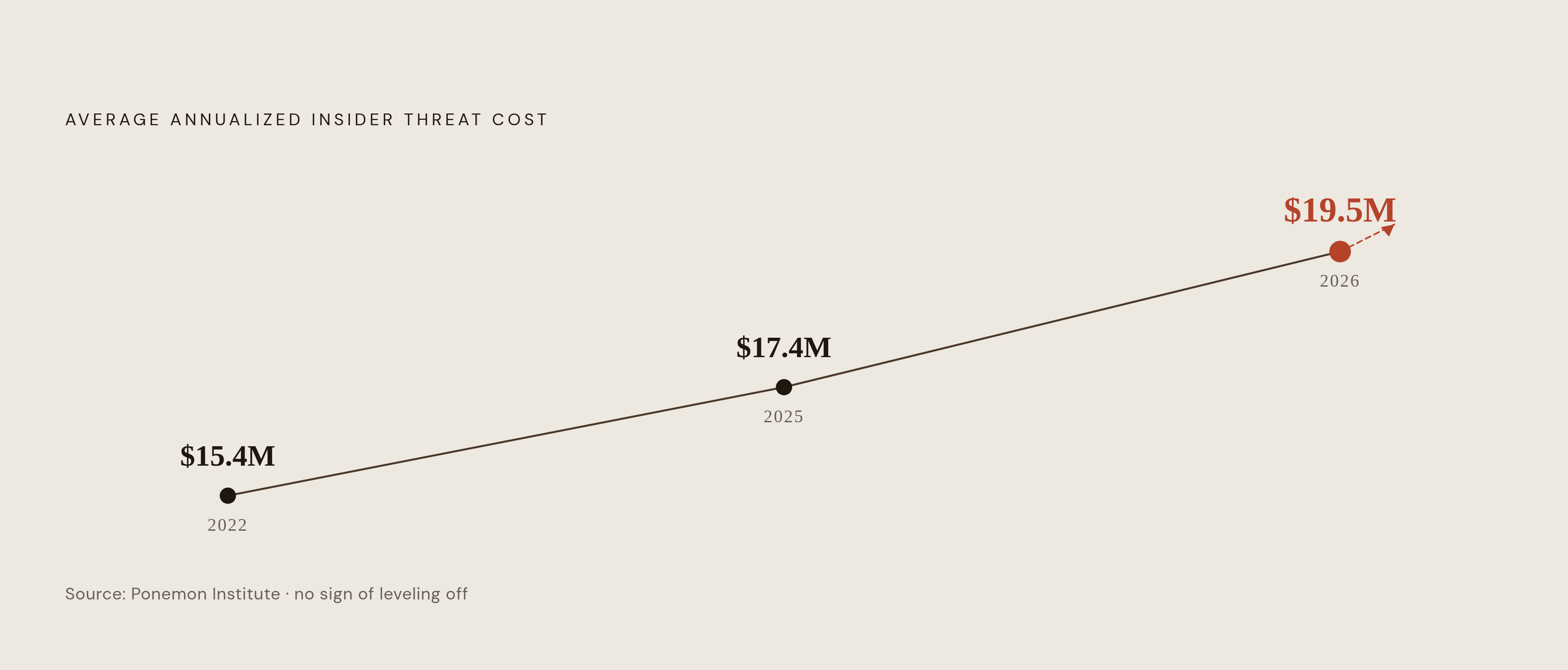
The financial stakes settle any remaining argument about whether the extra weeks of a rigorous POC are worth it. Average annualized insider threat cost was $15.4 million in 2022, $17.4 million in 2025, and $19.5 million in 2026, according to Ponemon research. That trajectory doesn't level off on its own either.
Why behavioral context, not data movement alone, is the detection primitive worth testing
Legacy DLP has one central failure: it watches what moves, not who's moving it or whether the pattern makes sense coming from that particular person. That's a design flaw, not a tuning gap, and no POC should let a vendor talk around it.
A single data movement event, in isolation, carries almost no signal. An engineer uploading a file to cloud storage on a Tuesday afternoon is routine, the kind of thing that happens hundreds of times a day across any mid-sized company. The same engineer doing the same upload at 11 p.m., the week after their manager was replaced, on a project they'd just been removed from, is a different story entirely. Nothing about the mechanics of the upload changed. Everything about the context did.
That's the distinction a behavioral baseline is built to catch, and it's the same distinction separating platforms with a longitudinal model of user activity from platforms that just match patterns against static rules. A rule can say "flag uploads over 500MB." It cannot say "flag this upload because it deviates from what this specific person normally does, at this point in their employment, given what just changed around them." The limitations are well recognized: conventional DLP cannot effectively manage GenAI data loss risks, including exposure via encrypted traffic, intent blindness, and shadow AI. That's an architectural ceiling. No amount of rule refinement fixes it, and any vendor who claims otherwise is selling a patch for a foundation problem.
Behavioral context, in practice, means four things working together, and a platform missing any one of them is working with half the picture. It needs a history of the user's activity across systems, access patterns, file movement, communication, working hours. It needs to measure deviation from that individual's own baseline, not some population average that flattens out everyone's quirks. It needs temporal clustering, catching multiple low-severity signals that add up to something worth a second look over days or weeks. And it needs role context: does this action even make sense given what this person's job actually is and what access tier they currently sit in?
A 2023 Ponemon report found that 64% of organizations worldwide consider machine learning essential for addressing insider incidents. Essential doesn't mean sufficient, though, and a POC has to be sharp enough to tell ML-powered marketing copy apart from ML-powered detection that actually works on the vendor's own product, in the vendor's own environment, under real conditions.
The POC criteria that actually reveal detection capability
Treat each of the following as a question the POC has to answer with evidence, not a box a sales engineer gets to check off during a slide deck.
Does the platform build a per-user behavioral baseline, and how fast? Measure the actual time before it can tell this user's normal apart from this user's abnormal. A platform needing weeks of manual tuning before producing a meaningful signal has already failed a large part of the test, because weeks is exactly how long a fast-moving insider threat takes to do damage and disappear. The bar to hold vendors to: differentiation within days, using telemetry that already exists, without a team of analysts hand-writing rules first.
Does the platform stitch events across sources into one coherent timeline? Feed it a scenario with several steps spread across different systems: an access change, then a file download, then a cloud upload, then a USB transfer. Does it hand the analyst one case with the full chain assembled, or four disconnected alerts the analyst has to reconstruct by hand? The second outcome is a warning sign, not a minor inconvenience, because reconstruction takes time the organization usually doesn't have.
Does it distinguish negligence from malice, and does that distinction actually change the response path? Run something genuinely ambiguous: a user forwarding a file to a personal email address on their last day of work. Does the platform score that identically to a clear exfiltration attempt, or does surrounding context shape the risk score differently? Given that the majority of incidents are negligent rather than malicious, a platform treating every data movement as an attack will flood analysts with noise and train them to start ignoring alerts altogether.
How does alert precision hold up once the platform is running at real scale? A survey of 883 IT professionals found only 47% believed their current DLP solution was effective at stopping sensitive data from leaving the company, a precision problem as much as a coverage one. During the POC, measure the ratio of actionable cases against total alerts generated. A platform throwing off large volumes of alerts with low actionability has failed this criterion no matter how strong its detection recall looks on paper. Ask the vendor for documented false-positive reduction figures from actual production deployments, not lab conditions built to flatter the demo.
Does the platform cover the channels where insider risk actually lives? Endpoints, cloud storage, SaaS applications, email, USB, and AI tool interfaces, tested explicitly, never assumed. Enterprise adoption of endpoint-based AI agents grew dramatically in a single year, and a platform with no visibility into that channel has a blind spot that's only widening. Run a scenario where sensitive data moves through an AI assistant prompt and see whether the platform notices at all.
Is the detection logic explainable to someone outside the SOC? Insider risk cases often end in HR action, legal review, or termination, and the platform's output has to make sense to people who've never seen a SIEM dashboard. Take the top three cases the platform surfaces during the POC and ask whether an HR business partner could follow the reasoning using nothing but what the platform provides. A risk score with no supporting narrative attached is a number without a story, and a number without a story can't support a decision that ends someone's employment.
How to build the test scenarios that stress these criteria
Use real, anonymized telemetry from the organization's own environment wherever possible. Synthetic logs test detection logic in a vacuum. Real data tests detection logic against the actual noise floor the platform will operate inside once it's live, and those are two very different tests, no matter how similar the results look on paper.
Five scenario types belong in any serious POC. Start with a planted known-bad case: a scripted exfiltration sequence, multiple steps, known timing. If the platform doesn't surface this one, nothing else in the exercise matters, so treat it as a gate, not a data point. Follow it with a planted benign-looking bad case, an exfiltration routed through approved channels, say a renamed file pushed through an authorized cloud upload path. This tests whether the platform actually relies on behavioral deviation or is quietly leaning on channel blocking dressed up as detection.
Add a planted noise scenario: high-volume, routine data movement engineered to resemble exfiltration purely by size. Does the platform suppress it correctly, or does it surface as a false positive that eats an analyst's morning? Add a planted negligence scenario too, an action that violates policy but carries no apparent malicious intent, to check whether negligence and malice actually produce different outputs rather than the same alert with a different label. Finally, run a temporal spread scenario, with risk signals for a single user distributed across two or three weeks rather than a single day, to see whether the platform correlates across time or treats each day as its own island.
The departing-employee archetype makes a strong reference scenario for the whole exercise. It has a known risk window, a believable mix of ordinary and suspicious actions, and a clean timeline, which makes it a good stress test for a platform's stitching capability specifically.
Keep this in mind while scoring: insider threat signals are rare, genuinely rare, inside real environments. Academic benchmark datasets such as CERT r4.2 and CERT r5.2 model insider threats at a tiny fraction of all log events, imbalance ratios on the order of thousands-to-one against the signal. Judge the POC against that kind of imbalance, not against a sanitized lab ratio where bad behavior makes up a comfortable slice of the test data. And write down what a correct detection looks like for each planted case before running anything. Scoring after the fact, once results are already sitting on the screen, invites the evaluator to rationalize whatever the platform happened to produce.
What to watch for in how each platform handles investigation, not just detection
Detection only solves half the problem. The other half is what an analyst actually sees once a case surfaces, and that half gets ignored in most POC designs because it's harder to quantify than an alert count. It shouldn't be, since it's often where the real cost hides.
Watch how much supporting context arrives already assembled when a case gets flagged. Does the analyst get a full picture in one place, or pivot across three separate tools to reconstruct what happened? Can the analyst trace a data movement from its source to its final destination, including renames, reformatting, and derivative copies along the way, or does the trail go cold the moment it crosses an application boundary? Is the timeline chronological and organized around the user, or a raw list of log events the analyst has to sort by hand before they can even start reasoning about it?
Time the investigation, too. From the moment an analyst opens a planted case to the moment they can make a real decision, escalate it, close it, or refer it to HR, how many minutes does that take, and how many separate tools does it require touching along the way? Manual reconstruction at that stage is a structural efficiency loss, not a minor annoyance, and it compounds directly into a well-documented readiness gap: only 16% of organizations felt extremely effective at handling insider threats, and clunky investigation tooling is a large part of why.
Ask the vendor to run a live investigation on one of the planted scenarios during the POC itself, not a pre-built demo and not a polished case study pulled from a slide deck. Watch closely for canned demo environments, suspiciously tidy "example" cases loaded in advance, or any reluctance to run the platform against telemetry resembling the organization's own data. Any of those should read as a signal that the investigation experience doesn't hold up once the controlled conditions disappear.
How the leading platforms compare on the criteria that matter
Evaluation should rest on detection architecture, the depth of data lineage, breadth of channel coverage, and the quality of the investigation workflow, not on feature-list length or how many connectors a vendor claims to support.
Architecture is the first fork in the road, and it's the one most buyers skip past. Some platforms build detection around tracking sensitive data itself across its full lifecycle, origin through every subsequent movement across endpoints, browsers, SaaS tools, cloud storage, and AI interfaces, rather than watching user behavior as a standalone signal. That approach tends to preserve lineage through renames, reformatting, and derivative works, which matters enormously in practice: an employee copying text out of a sensitive document, pasting it into a personal email draft, and sending it from a personal browser profile has broken every naming convention a rule-based system relies on, yet the underlying data's path stays traceable if the architecture is built to follow content rather than filenames.
Other platforms build primarily around user activity monitoring and behavioral analytics, collecting lightweight endpoint metadata to flag anomalies in how a person is acting rather than tracking the data itself end to end. That approach can infer file sensitivity from behavioral and metadata signals, and some offer on-device content inspection for regulated data categories specifically. But file lineage in that model tends to track activity and movement patterns rather than following the content through every rename and reformat, which matters when a POC scenario deliberately tries to disguise a file's origin. Enforcement in these architectures also tends to be alerting-first, with account or user lockout as the primary lever rather than more granular data-level controls, a real limitation when the scenario calls for surgical response rather than a blunt one.
Neither architecture is inherently wrong, and the right choice depends on what an organization actually needs to see. A company running a large hybrid environment, with sensitive data flowing constantly between endpoints, cloud applications, and now AI tools, has different requirements than one primarily worried about anomalous access patterns inside a smaller, more contained footprint. What the POC needs to force out into the open is which model a given platform actually uses, because that architectural choice determines almost everything downstream: how fast the baseline forms, how well the platform stitches a multi-step scenario into one case, and whether the investigation view gives an analyst a full story or a pile of alerts to sort through by hand.
Run the six criteria against whichever platforms make the shortlist, using scenarios built from real telemetry and scored against imbalance ratios that reflect actual production environments, not sanitized lab conditions. A POC is a controlled experiment. Design it like one, and the platform left standing at the end will be the one worth trusting with the real thing.