Vendor Viability Assessment for DLP and Insider Risk Platforms
Detection speed is the real cost driver—choose platforms built on behavioral AI, not legacy rules.

Insider risk is getting more expensive and more frequent, full stop. Any vendor evaluation has to start from that trajectory, not from a feature list. The average annual cost of insider risk reached $19.5 million in 2025, up from $17.4 million the year before, according to Ponemon research, and the number of incidents studied in that same research more than doubled between 2018 and 2025, moving from 3,269 to 7,868. Fortinet found that 77% of organizations dealt with insider incidents in 2024, a figure that underscores how broadly the problem has spread across the enterprise.
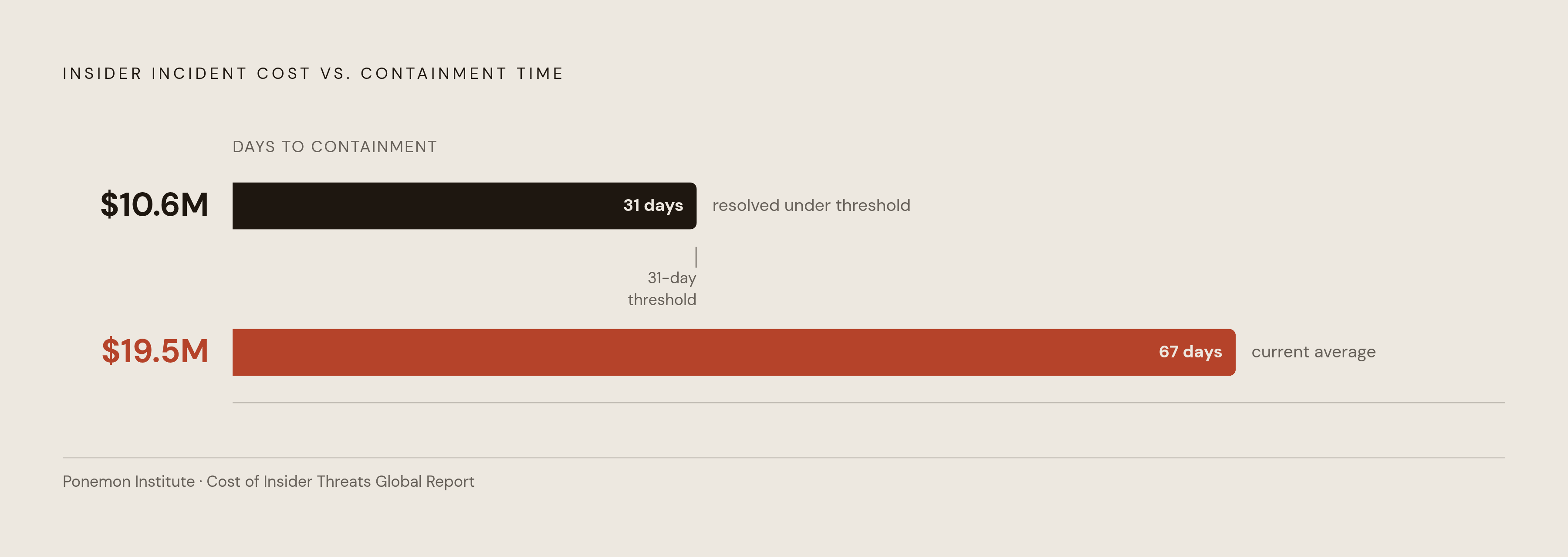
Detection speed is the failure sitting underneath those cost numbers, and it's the one that should worry a buyer most. Average time to contain an insider incident sat at 67 days in 2025, per Ponemon/DTEX, and cost scales hard with how long containment drags on: incidents resolved inside 31 days averaged $10.6 million, a fraction of what longer-running cases cost. Sixty-seven days is two months of unmonitored exposure. Sitting with that number for a moment, the instinct is to blame headcount — surely more analysts would close the gap faster. But the math doesn't hold: a team can hire ten more analysts and still lose two months if the tooling can't surface the pattern in the first place. Detection architecture is the bottleneck.
The exfiltration surface has also moved out from under legacy tools entirely. Personal cloud storage, removable media, and generative AI tools now sit among the primary paths data takes out the door, and each demands a different kind of detection than the last. Nation-state and organized threat actors have increasingly used fake identities to land legitimate employment, a vector behavioral pattern analysis is built to catch and one static rule matching struggles with badly. Pre-departure activity is among the most consequential patterns in insider cases, which makes offboarding detection a concrete, testable capability rather than an abstract one. A vendor whose architecture can't cover cloud, SaaS, GenAI channels, and unstructured behavioral signal is already structurally behind, and no amount of roadmap language changes that math.
Why legacy DLP architecture creates a viability ceiling for incumbents
Legacy DLP runs on static rules, keyword matching, and regex, checking data at a single point in time with no sense of who's moving it or why. The classic failure mode: flagging any 16-digit number as a credit card regardless of context, which floods analysts with false positives and buries the signal actually worth acting on. The false-positive problem in SOC environments is well documented, with legacy DLP classification logic widely identified as one of the main contributors to alert noise. Worth pausing on that: the instinct is to call this a tuning problem, something a few more months of rule refinement would fix. But rules can't be tuned toward context they were never built to see. The design itself is the flaw.
Four structural gaps define this architecture, and they compound rather than sit side by side. Visibility stops at the managed endpoint, so personal devices, home networks, and unsanctioned apps sit entirely outside its view. The engine can't tell structured data from unstructured data or apply behavioral context to either, which produces operational silos and alert floods at the same time. Static controls fail to adapt to hybrid cloud environments, and most run with no real integration into SIEM, UEBA, or identity platforms. Worst of all, there's no model of the person behind the movement: a single file transfer looks identical to the system whether it comes from a negligent employee or someone deliberately walking out the door with company data.
None of that gets fixed by a feature update, and this is where most buyers get it backwards: they treat a legacy vendor's behavioral-AI roadmap as a timing question, something the vendor will get to, when the constraint runs deeper than timing — it's a question of whether the architecture can support that capability at all. A vendor built on a legacy rules engine faces a genuine rebuild to support behavioral AI, not a patch cycle, and a roadmap promise is not architectural readiness no matter how it's worded in the deck. Vendors that have bolted behavioral features onto a legacy core tend to show it: slower inference, heavier configuration overhead, detection logic that still runs on tuned rules underneath the marketing language. Financial stability, roadmap credibility, and integration depth only matter in proportion to whether the underlying architecture can get where detection needs to go. A rebuild might get there, given enough time and capital, while a bolt-on won't, and that distinction should disqualify a vendor outright rather than sit as one more line item on a scorecard.
Financial stability signals worth checking before a platform decision
A vendor can have the right architecture on paper and still fail the customer by running out of runway. Financial screening is due diligence here, the same kind applied to any other multi-year infrastructure bet, and it deserves the same rigor.
For private vendors, which covers most specialized insider risk platforms, a few signals matter more than others. Total funding raised and how recent the last round was: a Series A from three years back with no follow-on financing is a warning sign in a category this capital-intensive. Who's investing tells a story too, since strategic investors, meaning enterprise software firms or security-focused funds, signal a different exit timeline than a generalist venture fund chasing a quick multiple. Customer growth trajectory matters as well; reference-able enterprise logos and published case studies point to recurring revenue, while a thin pipeline of pilots that never convert points to something else entirely. Watch the burn indicators too: heavy discounting to close deals, fast executive turnover, headcount cuts in product and engineering. Those tend to say more than a revenue claim on a slide ever will.
For public or private-equity-backed vendors, the DLP-specific revenue trend matters more than overall security revenue, since a large parent company can hide a shrinking product line inside a bigger, healthier portfolio. R&D spend as a share of revenue is another tell. Incumbents repackaging old technology often show flat or declining engineering investment even while sales and marketing spend holds steady, and that gap is its own kind of confession.
Consolidation risk deserves its own line of questioning given the market's projected climb from $42.87 billion in 2026 to $111.98 billion by 2031, a 21.17% compound annual growth rate, per Mordor Intelligence. Fast growth draws acquirers, and a buyer needs a straight answer about what happens to the contract, the data, and the support SLA if the vendor gets bought. Three questions belong in every conversation, no hedging allowed in the answers: what's the current runway or the next expected funding event, is the product sold standalone or is it getting folded into a larger platform deal, and what's the ratio of product engineers to sales staff.
How to read a vendor's roadmap for credibility, not just ambition
A roadmap is a sales document until there's a verifiable pattern of delivery behind it. Test that pattern by asking for the last three releases and comparing what actually shipped against what was announced at the time; slippage between the two tells you everything. Ask whether behavioral AI capability is on the roadmap or already running in production, because "coming soon" attached to a core detection feature in 2026 is a red flag, not a minor caveat. It's also worth asking whether the roadmap gets shaped by practitioner input, through something like a customer advisory board, or by competitive positioning against whoever the vendor happens to be chasing that quarter.
GenAI channel coverage is close to a litmus test right now. A vendor without a credible, demonstrable answer for detecting sensitive data moving through GenAI tools is behind on a problem that has already arrived, not one that's coming. Pre-departure detection and visibility into contractors and third parties are two other concrete test cases: ask for a live demonstration against a real scenario, not a slide describing the capability in the abstract.
Some roadmap language deserves suspicion on sight, mostly because it describes an outcome rather than a mechanism: "AI-enhanced" applied to what is still a rules engine that needs manual tuning underneath, "behavioral analytics" that turns out to mean a UEBA bolt-on with no timeline stitching across data sources, and integration promises that are really just API partnerships with no native data pipeline behind them. The right test for any roadmap is whether it closes the structural gaps in legacy DLP — coverage, context, integration, and behavioral timeline — or extends the existing architecture in ways that leave those gaps standing exactly where they were.
Integration depth as a long-term viability test, not a checkbox
A platform that runs isolated from identity, endpoint, HR, and SIEM systems is flying blind on behavioral context, no matter how sharp its detection logic looks in a vacuum. Real behavioral detection means stitching signals across sources over time. An access anomaly in an identity system, a file movement in a cloud storage app, and a termination date in an HR system mean nothing on their own; together, they form a pattern worth investigating.
A handful of practical questions separate genuine integration from a connector catalog. Which integrations are native, meaning the vendor built and maintains the data pipeline, versus API-dependent connectors that break every time a partner pushes a version update? How does HR data, things like role changes, offboarding triggers, or performance-improvement-plan status, actually surface in the detection logic, and does that require someone to manually import it? Does the platform write enriched context back into SIEM or case management systems, or only read from them?
Integration surface also works as a proxy for deployment speed. A platform that takes months of connector configuration before it produces usable signal is telling you something about its architecture, not just about onboarding friction. Map the stack: identity providers, endpoint tools, collaboration suites, HR systems, SIEM and SOAR platforms. A vendor with native data pipelines across that surface is a structurally different product from one offering a long connector list, and the difference shows up fast once real data starts moving through it.
Alert fatigue is itself an integration failure. Platforms that generate high alert volume without cross-source context are operationally unsustainable on top of being noisy, and that 67-day average containment time reflects, in part, the compounding cost of fragmented tooling that forces manual investigation rather than enabling rapid response.
Architectural fit for behavioral detection: the criterion most RFPs miss
Most RFPs skip the question that matters most: does the platform start from a behavioral baseline for each user and surface deviations from it, or does it start from a fixed policy ruleset and look for violations? Rule-based detection only works if someone anticipated the exact threat pattern in advance. Behavioral detection can surface a pattern nobody thought to write a rule for, and that distinction has direct, measurable stakes. Ponemon research attributes 53% of insider incidents to negligent employees, and negligence almost never trips a policy rule; it does, however, show up as a deviation from someone's normal behavior. Sit with that 53% figure long enough and the conclusion gets uncomfortable fast: over half the problem is structurally invisible to any tool built around anticipated violations instead of observed deviation, and a rules engine, however well maintained, is blind to most of what's actually happening. That alone should disqualify pure rules-based platforms from any serious shortlist, whatever else they get right.
A few architectural questions get at this directly. Does the platform model a user's full timeline, or does it score individual events in isolation, one file transfer or one login at a time? Is the AI inference explainable, meaning an analyst can see why a case got surfaced, not just that it did? Does the platform cut alert volume by design, putting signal first, or does it just pass the triage burden down to the analyst? And where does the AI inference actually run, on shared infrastructure or in a private, tenant-isolated environment? That last question has direct consequences for data privacy and regulatory exposure, not just architecture.
Explainability and auditability carry real weight here, beyond serving as a completeness check. Security teams need to justify investigations, answer HR's questions, and defend findings if a case ends up in a legal or compliance proceeding, and a black-box score can't support any of that. Deployment speed is its own viability signal too: a platform that takes months to go live hasn't been built for enterprise use, and slow time-to-signal means the vendor's value stays theoretical until it isn't. Data privacy belongs on this list as a non-negotiable, since customer behavioral data used to train shared models, or inference run on multi-tenant infrastructure, creates regulatory exposure and a trust problem at the same time. Ask for specifics on both; reassurance is not an answer.
Putting the framework into a structured assessment process
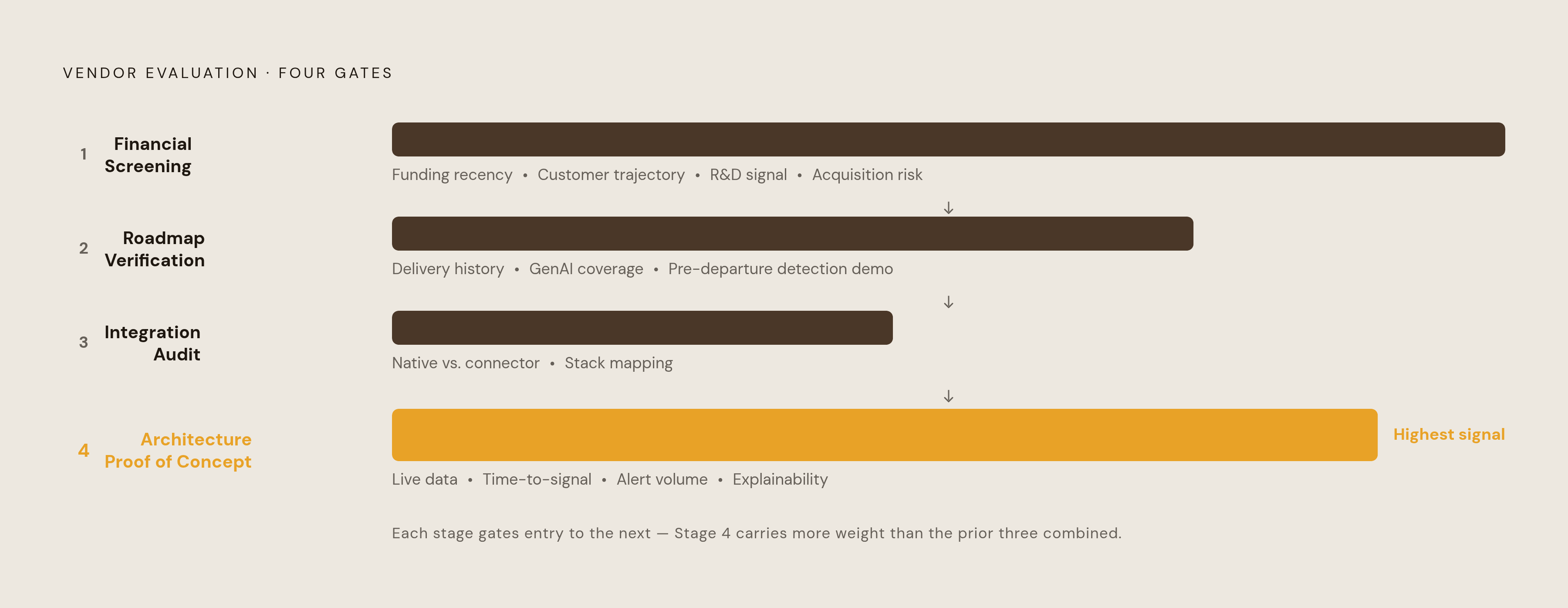
The four dimensions here belong in a specific order, because each one gates the next. Financial stability comes first: can this vendor execute and survive the next 24 months? Roadmap credibility comes second: have they shipped what they said they would, and does the roadmap close the architectural gaps in legacy DLP or just extend the existing limits? Integration depth comes third: is the platform natively wired into the stack already in place, or dependent on connectors that need constant upkeep? Architectural fit for behavioral detection comes fourth: does it model the person and the pattern, or just the event and the policy?
A workable evaluation runs in four stages. Stage one is financial screening: funding recency, customer base trajectory, R&D investment signal, and direct questions about acquisition risk. Stage two is roadmap verification: request the delivery history for the last three releases, then test GenAI channel coverage and pre-departure detection against a real scenario, not a hypothetical. Stage three is an integration audit: map native versus connector-based integrations against the actual stack in production, and ask directly what breaks when a new egress vector shows up. Stage four is an architecture proof of concept: run a live scenario using real data, and measure time-to-signal, alert volume, how explainable the surfaced cases are, and how long it takes an analyst to reach a decision.
That proof of concept is the highest-signal step in the whole process, by a wide margin, and it should carry more weight in a final decision than any other stage. A vendor who can't demonstrate behavioral timeline stitching, explainable AI output, and low-noise case surfacing against real data in a POC will not suddenly get better once it's in production; production only makes weak architecture more expensive to discover. A handful of questions belong in every RFP regardless of vendor: what's the data residency and AI inference model, and does customer data ever leave the tenant environment; what's the average time-to-live for a new enterprise customer; how many analysts does a typical customer need dedicated to triage after deployment; and what's the roadmap for the specific gap already identified in the current stack. Vendor viability, treated this way, is the difference between a platform still doing its job in three years and one getting ripped out at the 18-month mark, and it carries more weight than any feature checklist a procurement team puts in front of it.