Translating Alert Fatigue Costs Into Security Budget Language
Unaddressed alerts cost millions in wasted labor and delayed breach detection.

Alert fatigue is not a productivity complaint from the SOC floor; it turns security spending into waste, liability, and losses that are only counted after the damage is done. Vectra AI's 2026 research found that organizations field an enormous volume of security alerts every day, and 63% of them go unaddressed. That unaddressed remainder is where the financial exposure actually sits, because the SOC runs on an assumption that has quietly stopped holding: that a human analyst can reliably sort signal from noise at whatever scale the tool stack produces. That assumption fails industry-wide, and the failure can be measured in dollars well before it shows up as a breach: wasted labor, missed threats, departing analysts, and regulatory penalties all trace back to the same root cause. Executives already have a vocabulary for waste, liability, and talent loss. The job in front of the security leader walking into a budget meeting is to translate a technical dysfunction into exactly those terms.
The structural forces that make the noise problem self-reinforcing
The first question a CFO asks when alert volume comes up is usually some version of "why not hire more analysts." That question assumes the problem is a staffing shortage. That assumption is wrong: alert fatigue is an architectural failure, so adding headcount to a broken architecture buys only a short delay, because the forces producing the noise keep producing it no matter how many people watch the queue.
Three forces drive that noise at the same time. The first is tool sprawl: the average enterprise now runs close to 11 separate security consoles, and over two-thirds of organizations run ten or more detection tools, with close to 40% running twenty or more. Each tool has its own severity logic, its own interface, and its own blind spots, so analysts spend a meaningful share of every shift just reconciling context across systems instead of investigating actual threats. The second is conservative detection engineering. Most security tools are built, deliberately, to minimize missed threats at the cost of throwing off more false alarms, and stacking a dozen of these tools together buries real signal by design rather than by accident. The third is static rule decay. DLP and SIEM policies built on fixed rules do what they are told to do, and that is the problem: they flag what the rule specifies, not what actually matters, and they cannot adjust when attacker behavior shifts underneath them.
Those three forces combine into a shortcut every overloaded analyst eventually takes: close what looks unimportant, chase what looks urgent. Genuine threats routinely arrive labeled low-severity or informational, and that is why they get closed without a second look more than any other alert. The industry has already reached its own verdict on this. Gartner research found that a strong majority of organizations were actively pursuing security vendor consolidation as of 2022, up sharply from a small minority just two years earlier. That shift is an admission that the stack itself, not the staff running it, became the source of the risk.
What the wasted analyst hours cost when converted to dollars
False positives are not simply an annoyance analysts complain about at shift change. They represent a calculable share of SOC payroll spent producing zero security value, and that share can be modeled with numbers most security teams already have on hand: headcount, average salary, and hours spent on triage.
Microsoft and Omdia's 2026 State of the SOC research found that organizations running highly fragmented SOCs spend significantly more on operational labor than organizations running consolidated tooling. That gap is a labor premium paid for complexity, not for better detection. At industry scale, Vectra AI put the cost of manual alert triage in 2023 at roughly $3.3 billion a year across U.S. organizations. That figure is a snapshot of the industry's exposure, not a number any single organization should adopt as its own. The useful exercise for a security leader is building the same math locally: take the analyst headcount, multiply by fully loaded hourly cost, multiply by the hours spent each week on alerts that turn out to be noise, and the resulting figure becomes a budget line a CFO can check against payroll records in the same afternoon. That kind of number survives a finance review in a way that an industry-wide average never will on its own.
The threat-miss cost that does not show up on any invoice until it is too late
Labor waste is the visible cost. The far larger cost is the threat that alert fatigue lets slip past, because a buried SOC does not just waste money, it gives an attacker more time to operate undetected inside the environment.
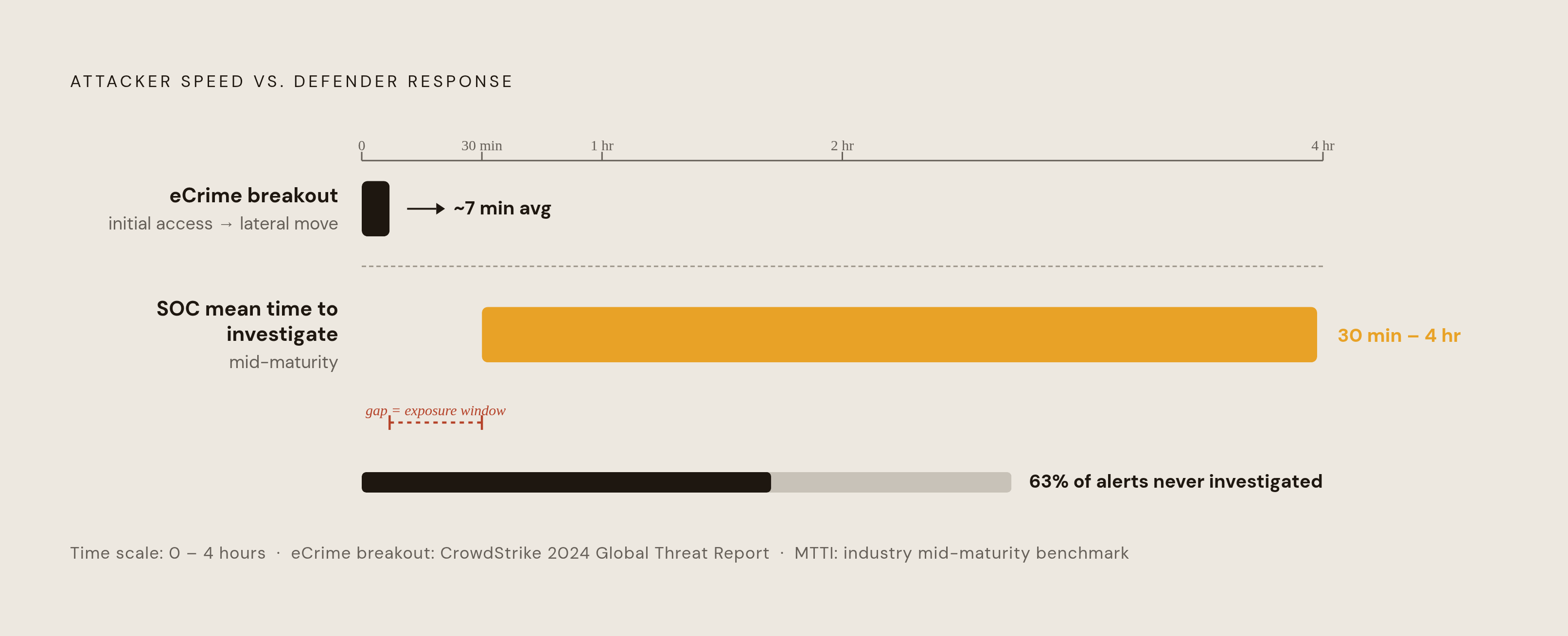
IBM's Cost of a Data Breach Report found that the global average cost of a breach reached a substantial multi-million-dollar figure, and that organizations still take an average of 241 days to identify and contain a breach. Those two numbers are connected by a single mechanism: when a SOC is buried under noise, the one alert that mattered was sitting in a queue behind a thousand that did not, and every day it sits there adds to the eventual cost of the breach. CrowdStrike's 2026 Global Threat Report gives the attacker side of that same clock: average eCrime breakout time, the gap between initial access and lateral movement, runs to a matter of minutes. A mid-maturity SOC's typical investigation window has not even opened by the time an attacker has already moved laterally through the environment.
Insider risk is where this dynamic costs the most, because behavioral anomaly alerts are inherently noisy. Legitimate user behavior and early-stage insider activity often look similar on a dashboard, and when fatigued analysts deprioritize that category of alert, insider threats go undetected longer than any other kind. The Ponemon Institute tracks the annual cost of insider risk, and that figure has grown year over year, with its 2026 follow-up up meaningfully from the year before, so insider risk is a cost that keeps climbing rather than a number you budget against once.
Two cases show what that undetected window looks like in practice. At Tesla in 2023, two former employees leaked tens of thousands of internal documents, including production secrets, customer financial data, and personal information belonging to tens of thousands of employees, over a multi-month exfiltration window. DLP controls did not catch the activity during the employees' notice periods, and that is the exact behavioral window alert fatigue tends to obscure. At Yahoo in 2022, senior research scientist Qian Sang downloaded hundreds of thousands of pages of confidential material, including source code, backend architecture, and algorithms tied to the company's AdLearn product, shortly after accepting a competing job offer. Behavioral context tied to that offer would have flagged the activity long before litigation became the only remaining option. Both cases share the same structure: the activity was visible in the data the whole time, and fatigue, not absence of evidence, is what let it run its course.
Analyst turnover as a compounding talent cost
Burnout-driven turnover is a recurring, estimable expense, not just a morale issue flagged in an employee survey, and it compounds every time an experienced analyst leaves the conditions that alert fatigue creates. Finance leaders already carry recruitment and training costs in their planning models. The work for a security leader is connecting a portion of those existing costs directly to the alert architecture, rather than letting the loss get attributed to the labor market in general.
Replacing a burned-out senior analyst, counting recruitment, onboarding, and the time it takes to transfer institutional knowledge, costs a substantial sum per analyst each year, and that figure belongs in a budget model as a line item rather than as a cautionary anecdote. The harder cost to price is what leaves with the departing analyst and never appears on any invoice: the specific knowledge of an organization's own systems, its normal traffic patterns, its known-noisy alerts, that lets a seasoned analyst tell real threats from background noise. That knowledge does not transfer through documentation, and it has to be rebuilt from scratch with every departure.
The labor market makes that rebuilding slower and more expensive than it would otherwise be. ISC2 research puts the global cybersecurity workforce gap at 4.8 million professionals, so the pool available to replace a departing analyst is structurally tight, and the seat takes a long time to fill. Every analyst alert fatigue drives out of the SOC has to be replaced in a market with fewer available people than open positions, so both the price and the delay of every replacement go up.
The regulatory clock that alert fatigue starts without anyone noticing
Alert fatigue does more than delay breach detection internally. It starts regulatory clocks that carry specific financial and personal liability consequences for leadership, often before anyone in the organization realizes the clock is running.
NIS2 requires a 24-hour early warning, a 72-hour incident notification, and a one-month final report once an incident meets its threshold. Penalties for essential entities under the directive can reach up to 2% of global turnover, and NIS2 includes personal liability for CEOs and board members, not just the organization as a corporate entity. The regulatory clock starts at the moment the organization should reasonably have been aware of the incident, not at the moment it actually acted on that awareness. That distinction is where alert fatigue turns into legal exposure: when a genuine breach alert sits in an uninvestigated queue, the regulatory clock has already started while the organization's own awareness of the incident has not caught up to it. The gap between those two points is the compliance exposure, and it accrues penalty risk whether or not anyone inside the organization has noticed the alert yet.
The Coinbase case from 2025 shows how this plays out when the insider element is collusive rather than a single bad actor. External attackers bribed a group of support agents, who then used their legitimate access to exfiltrate customer data affecting tens of thousands of users, and the attackers followed that up with a substantial ransom demand. If you had watched for patterns of access that deviated from normal account support work across the support agent population, you would have caught the activity earlier, before it reached the scale it did. The case illustrates the same principle running through NIS2 and GDPR enforcement generally: the regulatory clock does not wait for an organization's detection tools to catch up, and alert fatigue is one of the most common reasons they don't.
The MTTI Metric as a Number Finance Can Pressure-Test
Every cost category above traces back to a single measurable interval: mean time to investigate, or MTTI. It is the metric that gives a security leader something specific enough to model, benchmark against industry figures, and present as a concrete target for new investment, rather than a general appeal to "better detection."
MTTI covers the phase between an analyst picking up an alert and reaching a verdict on it. This is exactly where console-hopping across SIEM, EDR, identity, and cloud tools quietly consumes the day, and it is the point where the attacker's clock and the analyst's clock are most directly in conflict with each other. Mid-maturity SOCs typically run an MTTI of 30 minutes to four hours. Set against CrowdStrike's finding that average eCrime breakout time runs to a matter of minutes, every incremental hour inside that MTTI window represents measurable financial exposure, not a theoretical inefficiency to clean up eventually.
MTTR, mean time to respond, gets cited more often in SOC reporting, but it is a misleading headline number for a budget conversation because it only counts incidents the SOC already opened. It says nothing about the alerts still sitting unexamined in the queue, which is precisely where the cost categories built across this piece, wasted labor, missed threats, turnover, and regulatory exposure, actually accumulate. MTTI, by contrast, measures the exposure before a verdict exists at all, and that makes it the number a security leader can put in front of finance, show the industry benchmark against it, and ask for the specific investment that would bring it down.
Sources
- What Is Alert Fatigue? Causes, Impact & How to Reduce It
- Alert Fatigue in the SOC: Why More Tools Mean Less Security - Secure Network Solutions India Private Limited
- What Are SOC Operations? Roles, Workflow & Best Practices
- Alert Fatigue in the SOC: 2026 Causes, Costs & Fixes - World Informatix
- 2025 Cost of a Data Breach Report: Navigating the AI rush without sidelining security | IBM
- Lessons Learned from the 2026 Global Cost of Insider Risks | Ponemon Institute