Data Residency and AI Inference Architecture in Insider Risk Platforms
Where AI inference runs decides whether your platform can correlate cross-border risk signals.

What data residency means for AI workloads, and where most enterprise teams get it wrong
Where an insider risk platform runs its AI inference decides what it can see, full stop. That architectural choice, usually made early and almost never revisited, decides whether the platform can connect a suspicious file download in London to an odd login pattern in Singapore, or whether it just logs two disconnected events sitting in two separate jurisdictions. Security teams keep grading these platforms on detection accuracy, integration count, and dashboard polish, then find out months into deployment that residency rules quietly severed the cross-border correlation they were sold on. By then reprocessing data to satisfy a regulator adds days to an investigation that should take hours, and the fix costs far more than getting the architecture right up front would have.
Vendor pitches flatten three separate ideas into one word, and buyers who don't pull them apart make the first mistake in the room. Physical location is what data residency concerns: which country or region hosts the servers holding the data. Data sovereignty is about legal jurisdiction: whose laws actually govern that data, which isn't always the country where the servers sit if the vendor's home office is somewhere else. Data localization is a legal requirement, often the strictest of the three, that certain categories of data stay and get processed inside a country's borders, sometimes with a ban on letting it leave under any circumstances.
Picking a European data center from a US cloud provider's region menu doesn't resolve legal jurisdiction, and that confusion is the most common error in the room. A US-headquartered provider hosting data in Frankfurt still answers to compulsion under the US CLOUD Act no matter where the servers physically sit. Architects who treat "select EU region" as a compliance checkbox have solved for where data resides while leaving legal jurisdiction wide open, and that gap is what gets a company sued.
AI workloads make this harder because they multiply what counts as data. A prompt sent to a model, the completion it returns, the embedding built from a document, the inference log, any contextual memory the system keeps: all of it counts, and any piece of it can trigger sovereignty questions the moment it crosses a border, even briefly. Per-token API calls to inference endpoints create data flows most vendor contracts never anticipated. Plenty of data processing agreements were written for an era of simple database queries and say nothing about whether prompt content gets used to improve a model, or where that inference actually runs.
For insider risk platforms specifically, the raw material is usually personal data under GDPR or an equivalent regime: file access logs, communication metadata, endpoint telemetry tied to named employees. Sending that telemetry to a cloud inference endpoint in a different jurisdiction can count as a cross-border transfer that needs its own legal basis. Gartner's client inquiry volume on cloud sovereignty and geopatriation rose 305% in the first half of 2025. That jump means cloud sovereignty and geopatriation are now raised in the first vendor call, not buried in the contract's fine print.
How insider risk platforms use AI inference, and why the location of that inference matters
Inference here means classifying content, scoring behavioral anomalies, correlating signals across weeks or months, and building a risk profile for a specific person or system. That's a different computational job than answering a database query. It needs sustained, simultaneous access to data flowing in from email, endpoints, cloud apps, identity providers, and messaging platforms, all at once, all the time.
Multinational workforces throw off those signals in different countries at the same moment. If inference has to run regionally, and behavioral signals can't cross the jurisdictional line to meet each other, correlation breaks down at exactly the point where it matters most. A user's unusual file access in London and an odd authentication pattern from that same user in Singapore stop being one story about a person's rising risk. They become two log entries sitting in two systems that never talk, and that gap is the direct, mechanical result of splitting inference along borders without designing around it.
User and entity behavior analytics need a learning period, typically 60 to 90 days, during which the system builds a picture of what normal looks like for each person and system. That baseline needs integrated telemetry across the whole enterprise to hold up. Any residency constraint that fragments the data feeding that baseline weakens it from day one, before the platform produces its first meaningful alert.
Agentic AI adds a newer wrinkle. Autonomous agents that move data and trigger actions on their own generate inference events that behave functionally like an insider, one that never sleeps and never second-guesses itself, because the agent carries standing access to sensitive systems. Shadow AI is its own inference surface entirely: industry research has ranked shadow AI as the third most common non-malicious insider action. Catching it means inspecting prompt content the moment it leaves the network, a different inference job from scoring behavioral anomalies, with its own separate residency questions attached.
So "where does inference run" is really at least three stacked questions: where behavioral analytics run, where content inspection runs, and where the correlation across all of it happens. A platform can answer each one differently, and most do, often without telling the buyer that's what's happening.
The regulatory frameworks that directly constrain where behavioral data can be processed
GDPR doesn't dictate a storage location, but it restricts moving personal data to a country without adequate protections in place. Communication metadata, file access logs, and authentication records almost always count as personal data, and moving them across borders needs a legal mechanism behind it: Standard Contractual Clauses, Binding Corporate Rules, or an adequacy decision. The EU-US Data Privacy Framework survived a challenge at the EU General Court in September 2025, but several European data protection authorities have flagged that it still doesn't fully close the gap between GDPR's Article 48 and the extraterritorial reach of the US CLOUD Act.
The EU AI Act adds a second, heavier layer on top. Full enforcement for high-risk systems began on August 2, 2026, and systems affecting people in the EU now need documented data governance, bias testing, lifecycle-long risk management, automatic logging retained for six months, and formal conformity assessments. An insider risk platform that scores or investigates employees using AI likely falls under the Act's Annex III high-risk category. Penalties run up to €15 million or 3% of global turnover for high-risk violations, and up to €35 million or 7% for prohibited practices, so combined exposure with GDPR on a single failure can reach 11% of a company's global revenue. That number dwarfs anything GDPR alone ever threatened, and it applies no matter where the vendor is headquartered.
Outside that one heavily regulated region, the map gets more fragmented, not less. China's PIPL and Japan's APPI both require consent or a recognized safeguard before personal data leaves the country; locally hosted inference sidesteps the need for a transfer mechanism rather than trying to satisfy it. India's DPDP Act restricts cross-border transfer too, with the government naming which countries are allowed to receive Indian personal data. At least 34 countries now have data localization laws that touch AI deployment in some way, a patchwork that a single cloud provider's regional data center menu usually can't satisfy for a company operating in more than a handful of markets. HIPAA, by contrast, imposes no geographic residency rule at all, though enterprise contracts frequently add one anyway. That contractual add-on is where residency becomes a real concern for healthcare buyers even without a statutory push behind it.
Put together, a multinational company running an insider risk platform across several regions, including the US, answers to at least four different regulatory regimes at once, each with its own transfer restrictions, penalty math, and inference logging rules. Every one of those rules governs what the AI is doing with the data, in addition to where the data happens to be parked.
Four architectural patterns and the detection trade-offs each one makes
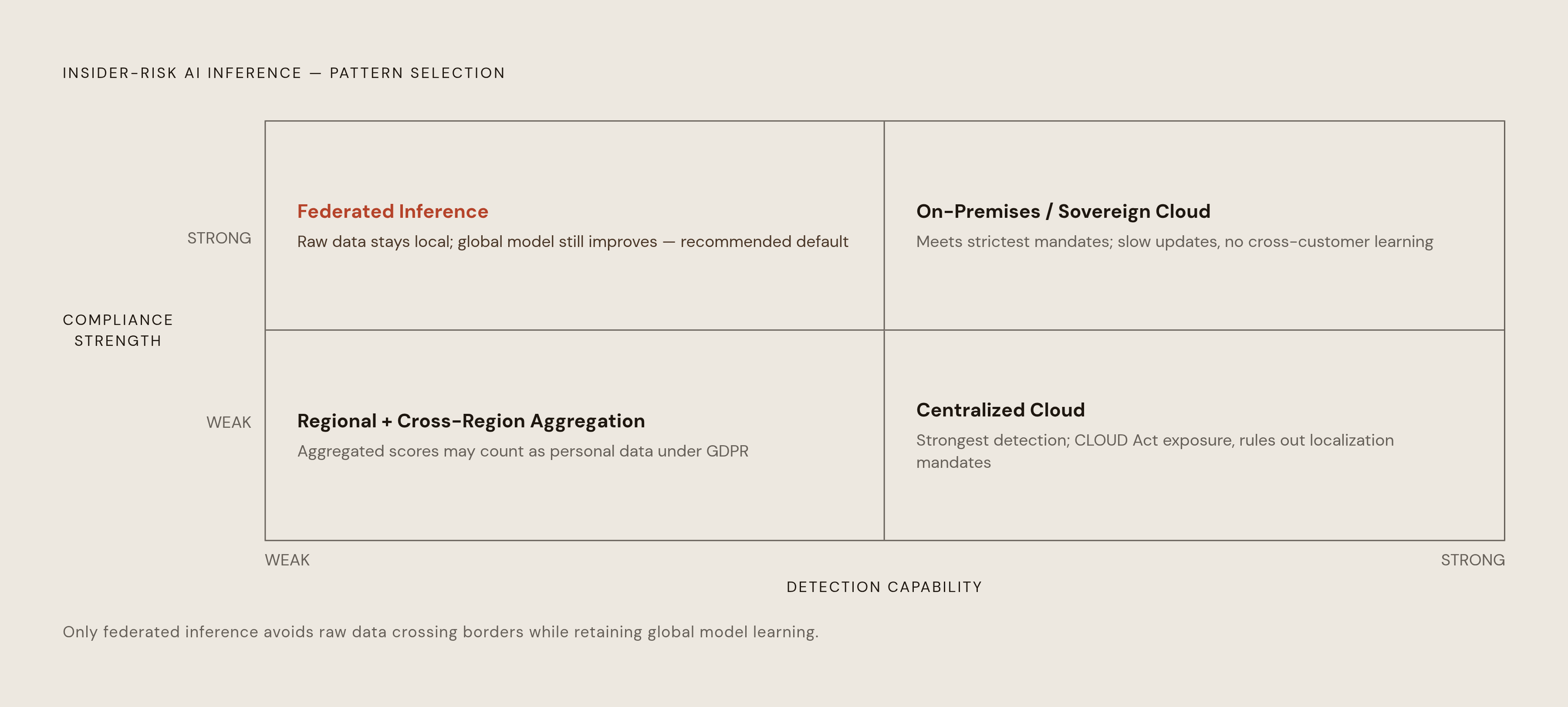
Centralized cloud inference in a single region sends all telemetry to one environment, which hands the model the full user timeline and the strongest correlation available. Cross-border transfer needs a legal basis, CLOUD Act exposure follows a US-headquartered provider regardless of region, and localization mandates in markets like China or India rule this pattern out. The quiet failure mode means an insider can operate for months with no alert ever firing, which costs a company far more than any regulatory fine would. A user operating inside a strict localization jurisdiction simply falls outside the detection model altogether, and that blind spot is exactly the kind a patient insider learns to work inside of.
Regional inference with cross-region aggregation keeps behavioral analytics local to each jurisdiction, then shares aggregated scores, not raw records, across regions to build a global risk view. This cuts down raw data movement and satisfies a good chunk of residency law, but aggregated scores can still count as personal data under GDPR depending on how easily someone could re-identify the person behind them, so the aggregation layer itself needs legal review on top of engineering sign-off. On detection, local baselines built from a smaller population run shakier, and a pattern that spans regions, staging in one, executing in another, may never be flagged by either region's detection system.
On-premises or sovereign-cloud inference keeps everything inside the customer's own infrastructure or a nationally controlled facility, and nothing leaves the boundary. For defense environments or the strictest localization mandates, this is the cleanest posture available, and it removes CLOUD Act exposure. The price is slower model updates, no benefit from cross-customer learning, and extra connectors for cloud-native SaaS tools that can quietly reopen the same data movement questions the architecture was built to close. Deployment timelines stretch, and the infrastructure burden lands on the customer instead of the vendor.
Federated inference with local model execution deploys model weights inside each jurisdiction and runs inference on local telemetry there, so only model updates, never raw data, ever cross a border. That's the strongest compliance answer of the four: it keeps local latency low, and it lets a vendor push global model improvements out without touching personal data. It demands real MLOps discipline to keep versions consistent across deployments, though, and a local model trained on a smaller data pool can underperform a centralized one. Anomaly detection built on autoencoders needs real volume of local data to train well, and a small regional deployment may not have enough of it. This is also where the market is actually headed: roughly 20% of companies in one heavily regulated region have already started repatriating business-critical data to local facilities, and vendors without a federated inference option are already losing deals in evaluations that span multiple regions.
Every one of these four patterns runs into the same wall eventually. UEBA needs that 60-to-90-day learning window on integrated telemetry to work, and any architecture that fragments the data or delays collection resets that clock, or quietly degrades what comes out the other end. That cost doesn't hit once and go away. It compounds for as long as the platform stays in production.
Federated inference is the pattern most teams should default to, unless a hard localization mandate rules it out. Centralized inference optimizes for detection and quietly loses the jurisdictions that can't legally send it raw data. On-premises optimizes for control and loses speed along with any cross-customer learning. Federated is the only one of the four that keeps raw data inside its own jurisdiction while still letting the model improve globally, and the other three trade away that combination.
What behavioral correlation loses when signals cannot cross jurisdictional boundaries
Insider risk detection works by watching an arc unfold over time: reconnaissance, a shift in access patterns, staging, then exfiltration. Real risk rarely announces itself in one signal sitting in one system. A pattern gets stitched together across several systems, and that stitching is the entire value proposition of a platform like this.
Jurisdictional fragmentation cuts that stitching apart. If cloud access logs are in an EU-resident inference environment and endpoint telemetry is in a US-resident one, neither environment ever sees the full pattern, only its own half of it. The average detection and containment window for insider incidents runs around 81 days according to Ponemon research, and fragmented signals are a real part of what stretches that number out.
Corporate turbulence makes the gap worse rather than incidental to it. Mergers, divestitures, talent poaching, corporate espionage: these get named as primary drivers behind incident surges in 2026 industry reporting, and they typically involve employees moving across multiple jurisdictions at once. An employee staging data in one region before transferring it from another isn't doing anything technically sophisticated. They're walking through the seam where the architecture simply stops looking.
Negligence doesn't even need multiple jurisdictions to become a problem. Ponemon's research attributes 55% of incidents to employee negligence or mistakes, a misconfigured sharing setting, or an accidental upload. A lot of that behavior runs through cloud collaboration tools and AI assistants that route data through inference endpoints in more than one region without the employee or the security team ever noticing. Autonomous agents raise the stakes further: an agent chaining tasks across systems in different jurisdictions throws off telemetry in all of them, and if that telemetry can't be pulled together, the agent's risk profile never gets assembled.
The financial shape of this problem is already documented. Ponemon's data shows organizations spending $211,021 per incident on containment against only $37,756 on monitoring, and that imbalance gets worse whenever investigators can't reconstruct the full story because the pieces of it sit in jurisdictions that don't talk to each other.
Evaluating a platform's residency architecture before it becomes an operational constraint
Start with the organization's own data map before sitting through a vendor's slide about residency options. A minority of organizations can say with confidence where all their data actually lives, and an evaluation that starts with a vendor's regional menu before the buyer knows its own jurisdictional footprint ends up locked into promises it can't keep six months later.
Once that map exists, the inference questions get specific fast. Where does behavioral analytics inference actually run, and is that configurable per region, or fixed to whatever environment the vendor happened to build first? Where does content inspection for shadow AI and prompt-level detection run, separately from behavior scoring, given that it's a different job with its own transfer implications? Where does cross-signal correlation happen, and does the platform's answer survive contact with the strictest jurisdiction in the deployment, or only the easiest one?
None of this is a compliance afterthought bolted on after detection capability gets picked. The architecture decision made before deployment, about where inference runs and how signals cross borders, decides whether the platform sees the whole picture or only the portion inside one jurisdiction's lines. Get that wrong, and no amount of dashboard polish or integration count fixes it later.