Policy Inventory and Rule Rationalization Before a DLP Migration
Audit your rules before migration or risk carrying the same dysfunction to your new platform.
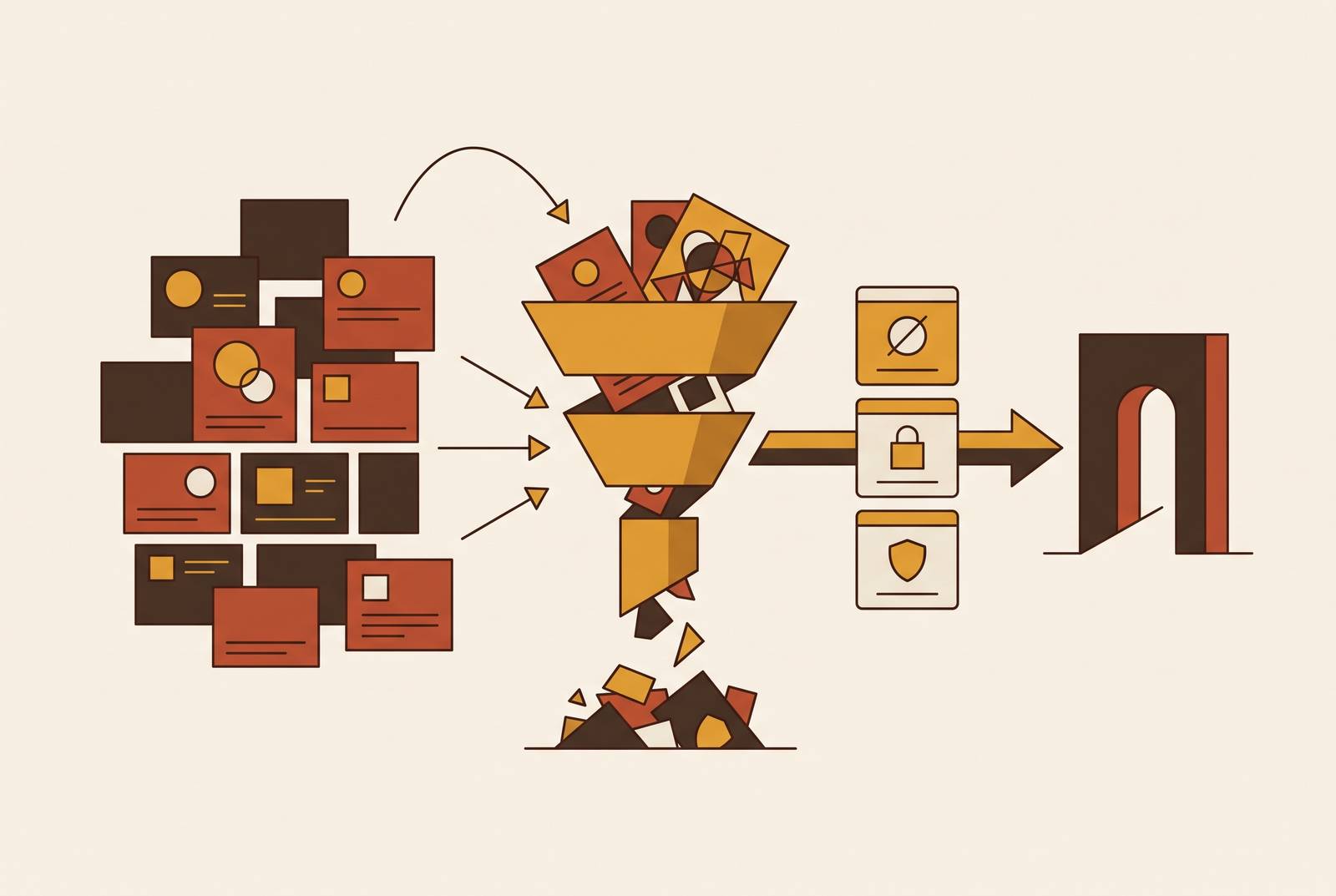
Six months after a DLP migration, the analyst queue often looks exactly like it did before the project started. The platform changed. The dysfunction did not. That outcome traces back to a decision made before a single policy was configured on the new system: the decision to carry unexamined rule debt across the transition instead of treating the migration as a chance to find out what the rule set actually does and whether it still matches the business it's meant to protect. Legacy DLP tools built up their policy libraries the same way almost every organization does: a compliance mandate lands and a team writes a rule to satisfy it; an incident happens and someone adds another rule in response; people leave and nobody goes back to ask whether the rules they wrote still make sense. A rationalization effort that focuses only on retiring the old system, without redesigning the policy logic underneath it, leaves the inefficiency in place. It just moves it to a different address.
Rule debt inside a mature DLP deployment
Rule debt isn't a vague sense of having too many policies. It appears in specific, nameable forms, and a team auditing its DLP deployment can expect to find most of them. Redundant rules are the most common: two or three policies covering the same data type on the same channel, written by different people at different times, each one firing its own alert for a single event and inflating the total alert count without adding any real detection value. Orphaned rules are close behind, policies built around a business unit that was later sold off, an application that was decommissioned, or a compliance requirement that got replaced by a newer one, yet the rule stays active and keeps generating noise for a risk that no longer exists.
A third pattern is the overly broad pattern match: a rule built from a wide regular expression or a long keyword list, written because the underlying policy statement was vague rather than tied to a specific data class and channel. Channel-blind rules are a fourth category: a policy written for email or endpoint activity that never gets extended when the real traffic moves to cloud storage or a personal sync client. The rule keeps watching the original channel faithfully while the actual risk moves somewhere it was never built to see.
Rules with no identifiable owner deserve particular attention, because they're the ones most likely to survive a migration without anyone raising an objection. Naming these categories gives a team a shared vocabulary for the audit that follows. Without it, "rule debt" stays an abstraction nobody can act on.
Static rules and the debt teams can't retire fast enough
DLP cannot protect data it has never identified, and the reverse holds just as firmly: a rule written before the underlying data was properly classified tends to fire on surface pattern matches rather than on content that is actually sensitive, and fixing it means going back to do classification work that was often skipped the first time around. That gap, once baked into a rule, is expensive to find and expensive to correct, so it tends to persist.
A related dynamic is the gap between rules deployed in monitor mode and rules that ever get switched to block. Many rules get deployed in monitor mode to establish a baseline before anyone commits to blocking on them, and a large share never graduate past that stage. They sit there generating alerts indefinitely, and analysts gradually learn to treat those alerts as background noise. That tolerance for unresolved alerts becomes part of the team's working culture, and it carries straight through a migration unless someone deliberately interrupts it.
Ownership gaps compound the problem over time. A DLP program is supposed to rest on identifying and classifying sensitive data across the whole organization, but in practice, each rule tends to get written by whoever happened to respond to a specific incident or mandate. None of this reflects a team failing to do its job. It reflects what happens, predictably, when a detection model built on static rules meets an environment that never stops changing.
Establishing the governance and ownership baseline before any rule is touched
An audit that starts by pulling the rule list, before anyone has settled who owns each rule and who can authorize changing it, produces decisions nobody can validate, reverse, or sustain once the migration is finished. The governance work has to come first because it's what makes every later decision defensible.
The first task is assigning a functional sponsor to each policy domain, a named person who can say with authority whether a given rule still reflects a real business need. That has to be someone who understands the business purpose behind the rule, beyond a technical owner who can describe what the rule does mechanically. The Business System Rationalization Playbook, published in March 2026, treats this as the precondition the rest of the process depends on: functional sponsors have to define mission requirements and validate redundancies before any system or rule gets touched, because rationalization attempted without that accountability layer doesn't resolve decisions, it just moves them somewhere else.
A governance structure for a DLP audit needs to settle who has the authority to approve retiring a rule, and that authority shouldn't sit with the security team alone when compliance mandates are involved; business and legal stakeholders belong in that conversation too. Rationalization works as a lifecycle: framing, analysis, planning, execution, and sustainment. Skipping the framing and governance step means the analysis phase produces findings that nobody has the standing to act on.
Conducting the policy inventory: what to document for every rule
A policy inventory only earns its name if it captures enough about each rule to support a real decision. A spreadsheet of rule names with no surrounding context isn't an inventory; it's a table of contents. The response action matters too: whether the rule monitors, alerts, blocks, or quarantines, and whether that action still fits the current risk rather than reflecting a decision made years ago under different conditions.
Alert volume over a defined trailing period belongs in the inventory as well, split between confirmed incidents and false positives wherever that distinction can be made, since that ratio reveals a rule's real value more clearly than anything else on the list. Each rule needs a named functional sponsor or owner who can speak to whether it's still necessary, together with the original business or compliance rationale and the mandate, incident, or decision that led to the rule being written. Finally, the inventory should flag whether a rule overlaps with another one covering the same data type on the same channel, since that overlap is often invisible until the rules sit side by side on paper.
Where the inventory turns up rules targeting data that was never formally classified, that classification work has to happen before those rules can be evaluated or migrated in any rational way; an unclassified data type simply can't be scoped or tuned with any precision. Some legacy platforms, such as Symantec DLP, support bulk export of policy configurations into an archive file, and where that capability exists, the export is a useful starting point for building the inventory. It is not a substitute for the ownership and rationale fields that only a person familiar with the organization's history can supply, since no export file records why a rule was written or who still depends on it.
Applying rationalization criteria to rule disposition
Once every rule has been inventoried, each one needs a disposition, and that decision should follow explicit criteria rather than simple comfort with leaving things as they are. A rule should be retired when no functional sponsor can point to a current business need for it, when the original compliance rationale has been superseded or is already covered by a different rule, when it has produced no confirmed incidents over the measurement period and its alerts are almost entirely false positives, or when it duplicates another rule covering the same data type and channel with the same response action.
A rule should be rewritten before it migrates when it covers a real risk but its match criteria are too broad, in which case tightening the pattern to the actual sensitive data type removes the false-positive surface without losing coverage. Where a rule's match criteria are only partly compatible with the destination platform, reviewing and removing the incompatible parts is necessary anyway, and that review is the natural moment to ask whether what remains is still fit for purpose.
Migration as-is should be reserved for rules that have a validated owner, a documented rationale, a specific data type and channel, and an alert-to-incident ratio that shows the rule is catching real risk without burying analysts in noise, and whose match criteria are technically compatible with the new platform without modification. Every new or rewritten rule should enter the destination platform in monitor mode first, so the team can confirm its alert-to-incident ratio against live traffic before switching it to block. Throughout this process, the deciding question should be whether a rule serves a validated business need, not just whether it's technically clean. A rule with pristine syntax that still protects a business process that no longer exists belongs in the retire pile, not the migrate pile.
Structuring the rationalized rule set for the destination platform
A rationalized rule set is organized around the data types and risk scenarios that actually matter to the business, with explicit coverage across all three enforcement surfaces: endpoint, network, and cloud. Getting there means the rule set, taken as a whole, has to answer three questions for every sensitive data type in scope. And does the response action tied to each rule match the real risk level of that data type and channel combination, rather than carrying forward a legacy default nobody has reconsidered?
Each policy in the rationalized set should tie back to a formally classified data type, with that classification reflecting how confidential and how critical the data actually is. Rules aimed at data that was never formally classified shouldn't migrate until the classification work is done, because there's no way to scope or tune a rule around data nobody has properly defined. Plan integration points at the rule design stage rather than bolting them on after deployment: how policy violation events will feed into a SIEM for correlation and alerting, whether response actions line up with SOAR playbooks already running elsewhere in the security stack, and how identity context, things like user role, department, tenure, and access entitlements, gets built into the rule logic so that the same data movement by two different users can trigger appropriately different responses.
One enforcement surface most legacy rule sets never accounted for is shadow AI and GenAI tool use: browser prompts, file attachments uploaded to AI tools, retrieval connectors, and copiloting features built into sanctioned SaaS products are all separate data paths that need their own explicit policy. The rationalization process is the right moment to define that coverage deliberately, rather than reacting to it after the migration is already complete.
Behavioral context and the gap the rationalized rule set cannot close
A fully rationalized rule set cuts false-positive volume and closes coverage gaps, but it doesn't change the basic question that static DLP asks. Even in its cleanest form, the rule set is still checking whether data matches a pattern rather than whether the behavior behind that movement fits the user's role, their access history, and the context they're currently operating in. That limitation comes from what static pattern-matching can evaluate, not from a shortfall in the rationalization work.
The cases that defeat even a well-tuned static rule set share a common trait: the person moving the data had valid credentials and legitimate access to it, so the movement looked authorized because, in a narrow policy sense, it was. A departing employee downloading files they're entitled to access, a contractor syncing a project folder to personal storage before an offboarding date, a compromised account moving data through a channel that's approved for that user's normal role: none of these get reliably caught by a rule that can only evaluate what moved, with no way to judge whether it should have moved given who moved it and when. Protecting intellectual property means guarding against theft or unauthorized disclosure from outside attackers and from insiders alike, but an insider using authorized access channels is, by the rule's own definition, not doing anything unauthorized at the moment the rule evaluates it.
Closing that gap means shifting part of the detection model away from pattern matching alone and toward behavioral context, what's normal for a given user, with a given type of data, on a given channel, at a given time, so the same data movement can generate very different risk signals depending on the pattern of activity surrounding it. Rationalization and behavioral context aren't competing approaches; they support each other directly. A rationalized rule set hands behavioral analysis a far cleaner signal to work with, since there's less false-positive noise competing for attention, and behavioral detection catches the risks that even a well-tuned static rule set structurally cannot. A security team needs both operating together, not one standing in for the other, because mean time to investigate drops once the rule set is rationalized, analysts aren't wading through noise before they can start evaluating real signals, and the signals that remain are easier to act on since the behavioral context around them is already assembled rather than something the analyst has to piece together by hand.